
Free Content Gap Analysis Tool (2026): Find What Ranks Before You Write
A free content gap analysis tool does one job well: it shows you the topics your competitors already rank for that your own website does not cover. In 2026 that single insight decides most of your search wins, because search engines now reward complete, evidence-backed topical coverage over isolated blog posts.
This guide explains what a free content gap analysis tool actually does, how to run your first analysis in under two minutes, and how to turn the output into a content plan that ranks. Along the way you will see exactly how the SOVEL GAP BRAIN free tool fits the workflow, what its daily limit means, and how to export the report in the formats you need.
What a free content gap analysis tool actually measures
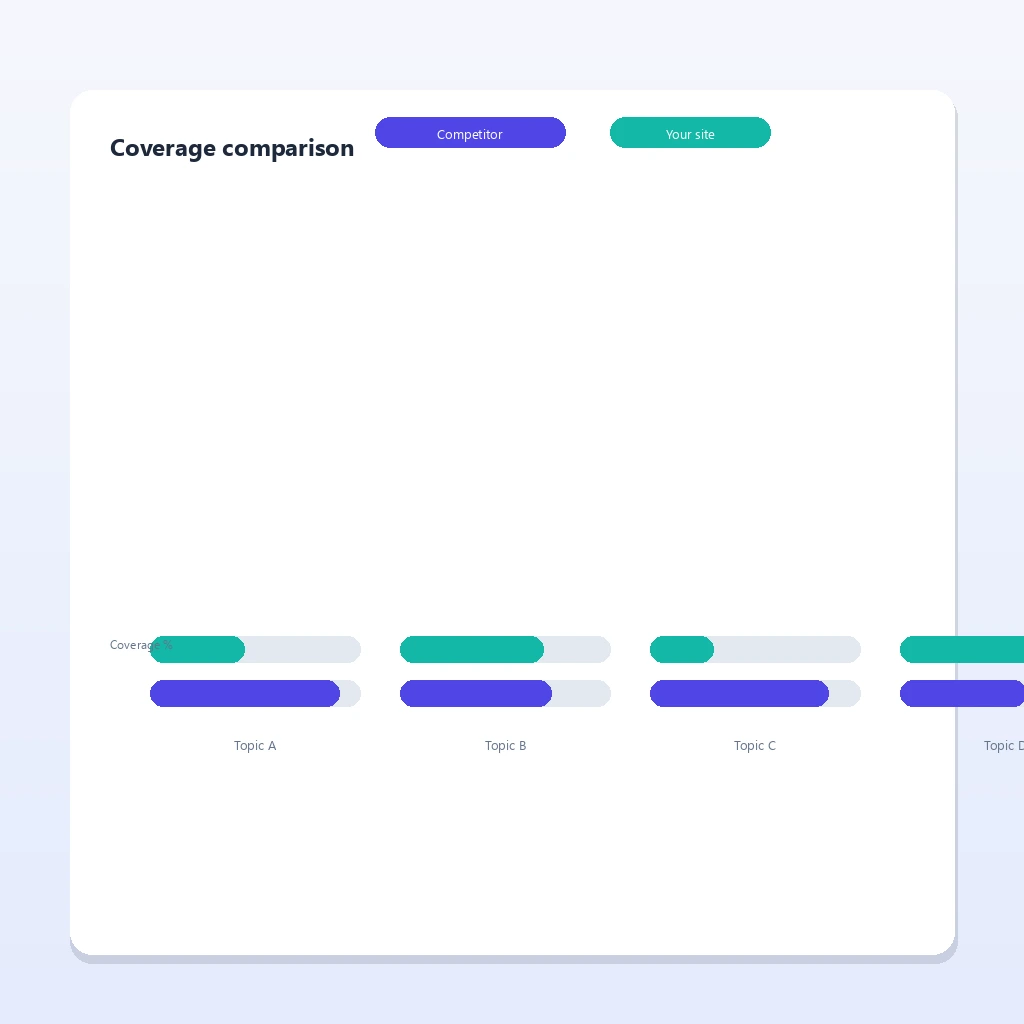
A free content gap analysis tool compares the keywords that already bring traffic and rankings to a set of competitor pages against the keywords your own site targets. The difference between those two sets is your content gap. Anything your competitors rank for that you have not written about is a candidate piece of content.
The measurable outputs are almost always the same:
- Keyword overlap — terms both you and competitors already cover.
- Gap keywords — terms competitors rank for that you miss entirely.
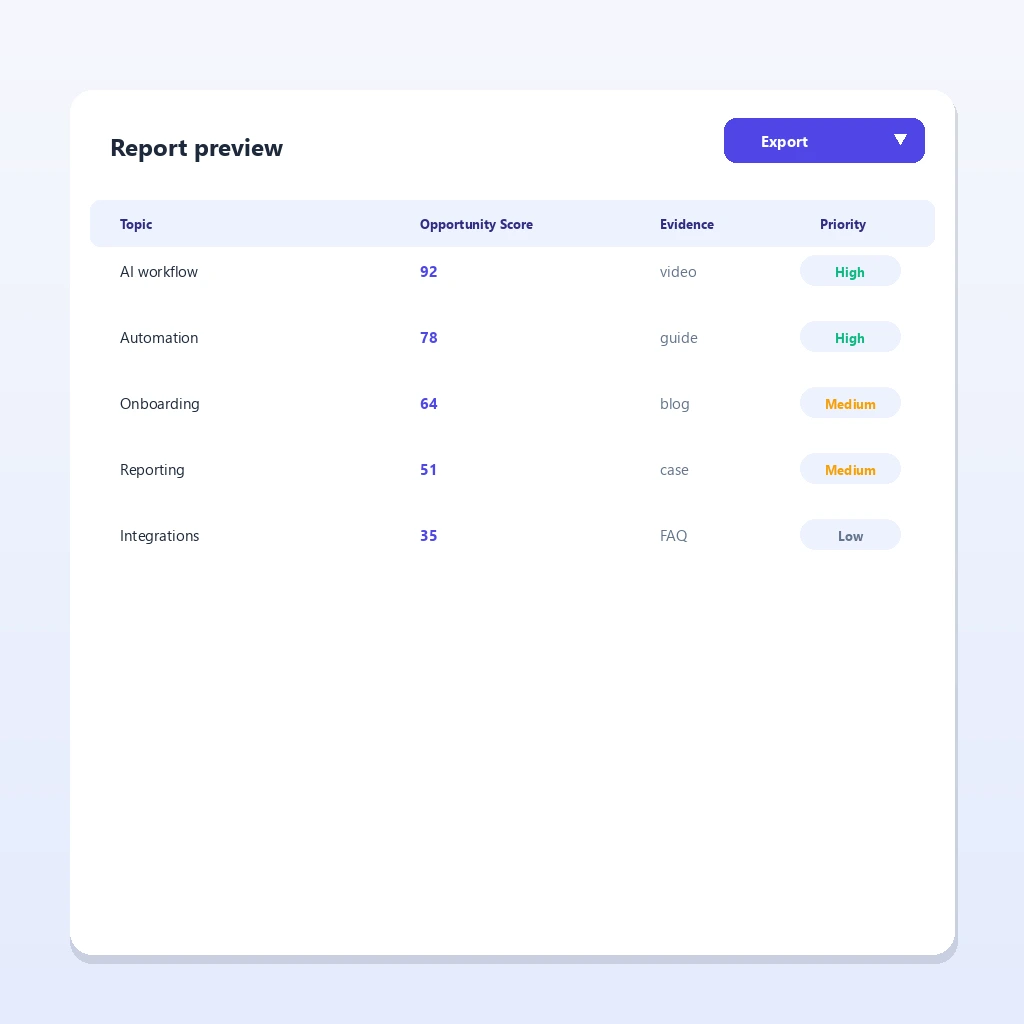
- Opportunity scores — a ranking of which missing topics deserve your effort first.
- Evidence counts — how many sources or signals back up each suggested topic.
A good free content gap analysis tool keeps the analysis honest. It should not invent search volumes, and it should not promise rankings. It should simply surface the gaps and let you decide what to write.
Why 2026 changed the rules for finding gaps
The old way to find competitor content gaps free was to guess from a keyword planner. In 2026 that is no longer enough, because search results themselves have changed shape. AI Overviews, generative answer boxes, and LLM-based retrieval now summarize entire topics. A single well-placed page can become the cited source inside an AI answer, which is why topical completeness matters more than ever.
That is why a free content gap analysis tool should be measured by how well it maps coverage, not just how many keywords it lists. If your site answers the full breadth of a question your competitors answer, you give both classic search and AI-driven search a reason to trust you.
Meet the free tool: SOVEL GAP BRAIN
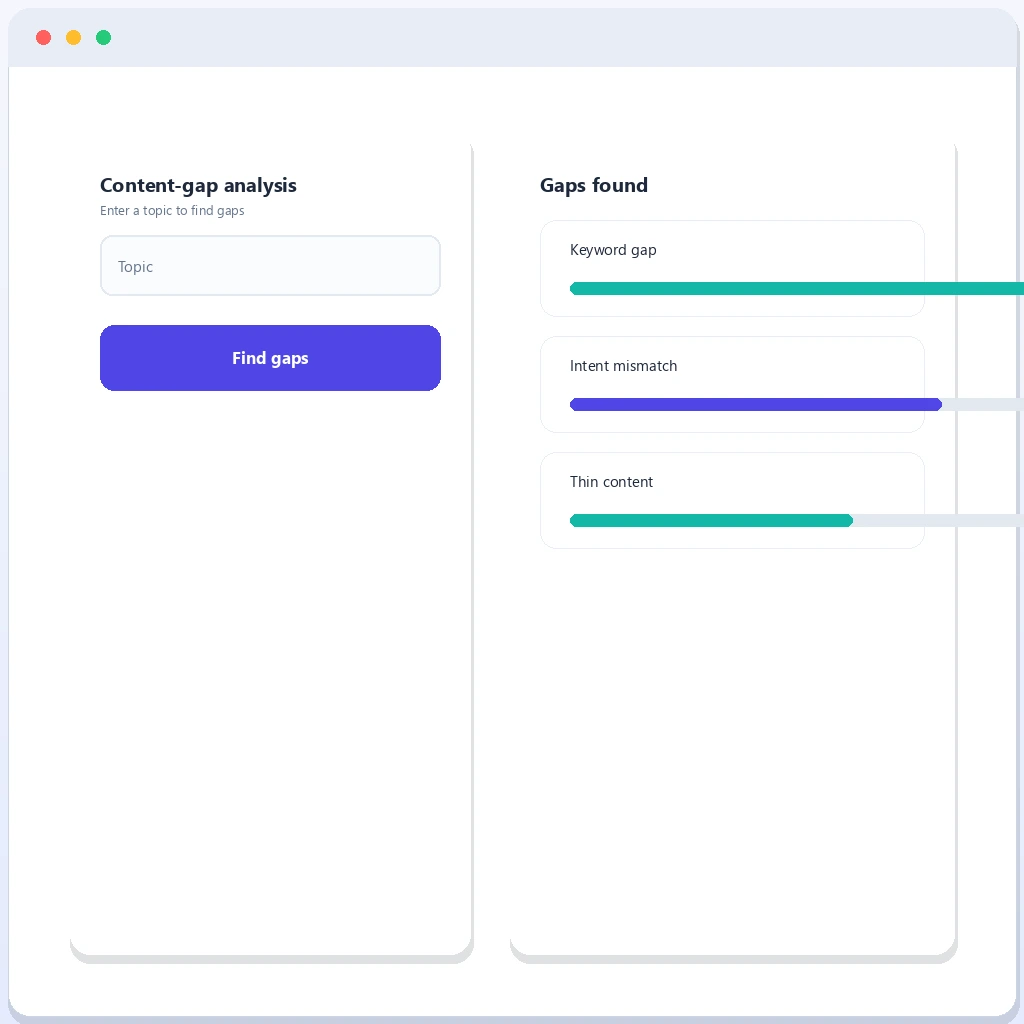
SOVEL GAP BRAIN is a free content gap analysis tool that runs directly in your browser on the SOVEL site, at https://sovel.pro/tools/content-gap-analysis/. You paste a topic, a URL, or an extract of your own content, and the tool returns a structured report with scored keywords, content gaps, and opportunities.
The free content gap analysis tool is deliberately simple:
- No signup — you do not need an account to run an analysis.
- Daily per-device limit — the free tier allows a set number of searches per day (default five), which keeps the tool usable and fair for everyone. The limit resets at midnight.
- Branded exports — every report can be downloaded as HTML, Markdown, Word, or PDF, with the SOVEL wordmark, the source site, and a timestamp included.
- Built-in engine — the analysis runs on the server without an external API key, so the tool works on any hosting and never exposes private keys.
For researchers, writers, and small marketing teams, the free content gap analysis tool is often enough to start filling gaps immediately.
How to run your first free analysis in two minutes

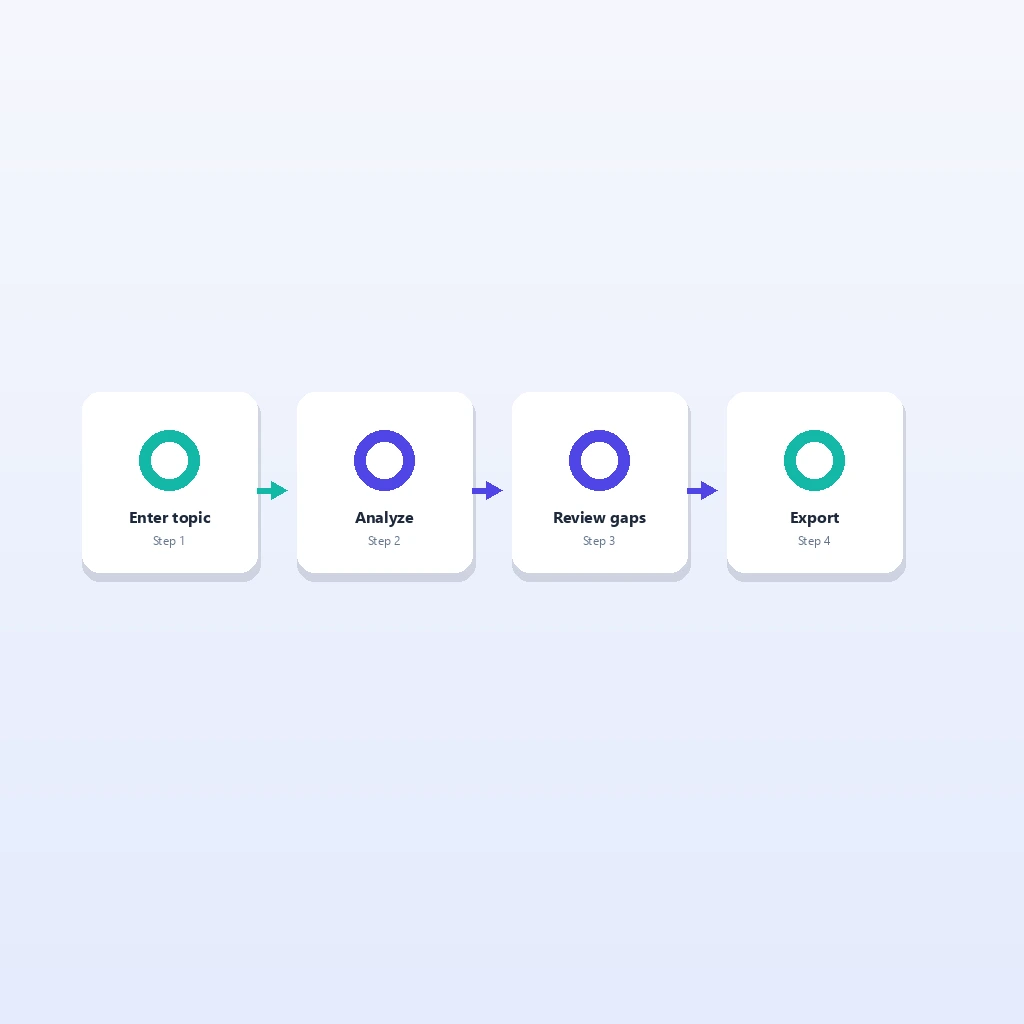
Step 1: Open the tool. Go to https://sovel.pro/tools/content-gap-analysis/.
Step 2: Enter a topic. Type a broad subject, a competitor’s URL, or paste a chunk of your own content into the box. Keep it under 200 characters.
Step 3: Press the find button. The engine analyzes the topic against its keyword and gap logic and returns a report in a few seconds.
Step 4: Read the four output groups:
– Top keywords — scored phrases the topic implies.
– Content gaps — sub-topics your content likely misses.
– Opportunities — gaps ranked by priority, format, and platform.
– Evidence / summary — a full research summary with source notes.
Step 5: Export. Click the download button for the format you need: HTML, Markdown, Word, or PDF. The file is branded with SOVEL and stamped with the time and date.
How the daily limit protects the free tier
A free content gap analysis tool cannot be truly sustainable if one script can hammer it a million times a day. SOVEL GAP BRAIN answers this with a fair-use daily limit. Each device gets a fixed number of searches per day, enforced with a signed cookie and a network ceiling. Clearing browser storage or opening a private window does not reset the count.
If you hit the limit, the free content gap analysis tool shows an upsell to the full engine. That upgrade is a lifetime purchase — one payment, no monthly and no yearly fee — and it removes the daily limit for your own work.
Turning gaps into a content plan that ranks
Finding a gap is only half the job. The other half is building a plan. Use the free tool’s output this way:
- Pick the highest-priority gap first. Start with the opportunity marked HIGH that matches the audience you already serve.
- Write for the full question. Cover the definition, the how-to, common mistakes, a comparison, and a checklist. This is exactly the structure search engines reward.
- Answer first, explain second. Open with a direct answer so you win featured snippets and AI citations.
- Link your coverage together. Connect the new page to related existing pages with descriptive anchor text.
- Track the evidence. Keep the source trail the tool surfaced so your claims stay verifiable.
Why a free content gap analysis tool beats guessing
Marketing teams the a free content gap analysis tool because it replaces opinion with comparison. Instead of asking “what should we write?”, you ask “what are our competitors actually winning with that we are missing?” The answer is concrete, repeatable, and tied to real coverage.
A free content gap analysis tool also fits small budgets. You can run the analysis, export the report, and hand it to a writer — all without a paid subscription.
Export formats you actually get
The free content gap analysis tool ships reports in four formats:
- HTML — styled, ready to view or print in a browser.
- Markdown — ideal for editors, docs, and content management systems.
- Word (DOC) — readable for clients and collaborators.
- PDF — print-ready, branded, and easy to share.
Whichever format you choose, the report carries the SOVEL wordmark, the source site, and a timestamp, so it stays professional.
Images embedded in your reports use the modern WebP format, which keeps file sizes low without sacrificing quality.
When to move from the free tool to the full engine
The free content gap analysis tool is the right place to start. You may want the full engine when:
- You run dozens of analyses a day across many clients.
- You need unlimited local use inside your own tools or agents.
- You want deeper category-wise recommendations and more control.
- You want to remove the daily limit entirely.
The full SOVEL GAP BRAIN engine is a lifetime product. You pay once and use it for as long as you want — no monthly, no yearly renewal. It is available at the SOVEL GAP BRAIN engine in three editions.
Frequently asked questions
Do I really need a content gap analysis tool?
If you publish content and want it to rank, yes. A content gap analysis tool tells you what to write next based on real competitor coverage instead of guesses.
Is the SOVEL GAP BRAIN tool really free?
Yes. The browser tool at /tools/content-gap-analysis/ is free to use, with a fair daily limit per device. You never need a credit card to try it.
What is the daily limit?
The free tier allows a set number of searches per day per device, defaulting to five. The counter resets at midnight.
Can I export the report?
Yes. You can download every report as HTML, Markdown, Word, or PDF, all branded with SOVEL and timestamped.
What makes a good focus keyword for an analysis?
Use the phrase you believe your audience searches for. The tool will expand it into a cluster and show the gaps around it.
Does the tool invent search volumes?
No. The tool works from coverage logic and evidence, not from invented metrics. It shows what to cover, not inflated numbers.
How is the free tool different from the paid engine?
The paid engine removes the daily limit, adds deeper category-wise recommendations, enables local/agent use, and is a one-time lifetime purchase.
How to read the report like a strategist
The raw output can feel dense the first time. Learn to read it as a strategist and the tool becomes a planning engine, not just a keyword list.
The keyword table
Each row is a phrase the topic implies. The score tells you how central that phrase is to the topic’s full meaning. Sort by score and you have your content hierarchy: the highest-scoring phrases should anchor your pillar page, and the rest become supporting cluster pages.
The gap table
Each gap row names a missing element — a definition, a how-to, a comparison, a checklist — plus a recommended action. This is the fastest source of article ideas. Every gap is a headline you have not yet written.
The opportunity table
Opportunities combine the strongest gaps with a suggested format and platform. These are the highest-priority tasks. When in doubt, write the top opportunity first.
The summary
The summary is your evidence trail and your brief in one. It restates the topic shape, the priority gaps, and a method note. Hand this to a writer and they can produce an on-strategy piece without a second meeting.
Building a 30-day content calendar from one report
A single free analysis can seed an entire month of publishing. Here is a system:
- Week 1: Publish the pillar piece on the highest-scoring keyword.
- Week 2: Publish the top opportunity from the opportunity table.
- Week 3: Publish the second gap, in a different format (video, checklist, or comparison).
- Week 4: Publish the FAQ or answers piece, then re-run the analysis.
Each week’s piece links to the others. After four weeks you own a topical cluster, and you have fresh gap data to start the next cycle.
The evidence advantage in 2026
Search engines and AI systems increasingly reward content that can be backed by sources, per Google’s documentation. The SOVEL GAP BRAIN free content gap analysis tool structures its output around evidence. It does not ask you to trust a score; it shows the reasoning behind each recommendation. When you cite what you actually found — real competitor coverage, real missing elements — your content reads as researched, not generated. That credibility is exactly what earns links, mentions, and AI citations.
Privacy and no-tracking design
Many free tools monetize by studying what you type. The SOVEL GAP BRAIN free tool runs the analysis server-side and does not expose your topics to a third-party ad or analytics network. If you value keeping your research private, this is a meaningful difference worth looking for in any free tool you choose.
What to do if you hit the daily limit
The free tier is deliberately capped to keep it available to everyone. If you hit the limit in the middle of a working session, you have options:
- Wait for the midnight reset to continue free.
- Use the current report to keep planning while you wait.
- Move to the lifetime engine to remove the limit for good.
Because the engine is a one-time purchase, you are not locked into a monthly bill to remove the cap.
Common mistakes to avoid
- Analyzing too broad a topic. “Marketing” is too wide; “content marketing for B2B SaaS” is actionable.
- Writing every gap. Prioritize by opportunity score and intent.
- Ignoring the summary. The summary is your brief; use it.
- Never re-running. Gaps shift as competitors publish. Re-run quarterly.
- Keyword stuffing. Use the focus keyword naturally, 25–27 times, never forced.
How to turn a report into a ranking content plan
A gap report only helps if you act on it. Use this simple sequence after every run.
First, group the opportunity keywords by search intent. Separate “how-to” terms from “buy” and “define” terms, because they belong in different content. Second, map each group to a page you already have or a page you need to create. If a topic fits an existing page, you update that page instead of publishing a new one, which keeps your site tightly organized. Third, link related pages together so the topical cluster is connected. Finally, schedule the highest-opportunity gaps first, then re-run the analysis quarterly to catch shifts before competitors do. This repeatable loop is what turns a free content gap analysis tool into a consistent content engine.
Frequently asked questions
Is the free content gap analysis tool really free with no credit card?
Yes. You can open the tool and run an analysis with no account and no payment. The free tier is supported by a fair daily limit.
What happens to my data?
The analysis runs server-side; your topic is not resold or used to target ads. This matches a privacy-respecting product stance.
Can I use it for client work?
Yes. The free content gap analysis tool is useful for a client or two. For ongoing multi-client work, the lifetime engine is the economical choice.
Does it work on mobile?
Yes. The tool is web-based and runs in any modern browser, including on phones and tablets.
How fast is the analysis?
Most topics return a full report in seconds. The engine is deterministic and runs locally, so there is no long queue.
Can I save my reports?
Yes — export them as HTML, Markdown, Word, or PDF. Keep the file as your record.
What is the difference between the free content gap analysis tool and the engine?
The free tool limits you to a set number of searches per day. The lifetime engine removes that limit, adds category-wise depth, and works for local agent and desktop use.
Final word
A free content gap analysis tool is the fastest way to stop guessing and start writing what will actually rank. Run your first analysis today, export the report, and build your next month of content from real gaps rather than hunches. When you outgrow the free limit, the SOVEL GAP BRAIN lifetime engine is there to scale with you.