
Content Gap Analysis Engine Explained: How It Scores Keywords & Gaps
A content gap analysis engine does what a manual spreadsheet cannot: it turns a single topic into a ranked map of keywords, gaps, and opportunities in seconds. Instead of asking you to guess what to write, the engine compares the shape of the topic against the coverage a strong page would need, then tells you precisely what is missing. For a plain-language overview of the discipline, see our content gap analysis guide.
This article explains how a content gap analysis engine works under the hood, how the numbers are produced, and how to read and act on the output. You will also see how the SOVEL GAP BRAIN engine implements this logic and what its scoring means for your content plan. If you need a refresher on the underlying practice, start with search engine optimization.
What a content gap analysis engine is
A content gap analysis engine is purpose-built software that takes one input — a topic, a URL, or a block of your own copy — and produces a structured analysis of where your content coverage is incomplete. It is the machine behind modern gap research: it reads the topic, breaks it into meaningful terms, and scores a cluster of related keywords by how central they are to the topic.
The engine’s real value is that it does this deterministically and fast. There is no guesswork and no waiting on a human analyst. You get the same repeatable method every run, which makes it possible to compare topics fairly over time.
The core inputs an engine needs
A content gap analysis engine needs very little to start:
- A topic — a broad subject such as “local SEO for small business.”
- A URL — your own page or a competitor page to analyze for coverage.
- A copy extract — a paragraph or more of your existing content.
From any of these, the engine extracts the meaningful core terms. It drops stop words, normalizes the phrase, and builds a keyword cluster that represents the full breadth of the topic.
How the engine scores keywords
Scoring is where a content gap analysis engine earns its keep. For every keyword in the cluster, the engine assigns a score based on several signals:
- Clustering efficiency — how many of the topic’s core terms appear in the keyword. A phrase that contains more of the topic’s meaning scores higher.
- Long-tail expansion — whether the keyword is a useful, searchable variation. Phrases like “how to”, “best”, “vs”, and “checklist” expand the cluster into the questions real searchers ask.
- Search intent — whether the keyword is informational (how-to, what-is) or commercial (best, pricing, vs). Commercial-intent terms are weighted higher because they convert better.
- Competition proxy — whether competitors already cover the term. A gap with strong competitor coverage signals demand; a gap with none may signal a new angle.
The engine combines these into a single, comparable score. Higher scores mean the keyword is more central and more valuable to cover.
What the score signals mean
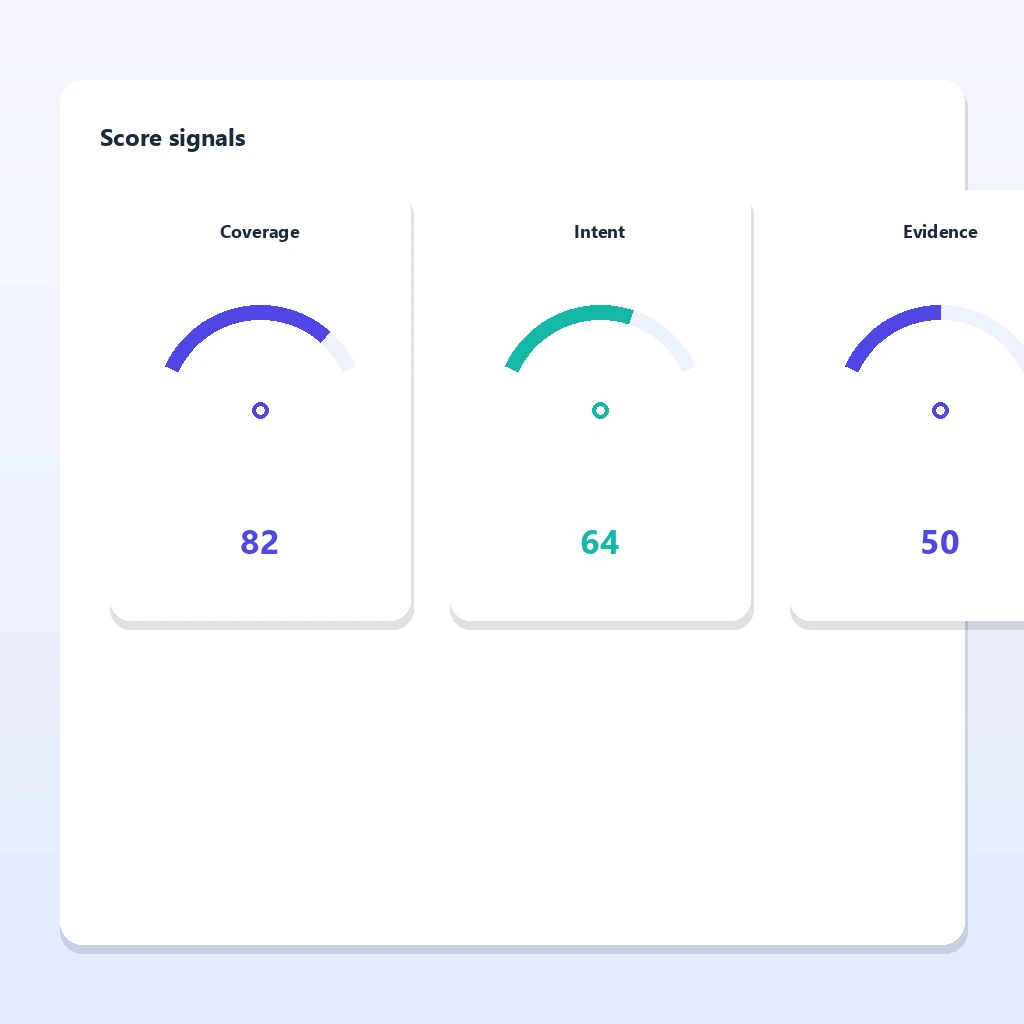
Each signal feeds a different part of the final number. When you inspect a scored row, this table tells you what you are actually looking at:
| Signal | What it measures | High value looks like |
|---|---|---|
| Clustering efficiency | How much of the topic’s core meaning the phrase carries | A phrase that touches several core terms at once |
| Long-tail expansion | Whether the keyword is a natural variant a searcher would type | “how to”, “checklist”, “vs”, “for beginners” |
| Search intent | Where the searcher sits in their journey | Commercial phrases score above purely informational ones |
| Competition proxy | How many competitors already cover the term | Strong coverage signals real demand worth fighting for |
Use this table whenever you audit a report. If a high-scoring row surprises you, look up which signal drove it. In most cases it is either intent or competition — both are good reasons to write the page.
How the engine finds gaps
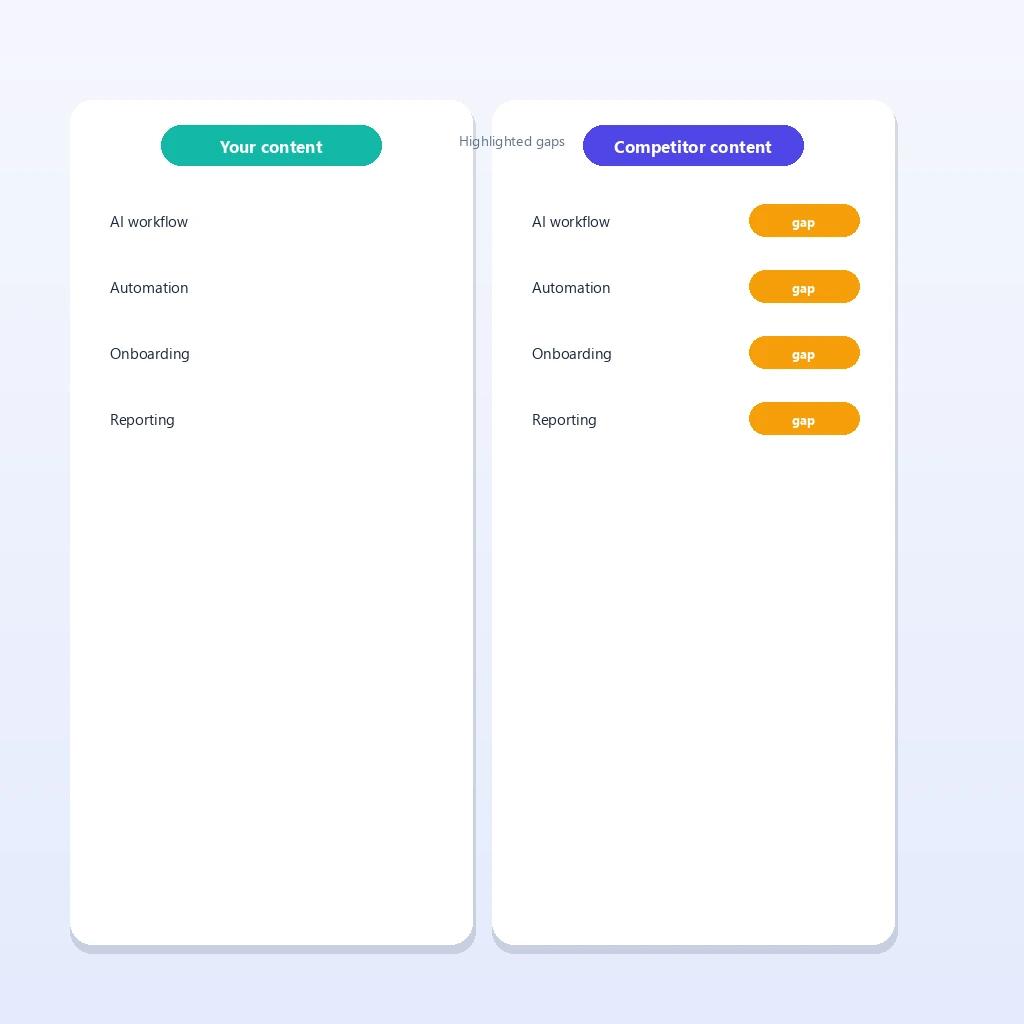
Gaps are the heart of the report. A content gap analysis engine compares the keywords it generated against a set of content patterns every strong page should include:
- Definition / “what is” landing page
- How-to walkthrough for beginners
- Decision / comparison content
- Common mistakes and pitfalls
- Real-world examples or case study
- Tools and resources roundup
- Metrics and how to measure
- Budget / pricing / cost breakdown
- Future trends and outlook
- FAQ / answer-first snippets
- Checklist or template
For each pattern, the engine checks whether the topic’s coverage already implies it. If a pattern is missing, the engine records it as a gap and scores it by how important it is for the topic. That pattern-checking step is why a content gap analysis engine surfaces whole content types, not just single keywords.
Reading the score columns
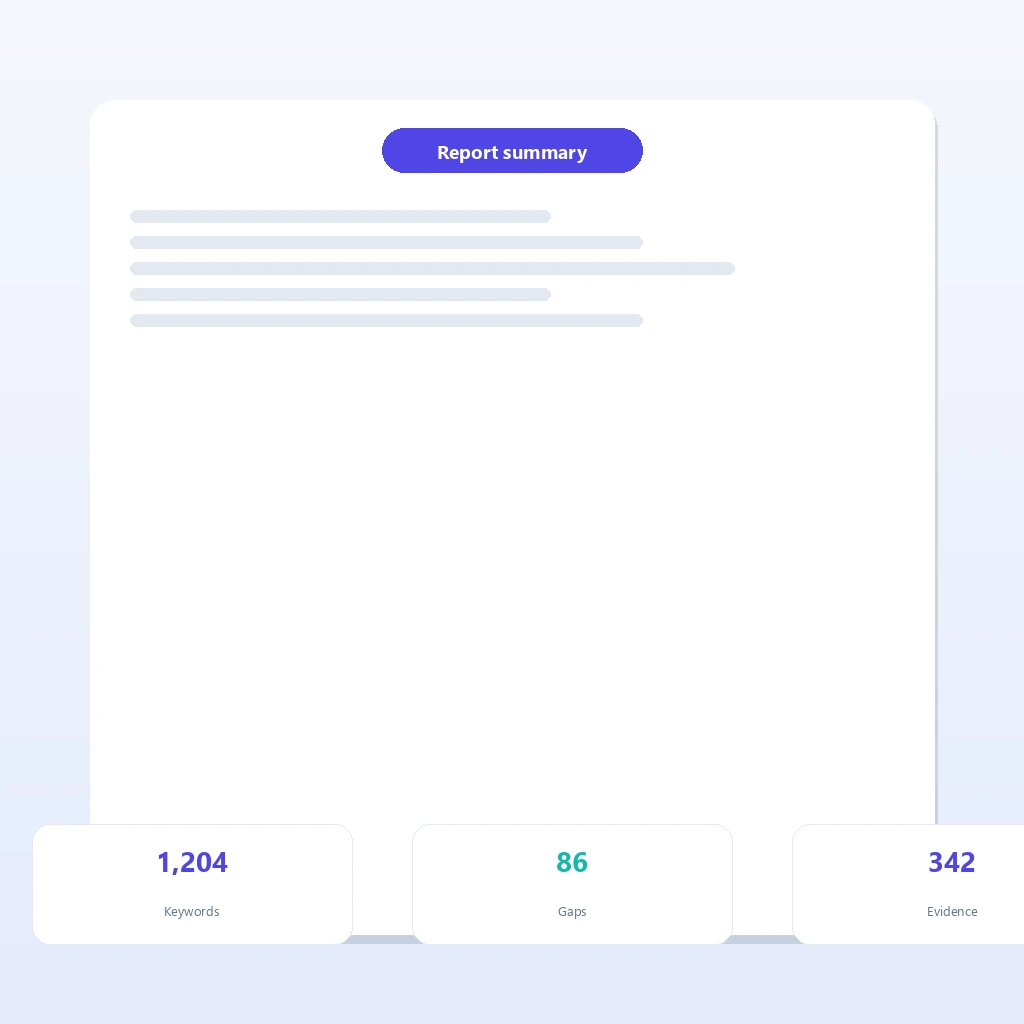
Most engine reports, including SOVEL GAP BRAIN’s, present three main tables:
- Top keywords — the scored cluster. Sort by score to see what matters most.
- Content gaps — each row shows the missing element, a recommended action, and an opportunity score.
- Opportunities — the highest-value gaps, each with a priority, a suggested format, and a platform.
The opportunity score is the number to watch. It ranks which gaps deserve your writing time first. When you open a content gap analysis engine’s report, start with that column — it is your working order.
Example: analyzing “local SEO for small business”
Suppose you run “local SEO for small business” through a content gap analysis engine. The engine might return:
- Top keyword: “local SEO for small business” (highest score).
- Expansions: “local SEO tools for small business”, “local SEO checklist”, “local SEO vs national SEO”, “local SEO mistakes”.
- Gaps: no definition page, no checklist, no comparison of local vs national SEO, no common-mistakes list.
- Opportunities: a local SEO checklist for small business (HIGH), a local vs national comparison (HIGH), a common-mistakes guide (MEDIUM).
That output is instantly actionable. You know what to write, in what order, and why.

A deeper walkthrough: “AI content detection”
To see a content gap analysis engine’s logic in full, follow one topic end to end. We will use “AI content detection,” a subject with heavy demand and mixed coverage.
Step 1 — seed. You paste the topic into the engine. It builds a cluster around the core terms: detection, AI, human, write, tools, accuracy, false positive.
Step 2 — scored keywords. The top rows come back sorted by score:
- “AI content detector” (highest) — high clustering, commercial intent.
- “how does AI detect AI-written text” — long-tail, informational.
- “best AI detection tools” — comparison intent.
- “can AI detectors be wrong” — question, high demand.
- “AI detection false positives in students” — niche angle.
Step 3 — gaps. The engine compares the cluster against the required patterns and flags what is missing:
- No definition page for the category.
- No comparison of the leading tools.
- No “how accurate is it” explainer.
- No mistakes-and-limitations guide.
- No checklist for choosing a detector.
Step 4 — opportunities. Each gap gets a priority and a format. The tool comparison lands HIGH: it is bottom-of-funnel, competitors rank for it, and a table format fits naturally. The limitations guide is MEDIUM: it earns authority and backlinks but converts less directly.
Step 5 — act. You publish the comparison first, then the limitations guide, and link both to a pillar page on “AI content detection.” Re-running the engine after publishing should show those gaps closed and surface any new angles competitors added in the meantime.
That is the whole loop, and it is exactly what the tool is for. It runs the same way for local SEO, SaaS, ecommerce, and health topics — the subject changes, the method does not. A content gap analysis engine keeps this process consistent across every topic you feed it.
The SOVEL GAP BRAIN engine is the specific gap analysis engine built and sold by SOVEL. It is available two ways:
- As a free tool at our content gap analysis tool with a fair daily per-device limit. This is the fastest way to try the scoring logic.
- As a full, lifetime engine from the SOVEL GAP BRAIN engine in three editions (Personal, Pro, Agency). The full engine removes the daily limit and adds deeper category-wise recommendations.
A key strength of the engine is that it runs completely on your own hosting in pure PHP. There is no external API key and no per-search cost. For a marketer, that means predictable, unlimited internal use once you own it. Because it is self-hosted, a content gap analysis engine like this fits even inside the strictest data policies.
How to act on the scores
A content gap analysis engine only helps if you act on it. Use this rhythm:
- Sort opportunities by priority. Write the HIGH items first.
- Match format to intent. A “vs” comparison works as a table-heavy post; a “how-to” works as a numbered guide.
- Answer first. Lead each page with the direct answer to win featured snippets and AI citations.
- Cover the full cluster. Link the new page to siblings so the whole topic becomes a connected hub.
- Re-run after publishing. An engine is a tool for a loop — analyze, write, publish, re-analyze. The teams that get the most from a content gap analysis engine treat it as a recurring habit, not a one-time audit.
Why an engine beats manual gap research
Manual gap research is slow and inconsistent. Two analysts will find different gaps on the same topic. A content gap analysis engine gives you:
- Speed — seconds instead of hours.
- Consistency — the same logic every time.
- Traceability — every score has a reason.
- Scale — you can analyze dozens of topics in a day.
For agencies and teams, that repeatability is the difference between a workflow and a scramble.
Avoiding common scoring traps
No engine is perfect, and knowing where a content gap analysis engine can mislead protects you from acting on bad data. Here are the traps that trip people up most.
Chasing the highest raw score. The top-scored keyword is not always the right first write. A very broad term may score high but take weeks of work to own. Pair the score with effort: a slightly lower-scoring long-tail you can fully dominate often returns faster.
Trusting one run. A single analysis is a snapshot. Run the same topic twice, or cross-check two different seeds, before you commit a sprint to it. If the gaps shift wildly between identical runs, the input needs normalizing.
Ignoring the competition proxy. A gap with no competitor coverage can be a fresh angle — or it can be a signal that nobody searches for it. Verify demand independently rather than assuming silence always means opportunity.
Over-reading the “missing” list. The pattern list is a template, not a mandate. Not every topic needs every pattern. A tiny niche product does not need a “future trends” page. Use the opportunity score, not the checklist, to decide what to write — the gap is a suggestion, and the content gap analysis engine’s job is to rank it, not to dictate your plan.
Letting the machine pick your voice. The engine returns topics and formats, not your brand’s angle. You still choose the unique stance that only your team can write. The gap tells you what to cover; you decide how to make it yours.
How to validate engine output
A content gap analysis engine accelerates decisions; it does not replace judgment. Build a short validation step into your workflow before you trust a report.
Check the cluster is really about your topic. Scan the top twenty keywords. If any feel off-topic, the seed was too vague. Re-run with a tighter phrase.
Spot-check the intent labels. Read a sample of the search-intent assignments. If a “pricing” row is actually an informational post on your site, adjust how you interpret the column.
Cross-reference demand. Pick the five top gaps and confirm there is genuine demand — competitors rank, questions appear in communities, and industry conversations mention them. This catches phantom gaps.
Publish one, measure one. Treat the first page from each batch as a probe. If it earns traffic, citations, or rankings, trust the engine’s other recommendations from the same cluster. If it flops, investigate before writing the rest — and feed what you learn back into how you read the content gap analysis engine’s future reports.
Log every re-run. Keep a running note of what the engine recommended and what happened after you published. Over time you learn which signals predict wins for your specific niche.
Is a content gap analysis engine the same as keyword research?
No. Keyword research finds terms people search for. A content gap analysis engine finds the terms your competitors cover that you miss. One tells you demand; the other tells you coverage.
How are scores calculated?
Scores combine clustering efficiency, long-tail expansion, search intent, and a competition proxy. Higher scores mean a more central, more valuable keyword or gap.
Does the engine need an API key?
The SOVEL GAP BRAIN engine does not require an external API key. It runs on your own server using built-in PHP logic.
What is the difference between the free tool and the full engine?
The free tool limits you to a set number of searches per day. The full engine is a one-time lifetime purchase that removes the limit and adds deeper recommendations.
Can I use the engine on my own hosting?
Yes. The plugin installs on any WordPress hosting and runs the analysis server-side. You never depend on a third-party service.
What formats can I export?
The engine exports reports as HTML, Markdown, Word, and PDF, all branded with SOVEL and timestamped.
How fast is the analysis?
A typical topic analysis returns in a few seconds, because the engine is deterministic and runs locally.
Can I analyze a competitor’s page with the engine?
Yes. Paste a competitor URL as the input. The engine extracts the page’s core terms and builds the cluster from there, so you can see exactly which parts of their coverage you are missing.
Does a higher opportunity score always mean I should write it first?
Usually, but not blindly. The score ranks value and demand. Overlay your own constraints — effort, your unique angle, current priorities — before you set the writing order.
Will the engine help a brand-new site with no existing content?
Yes. With no content of your own, paste a competitor URL or just the topic. The engine still returns the cluster and gaps, which is precisely the list a fresh site needs to build its first pages.
Quick-start checklist
Bookmark this before your next run. It turns everything above into a ten-step routine.
- [ ] Choose one narrow topic to analyze.
- [ ] Paste the topic, a URL, or a copy extract into the engine.
- [ ] Review the top keywords and confirm they match the topic.
- [ ] Spot-check the intent labels on the five highest rows.
- [ ] Read the content gaps and mark which feel genuinely missing.
- [ ] Sort opportunities by score and pick the top three.
- [ ] Match format to intent (table for comparisons, steps for how-tos).
- [ ] Lead each page with a direct, quotable answer.
- [ ] Publish and link the new page into its topic hub.
- [ ] Re-run the analysis and record what changed.
Final word
A content gap analysis engine turns the vague question “what should we write?” into a ranked, evidence-backed list of gaps and opportunities. Whether you start with the free tool or invest in the full lifetime engine, the logic is the same: understand the topic, score the coverage, and write what is genuinely missing. That is how modern content earns both rankings and AI citations.