
To prevent AI hallucinations in non fiction books, treat every checkable sentence as guilty until its source confirms it. A hallucination is any confident statement the model generated without grounding: an invented citation, a real author attached to a paper they never wrote, a statistic rounded into a different meaning, a date stated with certainty and no record behind it. In fiction these are style. In non fiction they are defects that survive into print, get quoted by readers, and attach to your name. The short answer: you prevent AI hallucinations in non fiction books by running every chapter through a fixed fact protocol: list each checkable claim, resolve its source live, confirm it against a second independent source, copy numbers exactly, cut what cannot be confirmed, and get a human sign-off before the chapter ships.
What counts as a hallucination in non fiction?
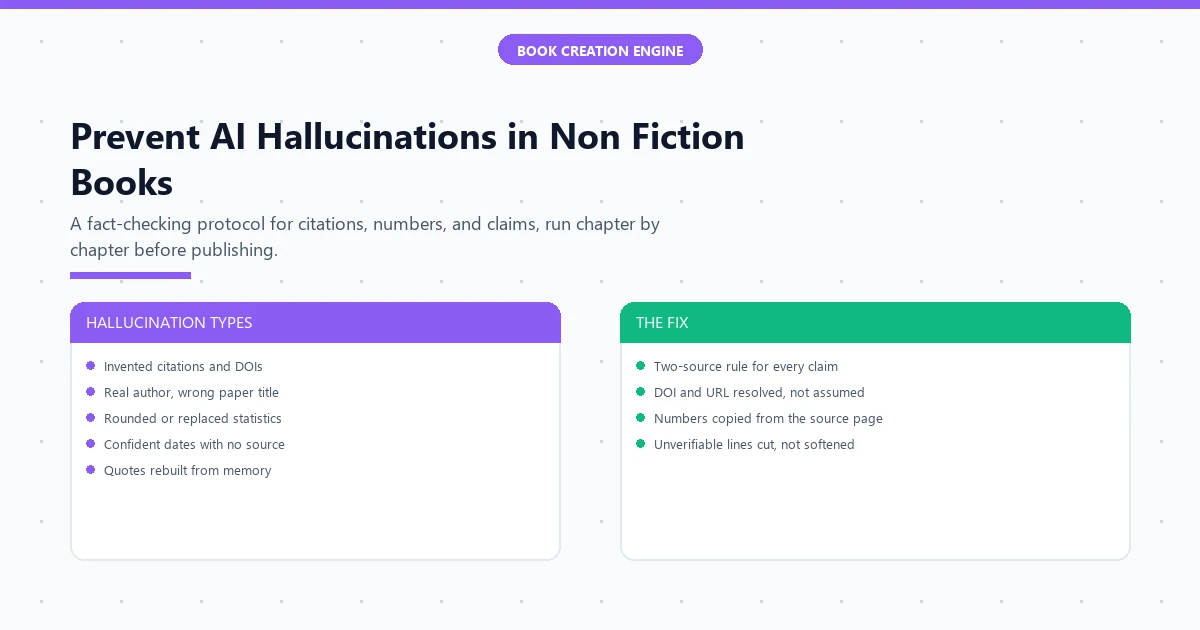
Five patterns cover nearly all of it. The famous one is the invented citation: a plausible author, a plausible journal, a well-formed DOI, and no such paper anywhere. The sneakier one is the real-author-wrong-paper error, where the model attaches a genuine researcher’s name to a title they never published; it passes a casual glance and fails any librarian. Then come number shifts, where 34.7 percent becomes 35 percent and later 40 percent as the figure travels across chapters. Date drift follows the same path: 2019 becomes the late 2010s becomes 2021. Finally there are rebuilt quotes, sentences presented as verbatim that no source contains. Any writer who wants to prevent AI hallucinations in non fiction books must check for all five, because models produce each of them in fluent, confident prose that feels true while being wrong.
This matters more for books than for blog posts because books get trusted. A reader treats a printed chapter as settled, quotes it in good faith, and spreads the error further than you can chase it. Writers who already verify AI-generated content with structured checks have the right instinct; this guide narrows that discipline to the fact layer specifically. Keep evidence attached to every chapter from day one, because a claim written with its source beside it is ten times cheaper to confirm than one fished out of a finished draft.
Why does non fiction need stricter rules than fiction?
Fiction readers forgive an impossible detail when the story earns it. Non fiction readers file complaints, post one-star reviews naming the exact page, and in professional fields they check your claims against their training. A fabricated medical dosage or a wrong legal deadline is not an embarrassment; it is a hazard. Publishers, Amazon reviewers, and subject-matter readers all punish invented facts harder than dull prose, which is exactly backwards from how most AI writing advice is weighted. Most guides teach voice and flow first. For non fiction, the first lesson of how to prevent AI hallucinations is that verification comes before voice, because no reader ever forgave a false citation on the grounds that the sentence sounded good.
The cost curve decides the method for anyone working to prevent AI hallucinations in non fiction books. Finding a wrong date in your own draft costs a minute. Finding it in a printed book costs the reprint, the refund requests, and the review that quotes your error forever. Every check in this protocol sits as early as possible for that reason: claims get listed during drafting, sources get resolved before the chapter closes, and the human reads with the ledger open rather than from memory. To prevent AI hallucinations in non fiction books at book scale, sixteen chapters times forty checkable claims each means roughly 640 individual confirmations; only a written ledger survives that count without leaks.
How does the two-source rule work?
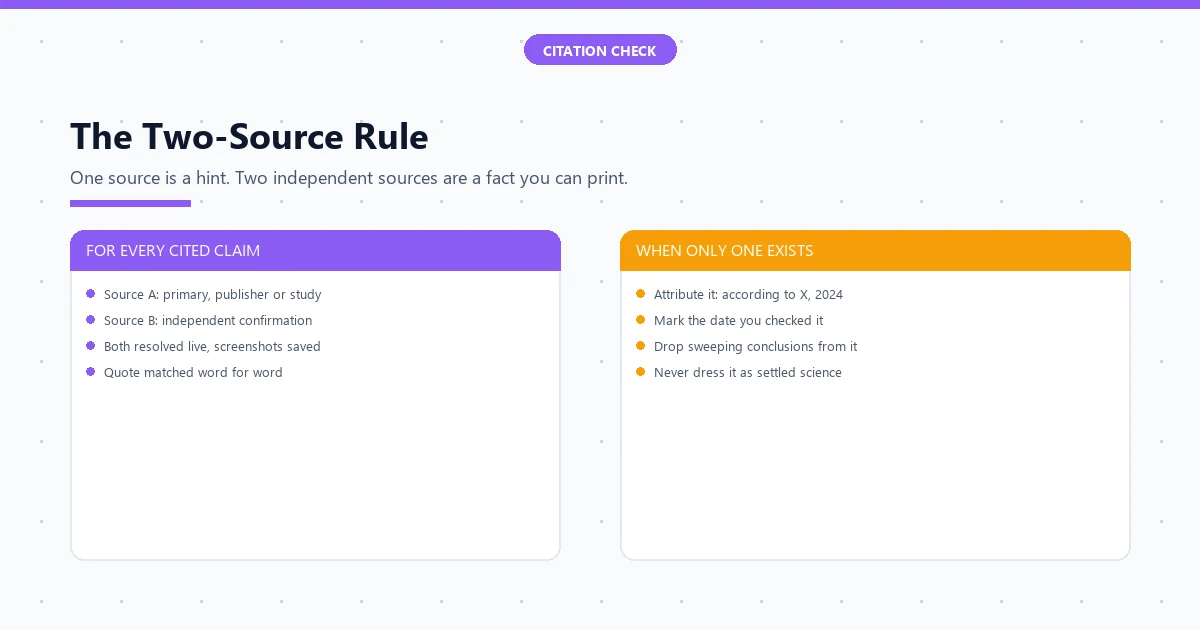
For every claim you intend to print, find two independent sources that confirm it, and resolve both live before the chapter closes. Independent means genuinely separate: the publisher’s page plus a news report, the study plus a citing review, the dataset plus the analysis built on it. Two pages quoting the same press release are one source wearing two hats. Both sources get opened, read, and saved with access dates, because a link that worked in March may redirect by September, and your ledger must show what you actually saw.
When only one source exists, the sentence must carry its limits on its face. Write “according to a 2024 survey by X” instead of stating the finding as settled fact, and add the check date in your ledger. Drop any sweeping conclusion that rests on that single leg. This discipline feels slow for the first two chapters, then becomes rhythm: draft with claims flagged, resolve in a batch at chapter end, rewrite the narrow misses, delete the orphans. Writers who publish across stores already run structured checks before release; read the eight pre-flight checks before publishing for the surrounding gates. To prevent AI hallucinations in non fiction books reliably, the two-source habit must outrank the deadline at least once, or speed will keep winning over truth.
How do you audit a chapter for invented claims?
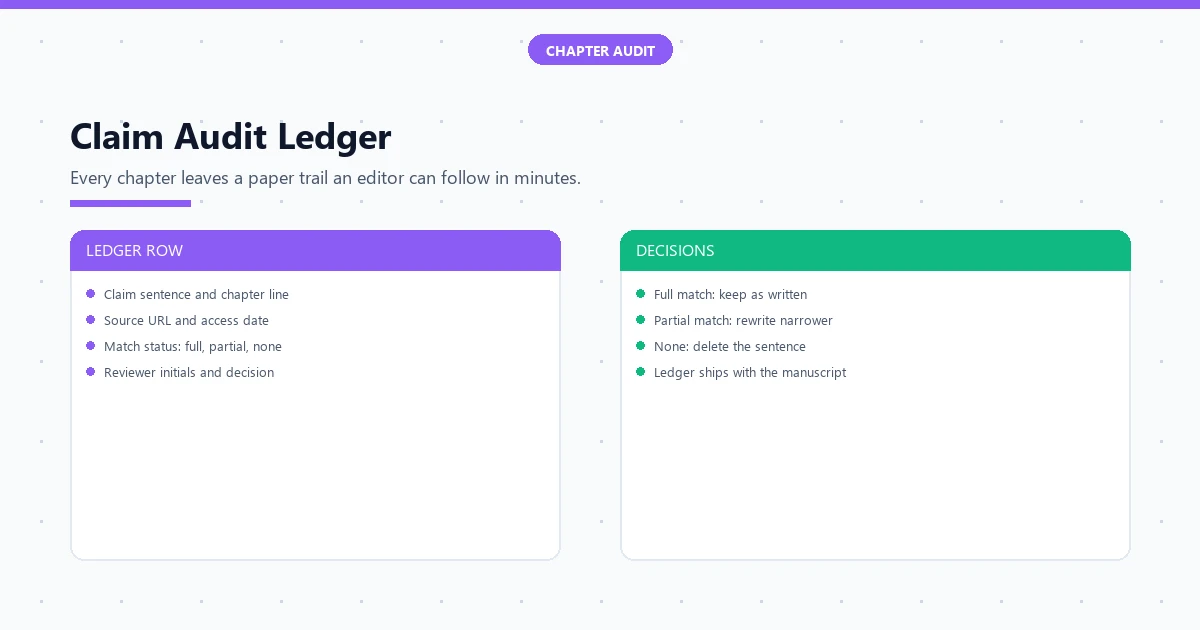
Read the finished chapter once with a single job: list every sentence a skeptic could challenge. Names, dates, numbers, causes, quotes, rankings, firsts, onlys. Expect thirty to fifty items in a research-heavy chapter and fewer than ten in a reflective one. Write each into the ledger with its line number. Then, separately, resolve them one by one against live sources. Never audit from memory; memory is where the model got you into trouble, and yours is not safer on the same material. The ledger row holds the claim, the source URL, the access date, the match verdict, and the reviewer’s decision.
Three verdicts cover everything. Full match means keep the sentence as written. Partial match means rewrite the sentence narrower until it matches what the source actually says, which usually means softer verbs and tighter numbers. No match means delete the sentence entirely, not soften it into survival. Deleted sentences outnumber rewritten ones by roughly two to one in most AI-assisted drafts, and that ratio is normal. A second reader then runs a contradiction pass: does chapter nine’s figure agree with chapter three’s, does the terminology match the locked list, does any surviving claim quietly assume a deleted one? For long manuscripts, a systematic hunt for continuity errors catches exactly these cross-chapter breaks.
How do you lock terminology and stop style drift?
Keep a single terminology file from the first outline and let no chapter invent around it. Every person, product, method, and key term gets one spelling, one capitalization, and one definition. The drafter receives this file with every section; the auditor checks against it. When a new term must enter in chapter eleven, it enters the file first with its definition, then the chapter. To prevent AI hallucinations in non fiction books, this file before prose order is what separates a locked book from a drifting one.
Style drift needs a different check because it is not binary. Read the first and last paragraphs of three distant chapters aloud in one sitting; if they sound like different authors, the middle needs a copy-edit pass against the earliest chapters, not the reverse. Traceable sources for every section help here too, because a chapter grounded in the same source style drifts less than one written from the model’s general memory. Sixteen chapters that share one terminology file and one source discipline read like one book, which is the entire goal.
Where do human verification gates belong?
At four points, no more. The human approves the outline’s claim plan before drafting starts, because a chapter planned around uncheckable claims is lost before its first sentence. The human reviews the ledger’s open questions weekly, answering from real research what the model could not. The human reads each chapter’s contradiction pass with the terminology file open, catching drift no script sees. And the human signs off the finished manuscript against the complete ledger, confirming that every row closed as keep, narrowed, or deleted. Four gates, each under an hour for a standard chapter, and nothing ships between them without a decision recorded.
What the human must not do is line-edit AI prose for style while ignoring the fact layer. Polished sentences with wrong dates are the exact failure this protocol exists to stop. Read for truth first with sources open, then for rhythm with sources closed. Editors who also manage long manuscripts should pair this protocol with a state ledger for long AI-assisted manuscripts, because hallucination checks and continuity checks share the same ledger habit. To prevent AI hallucinations in non fiction books at production speed, the human’s scarcest resource is attention; spend it on claims, not commas.

What does a finished, verified chapter look like?
Three artifacts leave the desk together. The chapter text itself, clean and final, with every surviving claim traceable. The ledger section for that chapter, listing each claim, its sources, its verdict, and the reviewer’s initials. And a short verification note for the publisher or editor stating the method: two-source rule applied, numbers copied from source tables, contradiction pass by a second reader, sign-off date. This packet answers the only question that matters when someone challenges a fact on page 112: show me where it came from. A book whose chapters ship with packets like these survives scrutiny that sinks books “verified” by a single careful read.
Keep the packets after publication. When a reader reports a possible error in year two, the ledger tells you in minutes whether the claim was confirmed, narrowed, or missed, and the correction goes to the errata page with a clear conscience. That long tail is the quiet payoff of every attempt to prevent AI hallucinations in non fiction books: not just a cleaner first edition, but a book you can defend for a decade. Authors building full manuscripts under a governed pipeline get this structure built in; see how a staged book pipeline organizes verification for the surrounding machinery.
How do you verify numbers and dates specifically?
Numbers get their own pass because they fail differently from prose. A model rarely invents a number from nothing; it rounds, swaps, or migrates a real figure from a neighboring fact. The check is therefore mechanical: open the source table, read the figure digit by digit, and copy it character for character into the ledger. Percentages keep their decimals until the style guide says otherwise. Dates keep their full form, day, month, year, with era markers where ambiguity exists. Ranges keep both endpoints. When two sources disagree, print the disagreement openly (“sources report 34.7 and 35.1 percent”) instead of averaging them into a false precision neither source supports.
DOIs and URLs get resolved, never trusted on sight. Paste every DOI into the resolver at doi.org and confirm it lands on the paper you meant; paste every URL and confirm the page still holds the claim. Crossref’s metadata search (Crossref search) settles author-title disputes in seconds when a citation smells wrong. A chapter whose numbers and links all resolve is already in the top decile of AI-assisted non fiction, because most failures hide exactly there, wearing confident formatting.
How do you train co-authors to follow the same protocol?
Hand them three things on day one: the terminology file, one finished chapter with its ledger, and a one-page checklist of the four gates. New collaborators learn faster from a worked example than from rules, so the sample chapter does most of the teaching. Their first assignment is a short, low-stakes section audited twice: once by the protocol, once by you reading alongside them. Correct the method, not the person; most early failures come from verifying from memory or softening no-match sentences instead of deleting them. Every correction that helps a co-author prevent AI hallucinations in non fiction books compounds, because the whole team converges on the same reading. Two supervised chapters convert almost anyone into a reliable checker.
Protect the ledger from well-meaning shortcuts with two rules. Nobody edits another reviewer’s verdict rows, only appends new ones with fresh dates, so disagreements stay visible instead of silently resolved. And nobody closes an open question with a guess; unanswered items wait for real research or the sentence ships without the claim. Teams that follow these two rules find that joint books stay consistent across authors, because the system carries the standard instead of any individual’s vigilance. To prevent AI hallucinations in non fiction books written by three people at once, shared files beat shared intentions every time: the protocol is the co-author that never gets tired, never assumes, and never forgets to check.
Frequently asked questions
How do you prevent AI hallucinations in non fiction books without slowing to a crawl?
Batch the checks: draft with claims flagged, resolve sources once per chapter, run one contradiction pass. To prevent AI hallucinations in non fiction books at speed, never verify sentence by sentence during drafting; separate writing days from checking days and the pace stays close to unverified drafting. Authors who prevent AI hallucinations in non fiction books as a weekly rhythm report roughly one checking day per three writing days, a ratio most schedules absorb easily.
Are AI-generated citations ever safe to use unchecked?
No. Treat every model-produced citation, DOI, quote, and statistic as a lead, not a fact, until resolved live. Even correct-looking references fail often enough that skipping the check is the single costliest shortcut in AI-assisted non fiction. The entire effort to prevent AI hallucinations in non fiction books rests on this one refusal: no citation prints without a live resolution behind it.
What is the two-source rule in plain terms?
Two genuinely independent sources must confirm a claim before it prints, both opened and dated. One source is a hint; the sentence must then carry its limit openly, such as naming the single survey and year. Writers working to prevent AI hallucinations in non fiction books treat the two-source bar as the difference between a draft and a manuscript.
Who should do the second-reader pass?
Anyone who did not draft the chapter: a co-author, an editor, or a different AI model running cold with sources attached. Distance from the drafting session is the qualification, not seniority. A cold reviewer who never saw the draft defends no sentences, which is exactly the mindset needed to prevent AI hallucinations in non fiction books chapter after chapter.
Should fiction writers bother with any of this?
Only the parts about internal consistency: the terminology file, the continuity pass, the open-questions habit. Fictional facts need no sources, but contradictions still break reader trust, so the ledger habit transfers even where citations do not apply.
What if a source disappears after you cited it?
The ledger’s access date and saved snapshot carry you. Note the change in the errata file, replace the citation with an equivalent live source if one exists, and keep the snapshot as your record of good-faith verification. Disappearing sources are why access dates exist.
How many claims can one person verify per day?
Roughly eighty to one hundred twenty with sources open, which means a forty-claim chapter takes half a day. Budget verification days separately from writing days; mixing them halves the pace of both and doubles the miss rate.
What is the fastest way to prevent AI hallucinations in non fiction books on a deadline?
Flag claims during drafting, resolve sources in one batch per chapter, and run a single contradiction pass before sign-off. To prevent AI hallucinations in non fiction books under time pressure, protect the ledger first and polish prose second; a plain chapter with resolved sources beats a beautiful chapter with invented dates.
What is the one-line version of the whole protocol?
List every claim, resolve every source live, confirm twice, copy numbers exactly, cut the orphans, and sign off. Authors who prevent AI hallucinations in non fiction books with this card taped above the desk rarely need the longer manual; the six steps fit every chapter, every genre, every deadline.
One last habit separates careful authors from defended ones: the public errata page, linked in the front matter where every reader finds it. A living corrections list turns inevitable small errors into proof of process instead of proof of sloppiness.
When co-authors join mid-book, onboard them with one finished chapter and its ledger, then assign a short section under supervision. Shared checklists let three writers prevent AI hallucinations in non fiction books as reliably as one, because the files carry the standard.
Conclusion: print what you can prove
The whole protocol fits on an index card: list claims, resolve sources live, confirm twice, copy numbers exactly, cut the orphans, sign off. To prevent AI hallucinations in non fiction books is not to distrust AI but to fence it where it is weakest and free it where it is strongest. Draft with the machine’s speed, verify with a ledger’s patience, and publish books that survive their readers. That is the job, and it has not changed since printing began.
Archive the packets beside the manuscript files when the edition ships. If a reader flags a possible error in year two, the ledger shows in minutes whether the claim was confirmed, narrowed, or missed, and the correction goes to the errata page with the dates to prove it. That long tail is the quiet payoff of the whole system: not only a cleaner first edition, but a book its author can still defend ten years later.