
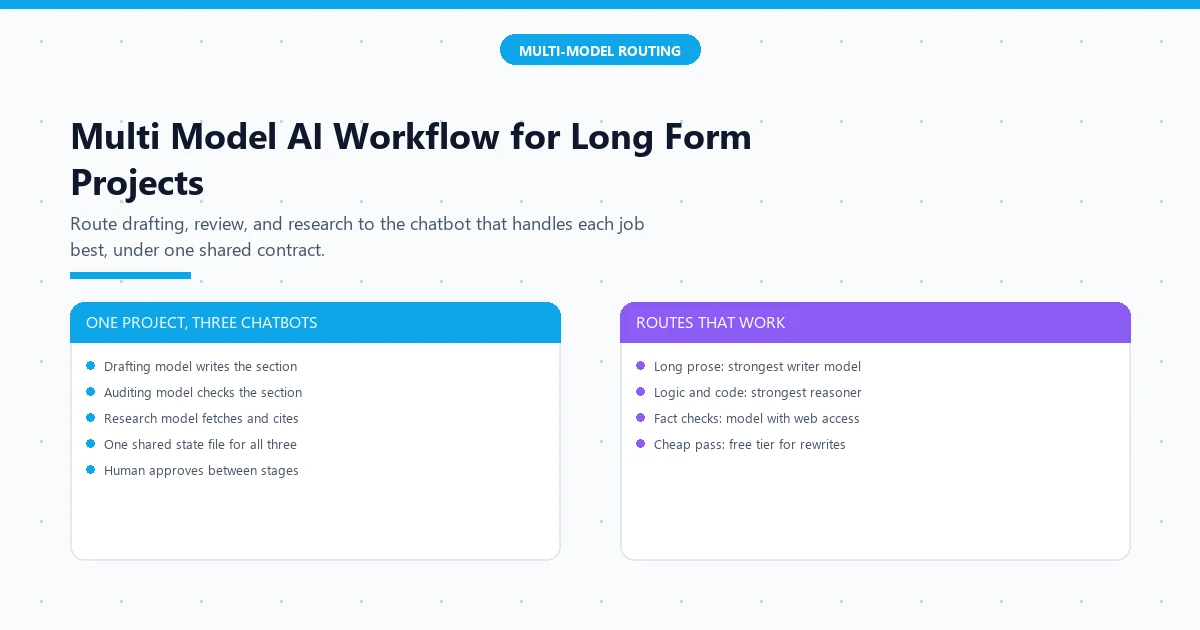
A multi model AI workflow for long form projects means one book, manual, or codebase moves through several different chatbots, each handling the stage it does best, under a single shared contract. One model drafts the chapter because it writes long prose well. A second model audits the same chapter because it reasons about logic well. A third fetches and checks sources because it can browse. No model sees the whole job, and no model improvises the rules: the outline, terminology list, sources, and word budgets travel in files every chatbot reads before it touches a word. The short answer: a multi model AI workflow for long form projects routes research, drafting, auditing, and copy editing to different models through six shared files, with a human approving each stage, so long books and large codebases survive context limits that defeat any single chatbot.
What is a multi model AI workflow?
The work is divided into fixed roles. The researcher gathers cited notes and hands over facts, never prose. The drafter turns an approved outline into a section within a word budget. The auditor receives the draft cold, with sources attached, and returns a pass or a numbered fix list. The copy editor polishes accepted text for rhythm and shortens it by ten percent. A human editor approves the outline, approves each draft, and signs off the final text. The models change with the market; the desk layout does not.
Why not use one strong model for everything? Two hard limits. Context windows still cap how much text a model can hold at once, so a 50,000-word manuscript cannot sit inside one session without the early chapters fading from memory. And a model that wrote a passage will defend its own errors, including invented facts, when asked to review it. Splitting drafting from auditing across two models breaks both traps at once. Builders familiar with separating planner from executor agents already know the principle; this workflow extends it across vendors. Readers moving work between tools should also read how project context travels across sessions and tools, which covers the file discipline that makes multi-model work possible.
Why do single-model long-form projects stall?
They stall in three predictable places. First comes context rot: around chapter six or seven of a long book, the model starts contradicting chapter two, because the early text fell out of its working memory and only a vague summary remains. Second comes review blindness: the same model that drafted a section approves it with minor polish, leaving invented citations and reversed numbers untouched. Third comes the resume problem: a long session hits a token limit or crashes, and restarting means re-explaining the entire project from zero, in slightly different words, which quietly changes the rules.
A multi model AI workflow for long form projects answers each stall with structure. Context rot is answered by never feeding full chapters across stages: each stage receives an outline, a short rolling summary under 500 words, and its own inputs. Review blindness is answered by assigning audit to a different model with different training, which has no loyalty to the draft. The resume problem is answered by the shared state file: a new session reads six small files and continues exactly where the last one stopped. Authors running controlled book builds have measured the difference in practice; see how interrupted drafting sessions resume without losing a paragraph.
How do you divide drafting from auditing?
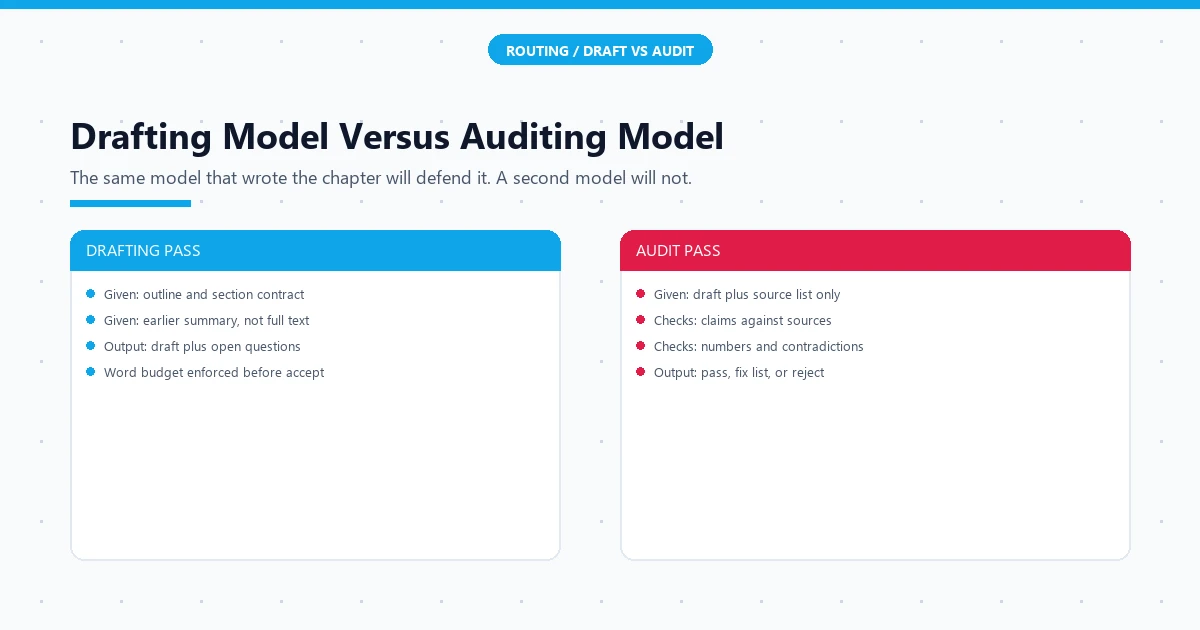
The rule is simple and non-negotiable: the model that writes never judges. The drafting model receives the outline section, the terminology file, and a rolling summary of what came before, capped at 500 words. It returns a draft within the word budget plus a short list of open questions: facts it could not confirm, transitions it found weak, claims that need a source. The drafting model is explicitly told that guessing an answer is worse than flagging a gap. An open question is a success; a smooth invented paragraph is a failure.
The auditing model receives the draft cold. Cold matters: it gets no memory of the drafting session, no sympathy for the effort, only the text, the source list, and the contract for that section. It checks every verifiable claim against the sources, flags contradictions with earlier sections using the summary file, verifies numbers character by character, and returns one of three verdicts: pass, fix with a numbered list, or reject back to drafting. A multi model AI workflow for long form projects stands or falls on this cold-start audit, because shared training between vendors no longer matters when the auditor never saw the draft being written. Writers who want the verification mindset in depth should study how prompt contracts turn models into deterministic compilers.
What travels between the models?
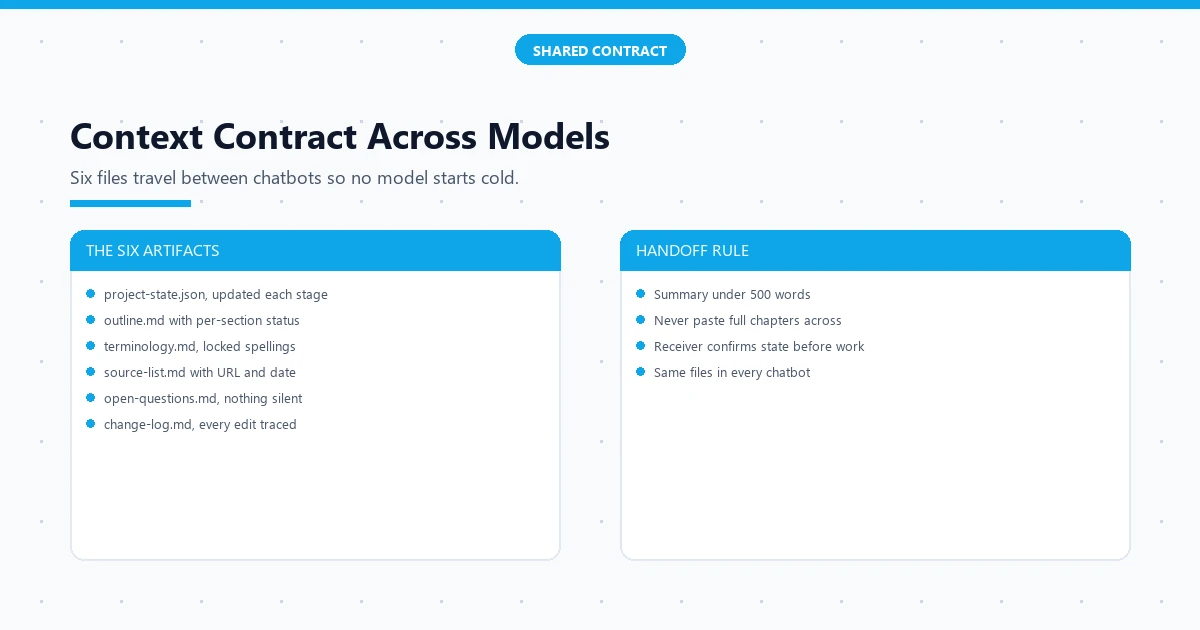
Six files, no more and no fewer. The project state file records which sections are drafted, audited, accepted, or rejected, one line each. The outline holds per-section status and word budgets. The terminology file locks spellings, names, and preferred terms so chapter twelve says what chapter two said. The source list records every citation with its URL and the date it was checked. The open-questions file collects everything no model could answer yet, reviewed by the human weekly. The change log records every edit with a timestamp, so any regression traces to its cause in minutes.
Two rules keep the bundle light. First, never paste full chapters across models; the summary plus the section’s own files is always enough, and full pastes are how context windows choke on chapter nine. Second, the receiving model confirms the state before starting: it restates the section goal, the word budget, and the open questions in its own words. If the restatement is wrong, the human fixes the files, not the model. This confirmation step catches most cross-model misunderstandings before they cost a drafting cycle. It also makes a crashed or cancelled session trivially resumable: a fresh chatbot reads the same six files and continues exactly where the last one stopped.
Which stages run on which model?
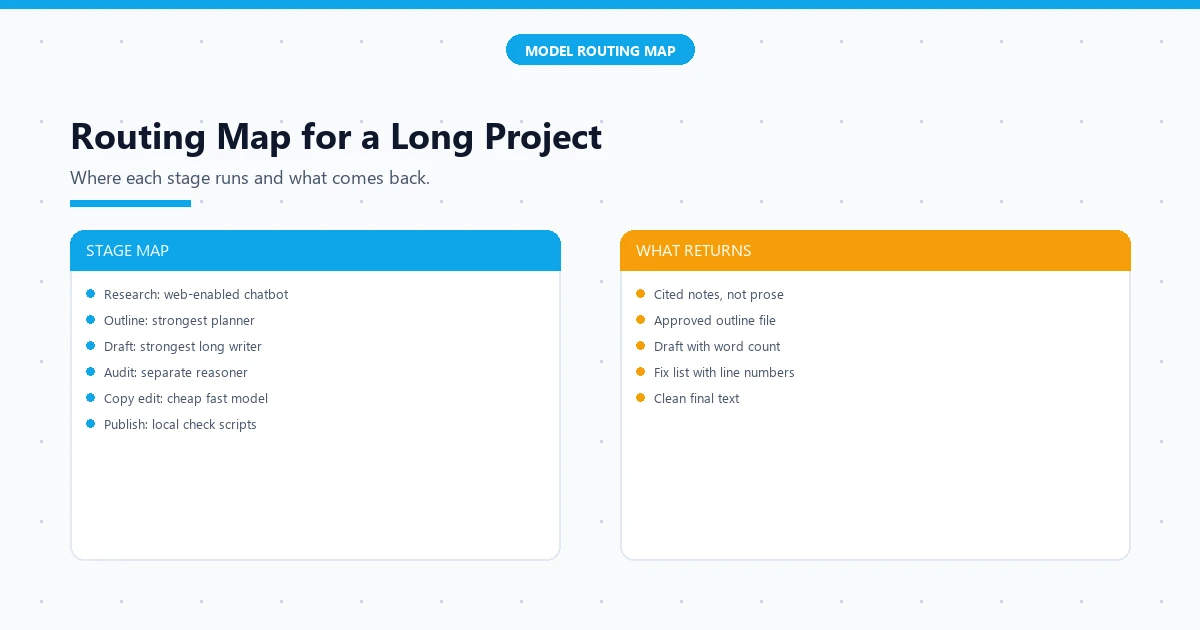
Route by job, not by loyalty. Research runs on whichever chatbot currently browses the web best and returns citations you can open. Outlining runs on the strongest planner available, because a weak outline guarantees weak chapters whatever the drafter does. Drafting runs on the strongest long-form writer, the model that holds tone across 3,000 words. Auditing runs on a different vendor’s strongest reasoner, cold, as described above. Copy editing runs on the cheapest fast model with strict instructions to shorten and never to add facts. Publishing checks run locally as scripts: word counts, link resolution, format validation.
Costs stay controlled in a multi model AI workflow for long form projects because the expensive models touch only their stages. A common split: free tiers handle research collection and copy editing, one mid-tier subscription covers drafting, and pay-per-use reasoning covers audits. For a 50,000-word book this routing typically halves the token bill versus running the flagship model for everything, while raising quality because each stage uses the right strength. Run a multi model AI workflow for long form projects on this split and the budget line stays flat while chapter count grows. Authors planning full-length books should read the six-stage production framework for 50,000-word books alongside this routing map.
What breaks most often, and how do you fix it?
Three failures cover eighty percent of the pain. Context overflow arrives when someone pastes full chapters “for background”; the fix is the 500-word summary rule plus the six files, enforced without exceptions. Style drift arrives around the middle of long books, when the drafter starts writing like its own recent output instead of like the outline; the fix is a copy-edit checkpoint every three sections against the terminology file and the earliest accepted chapter. Contradiction blindness arrives when numbers or claims disagree across sections and both models wave them through; the fix is a dedicated audit pass that compares figures across the summary files with a calculator’s literalism, never the model’s optimism.
The remaining twenty percent is human process failure: skipping the approval between stages, letting the drafter also “quickly fix” audit findings, or editing the shared files mid-stage instead of between stages. A multi model AI workflow for long form projects only works when the human acts as the release manager: approve, freeze, hand off, approve again. The moment stages blur, the models start negotiating with each other through the text, and quality slides back to single-chatbot levels. Keep the gates boring and the output stays sharp.
How do you start your first multi-model project?
Begin with a three-section pilot, not the whole book. Pick one representative chapter and one appendix-like section plus the outline. Run the full loop: research notes, outline approval, drafting pass, cold audit, copy edit, human sign-off. Time each stage and note every friction point in the change log. Fix the files, not the models: tighten the terminology list, shorten the summary template, clarify the word budgets. Then scale to the full project with the same files. The pilot typically exposes two or three contract gaps that would have cost a week at full scale.
Choose vendors only after the pilot. Drafting quality differs by genre: test your actual material, two sections each, on two candidate writers before committing. Auditing quality differs by domain: feed both candidate auditors the same draft with three planted errors and pick the one that catches all three. This tryout costs an afternoon and prevents a month of arguing with the wrong model. Teams already running agent pipelines can slot this routing into their existing stages; see how enterprise setups organize local execution stages for the software-side equivalent.
How do you keep one project affordable across vendors?
Budget by stage, not by subscription. Research and copy editing live happily on free tiers because they need breadth and speed, not depth. Drafting earns the one paid subscription: long, coherent sections are the hardest job and the one that most affects quality. Auditing runs best as pay-per-use reasoning, bought in small batches per chapter, because a cold audit is short and decisive. Track spend per stage in the change log beside the word counts; after three chapters you know the exact cost per thousand accepted words, and that number guides every later decision. Book authors face the same unit economics creators use to price KDP royalties per format when a multi model AI workflow for long form projects ends in a published book. A multi model AI workflow for long form projects usually lands cheaper than a single flagship subscription doing everything, while producing better-checked text.
The second saving is rework avoided. A rejected chapter caught at audit costs one redraft; the same errors caught after publication cost the edition. Vendor diversity pays for itself the first time the auditor catches an invented citation the drafter defended, which happens more often than anyone expects. Price the audit stage as insurance, not overhead.
How do prompts differ for each model in the workflow?
Each role needs its own prompt shape, and sharing one template across roles is the fastest way to flatten the whole system. The drafting prompt leads with the section contract and the word budget, attaches the terminology file and the rolling summary, and ends with the open-questions rule: flag gaps, never fill them. The audit prompt leads with the draft and the source list, forbids stylistic comment entirely, and demands verdicts with line numbers. The research prompt asks for cited notes only, with URLs and dates, and rejects prose paragraphs outright. The copy-edit prompt permits shortening and rhythm fixes and forbids adding any fact, number, or name. For the underlying craft of writing prompts that models obey literally, the vendor guides remain the primary reference; see Anthropic’s prompt engineering overview for the patterns this section adapts.
Keep every role prompt in the project folder beside the six state files, versioned with dates. When a vendor updates a model and behavior shifts, you change the prompt file once and rerun the pilot section, instead of re-explaining rules inside every chat. A multi model AI workflow for long form projects stores its intelligence in these files rather than in anyone’s memory of what worked last month. New collaborators read the prompts before touching a chatbot, which onboards them in an afternoon. Prompts are infrastructure here, maintained like code, reviewed like contracts, and never improvised mid-stage. Treat the prompt files as part of the multi model AI workflow for long form projects contract, and vendor updates become routine maintenance instead of emergencies.
Frequently asked questions
How many models do you need for a multi model AI workflow?
Three roles minimum: a drafter, a separate auditor, and a research or copy-edit pass, which can share a third model. A multi model AI workflow for long form projects works with two vendors plus one free tier; more models add choice but also handoff overhead. Start any multi model AI workflow for long form projects with exactly three roles, and add a fourth only when the ledger proves one stage is starved.
Can free chatbot tiers handle a whole book project?
Free tiers handle research collection, copy editing, and short rewrites well. Budget a paid tier for drafting long sections and for cold audits, because those two stages decide final quality and free limits interrupt them mid-chapter. Many authors run a multi model AI workflow for long form projects on one mid-tier subscription plus free tiers everywhere else, which keeps the whole book under the price of a single flagship plan.
What if the auditor disagrees with the drafter on style?
Style authority belongs to the human-approved terminology file and the earliest accepted chapter, not to either model. The auditor flags the drift; the human picks the direction once, records it in the files, and both models follow it after. In a multi model AI workflow for long form projects, this rule prevents endless stylistic negotiation between chatbots that would otherwise rewrite each other’s sentences forever.
How do you keep one voice across different models?
One terminology file, one outline voice note, and copy-edit checkpoints every three sections against the first accepted chapter. Voice comes from constraints shared in files, never from hoping different models sound alike. A multi model AI workflow for long form projects keeps its voice the way orchestras keep time: everyone reads the same score, and the conductor checks every third bar.
What happens when a vendor changes its model mid-project?
Nothing, if the contract lives in files. Finish the current section on the old behavior, update the terminology and summary files as usual, and test the new version on one pilot section before routing real work to it. A multi model AI workflow for long form projects treats models as replaceable parts; the files are the project, not the chatbot.
Can two people run different stages at once?
Yes, and the file contract makes it safe. One person shepherds drafting while another runs audits on accepted drafts, because the state file serializes who owns which section. Parallel work doubles throughput only when both people respect the freeze rule: no editing shared files mid-stage.
How long does a 50,000-word book take this way?
Four to eight weeks of steady part-time work for most non fiction: one week for research notes and outline, two to four for drafting with audits interleaved, one for copy editing and publishing checks. Controlled runs with staged pipelines report full suites shipping inside a single focused sprint; see how a 50,000-word book comes together with AI for the accelerated end of that range.
How do you run a multi model AI workflow for long form projects on a deadline?
Freeze the file contract on day one and run drafting and auditing in parallel pipelines. A multi model AI workflow for long form projects meets deadlines by overlapping stages: while the drafter writes section five, the auditor checks section four and the researcher gathers sources for section six. The state file serializes ownership so parallel work never collides. That serialization is what lets a multi model AI workflow for long form projects run drafting and auditing side by side without rework.
One last habit separates pilot success from book success: the weekly files review. Every Friday, read the six shared files for drift before the weekend, and a multi model AI workflow for long form projects stays coherent across months. Ten quiet minutes of file hygiene prevent ten loud hours of chapter repair later. Run a multi model AI workflow for long form projects with the same Friday review every week, and drift never survives the weekend.
When vendors release new models mid-book, a multi model AI workflow for long form projects absorbs the change: test the newcomer on one pilot section, update the prompt file, and route only the stages it wins. Keep the desk files frozen during the test and the multi model AI workflow for long form projects never loses a chapter to a vendor update. The desk stays the same; only the seats change.
Conclusion: the desk outlasts the models
Chatbots will keep changing names and prices. The desk layout, researcher, drafter, cold auditor, copy editor, human release manager, and six shared files, survives every cycle because it encodes editorial judgment instead of vendor habits. Build the files once, pilot them on three sections, and your next long project starts organized instead of hopeful. That is what a workflow is for.