
Prompt engineering got the headlines, but a different discipline is quietly deciding whether agent projects ship or stall. Call it loop engineering: the practice of designing what happens around the model’s turns, the verification after each step, the interception of failure patterns, the fallback paths when a step dies, and the audit trail when everything else fails. Prompts shape what an agent tries. Loops decide what happens when the try fails, which in real projects is most of the interesting engineering.
The distinction matters because 2026’s agent failures are rarely failures of wording. They are failures of process: an agent repeating a broken fix, a session that forgot its own decisions, a runaway command that nobody was watching. Every one of those is a loop problem, and no amount of prompt polish fixes a loop problem.
This article defines loop engineering as a discipline, sets it against prompt engineering honestly, walks through a four-phase methodology you can apply to any agent workflow, and covers the human’s role and the tooling market. It is the category guide for everything else in this series, and it assumes no prior framework loyalty.
What is loop engineering?
Direct answer: it is the discipline of designing, instrumenting and governing the cycles that AI agents run in: how each turn is verified, how failure patterns are intercepted, what happens on fallback, and what evidence is recorded. Where prompt engineering improves the content of a single request, the loop discipline improves the behaviour of the whole cycle across many requests.
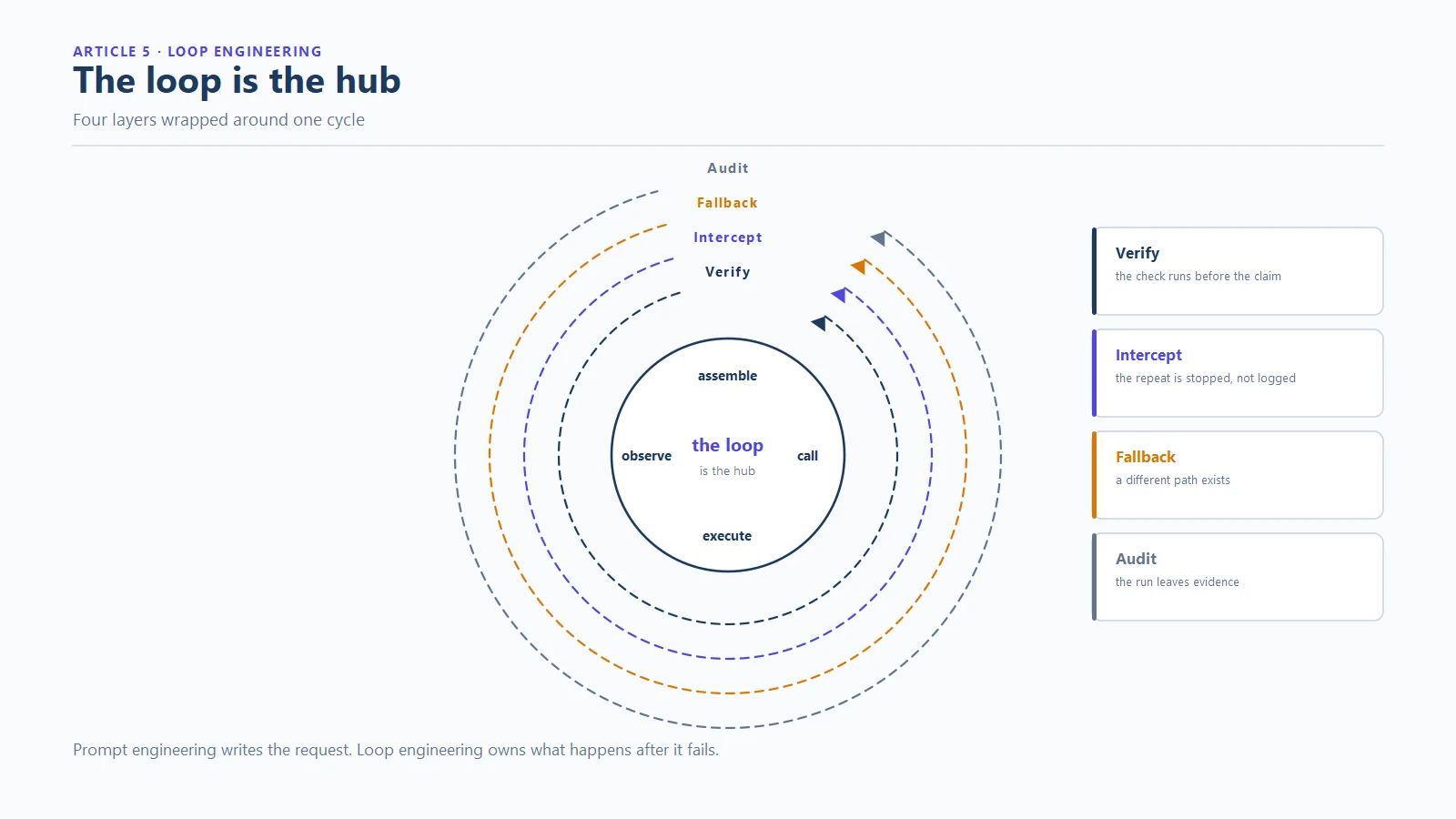
The word loop is doing real work here. An agent is literally a loop: assemble context, call the model, execute whatever the model requested, observe the result, and go around again until a goal is met or a limit is hit. Every property you care about in production, reliability, cost, safety, auditability, is a property of that loop, not of any single prompt inside it. The discipline is the acknowledgment that the loop is the product.
It helps to name what the discipline owns. Verification: deciding what counts as a step succeeded. Interception: catching repetition and stall before they burn the budget. Fallback: preparing where the agent goes when a step dies. Audit: recording what actually happened, in a form you can inspect later. Four responsibilities, and prompts are involved in none of them directly.
Loop engineering vs prompt engineering
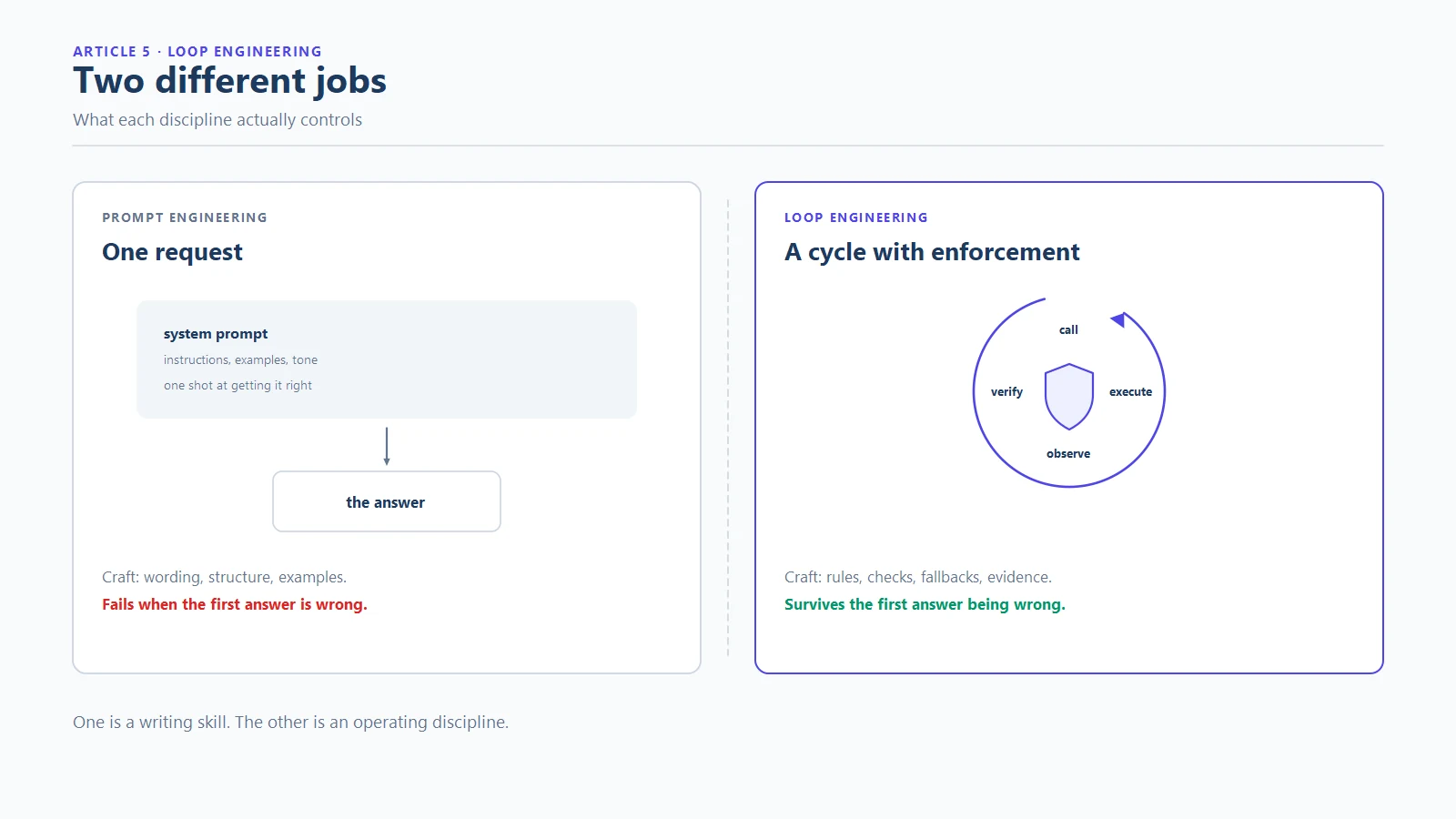
The two disciplines are complements, and teams do best when they stop expecting either to do the other’s job. Prompt engineering is craft work on the content of requests: instructions, examples, constraints, output formats. The loop discipline is systems work on the machinery around those requests. The comparison is worth a table:
| Prompt engineering | Loop engineering | |
|---|---|---|
| Unit of work | One request | The whole agent cycle |
| Answers | What should the model try? | What happens when the try fails? |
| Failure handled | Ambiguity, bad output format | Repetition, stalls, runaway cost |
| Enforcement | Advisory, model may comply | Mechanical, code enforces the rule |
| Scales to unattended runs | Poorly | By design |
| Evidence produced | The transcript | Verifiable records and reports |
The enforcement row is the one that changes minds. A prompt that says “stop after two failed attempts” is a suggestion the model can miscount or reinterpret. A loop breaker that interrupts on the second strike is a rule with no opinion. This is why teams that write better and better prompts still get burned by the same failure classes: the prompt layer cannot enforce anything, and the failures that matter live in the enforcement layer. The market has noticed. Interest in loop engineering as a named discipline grew through 2026 developer discussions, including long threads on Hacker News about agents that govern themselves badly, and keyword tools now register the term as its own query, distinct from prompt engineering, with real monthly volume behind it. That is the market’s way of saying the two disciplines no longer fit in one word.
The four phases of loop engineering
Applied to a real workflow, the practice runs in four phases. They are a cycle themselves, which is fitting: you engineer the loop, watch it run, and re-engineer what the evidence tells you.
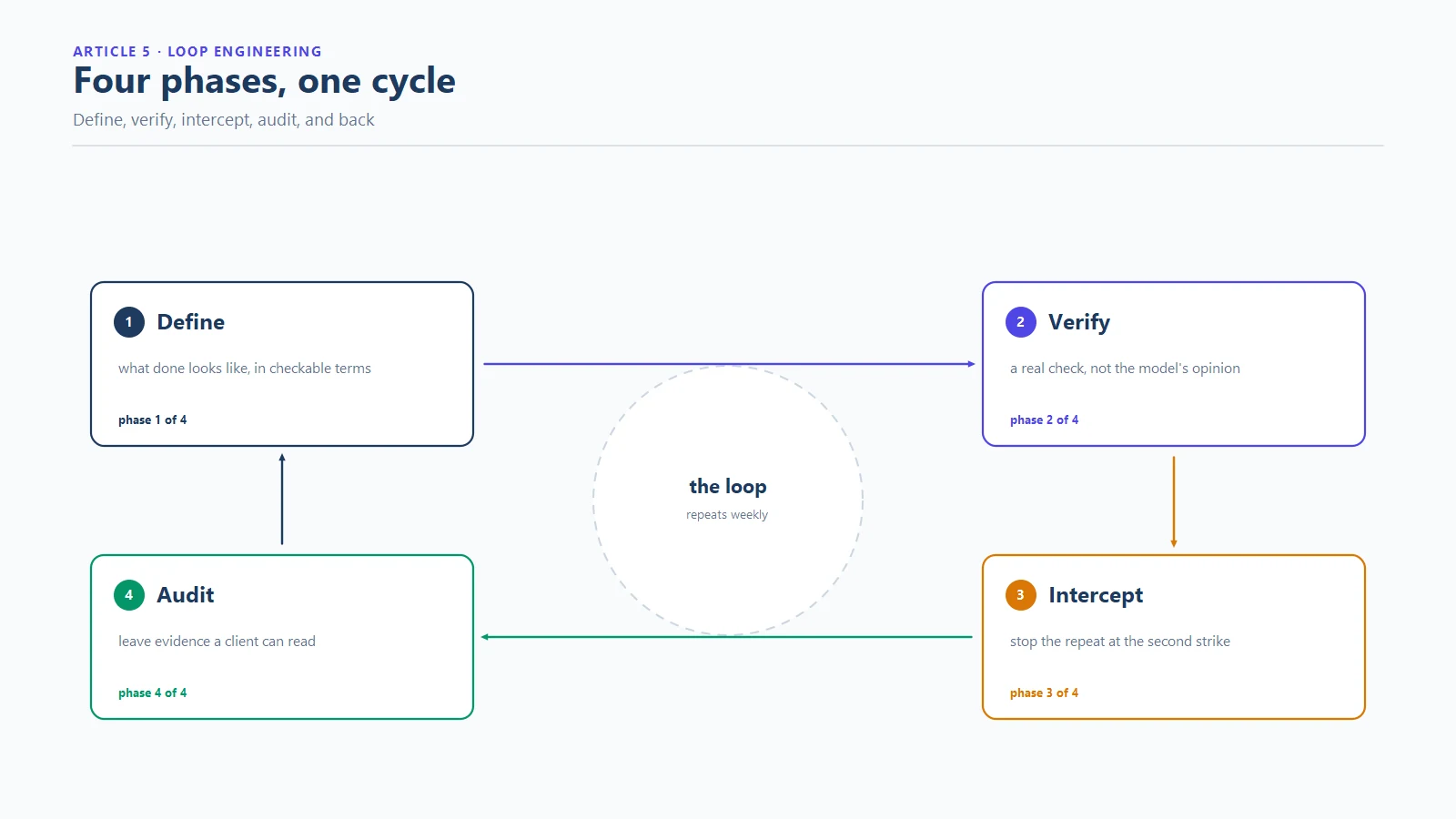
Phase 1: Define the loop’s rules
Before an agent runs, write down what the loop may do. Which commands are permitted, which require a human, what the retry budget is per failure class, what the hard stop condition is, and what the fallback path is when a step dies. Most teams skip this phase and discover its value during the first overnight run, when there is no one present to improvise policy. A rule that exists only in someone’s head is not a rule at 3 am.
A concrete example makes the phase tangible. A data-team’s rule sheet for their reporting agent fits on one page: the agent may run read-only queries freely, may run schema migrations only in the staging database, may never touch production credentials, gets three retries on network errors and zero retries on assertion failures, and must stop and escalate if two consecutive steps fail verification. None of that is prompt material. All of it is enforceable, and writing it took twenty minutes that later saved a night.
Phase 2: Verify every step
Each turn needs a check: did the step do what it claimed? Verification can be as plain as an exit code and as rich as a test suite, but it must be mechanical and it must run every time. The alternative, trusting the agent’s own summary of its work, is how confident wrongness enters a codebase. Verification is also where cost discipline lives, because a step that cannot prove value should not get another turn.
Phase 3: Intercept failure patterns
When verification fails twice on the same target, the loop has formed, and something outside the model has to end it. This is the interception phase: repetition detection, stall timers, rate limits on external calls, and a prepared fallback path so the interrupt hands the agent somewhere to go. Interception is where the practice earns its name, and it is the phase with the clearest return on investment, because every intercepted cycle is budget saved and context kept clean.
Interception also has a public-relations job inside the team. The first time a loop breaker fires correctly, at 2 am, with a clean log line explaining what it caught and what the agent did instead, the sceptics on the team stop asking why the tooling exists. Interception is the phase people can watch working, which makes it the phase that funds the rest of the programme politically.
Phase 4: Audit what actually happened
After the run, the evidence has to exist in a form a human can inspect. Not a chat transcript, which is a story the agent tells about itself, but a record of commands executed, outcomes, interceptions and fallbacks taken. Exportable, storable, diffable. Audit closes the cycle: it tells you which rules from phase 1 were right, which verification from phase 2 missed something, and which interception from phase 3 fired too early or too late.
The human’s role in a well-engineered loop
The discipline does not remove the human; it repositions the human. Instead of watching transcripts for emerging disasters, the human sets policy, reviews audit evidence and handles the escalations the loop flags. The work moves from vigilance to governance, which is both safer and more interesting.
This connects to a broader principle we have written about before: human-in-the-loop automation works best when the human touches defined points in the process rather than hovering over all of it. The four phases give those points definition. Approval before destructive commands, review after each phase gate, escalation when the fallback path also fails. The agent runs the turns; the human owns the boundaries.

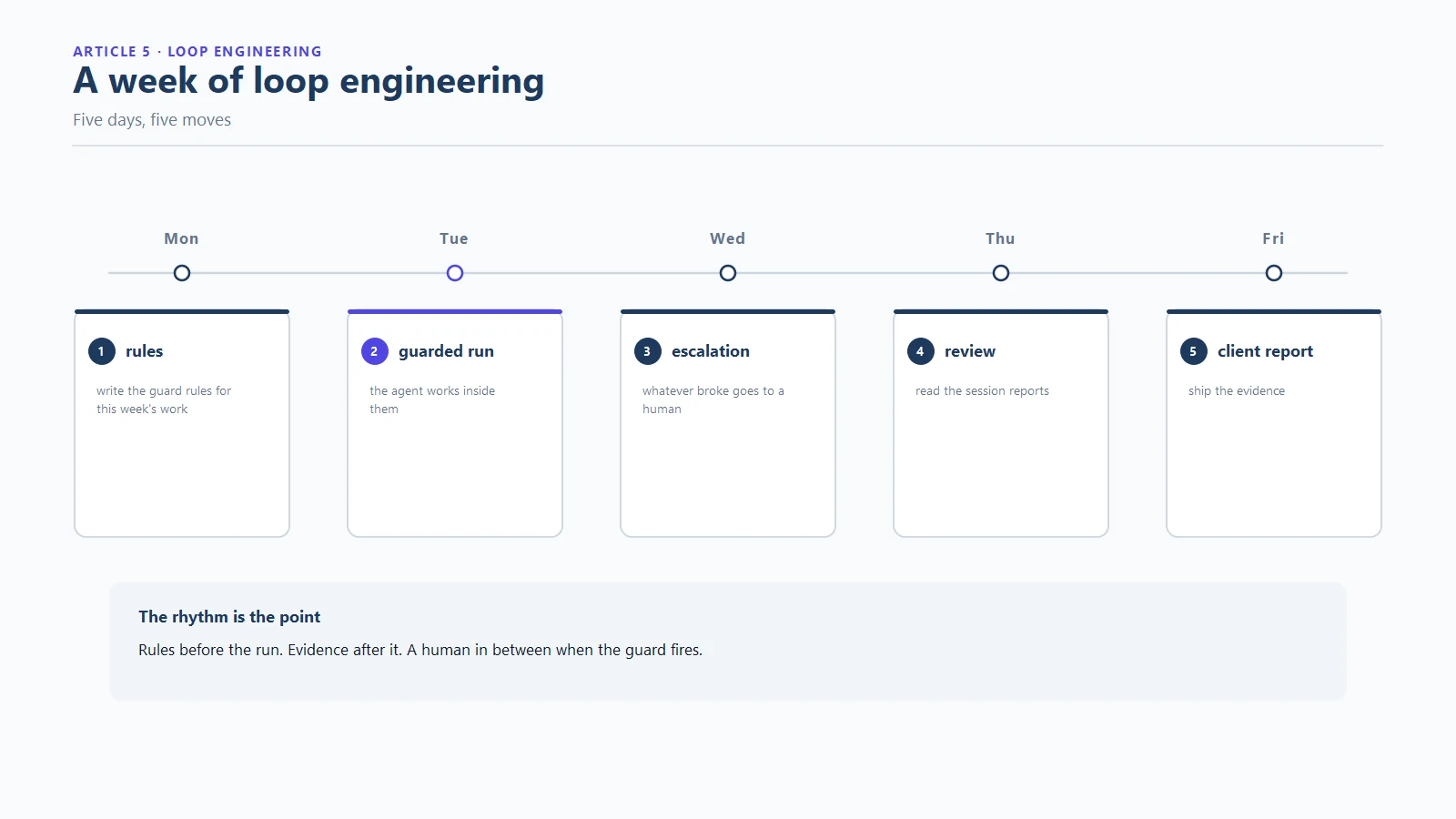
What loop engineering looks like in a real week
Abstractions settle better with a calendar. Here is one week on a team that runs the discipline seriously, with a coding agent doing migration work on a mid-sized service.
Monday. The week’s task is written down as three verifiable steps, each with a definition of done. The rule sheet gets one addition: this migration touches the auth module, so schema changes require human approval. Setting the week’s policy took fifteen minutes.
Tuesday. The agent runs the first migration step overnight under guard. In the morning the audit record shows eleven commands executed, one loop intercepted on the second strike, and the fallback path taken successfully. Nobody watched anything live. The verification gate, a test suite, is what decided the step passed.
Wednesday. A verification failure the loop could not resolve: the fallback path also failed its check. The engine escalated instead of improvising, which is the correct behaviour, and the human fixed the underlying environment issue over one coffee. The escalation log made the diagnosis ten minutes of work instead of an hour of transcript archaeology.
Thursday. The remaining migration runs clean. The team reviews the week’s audit export, notices that rate limiting fired twice against a slow external API, and tightens the rule sheet accordingly. Loop engineering in practice is mostly this: small weekly adjustments to rules that the evidence justifies.
Friday. The client receives a PDF audit trail of every command that ran against their system, generated by the engine’s export suite. The report took one command to produce and answers the question clients increasingly ask: what exactly did your automation do?
Notice what never happened that week: nobody read a raw transcript to find out what went wrong, nobody watched a doom loop burn budget, and nobody argued about what the agent meant to do. The loop was governed, and the governance paid for itself by Wednesday.
The tooling market for loop engineering
The tooling market for this discipline in 2026 is thin but real. On one side sit the agent frameworks, which give you the loop but expect you to engineer it: they provide the while-statement and leave verification, interception and audit as exercises. On another side sit observability tools that record what agents did, which covers the audit phase nicely and the other three not at all. And on a third side sit reliability engines that implement the full stack: loop protection, guarded execution, memory, and exports you can hand to a client.
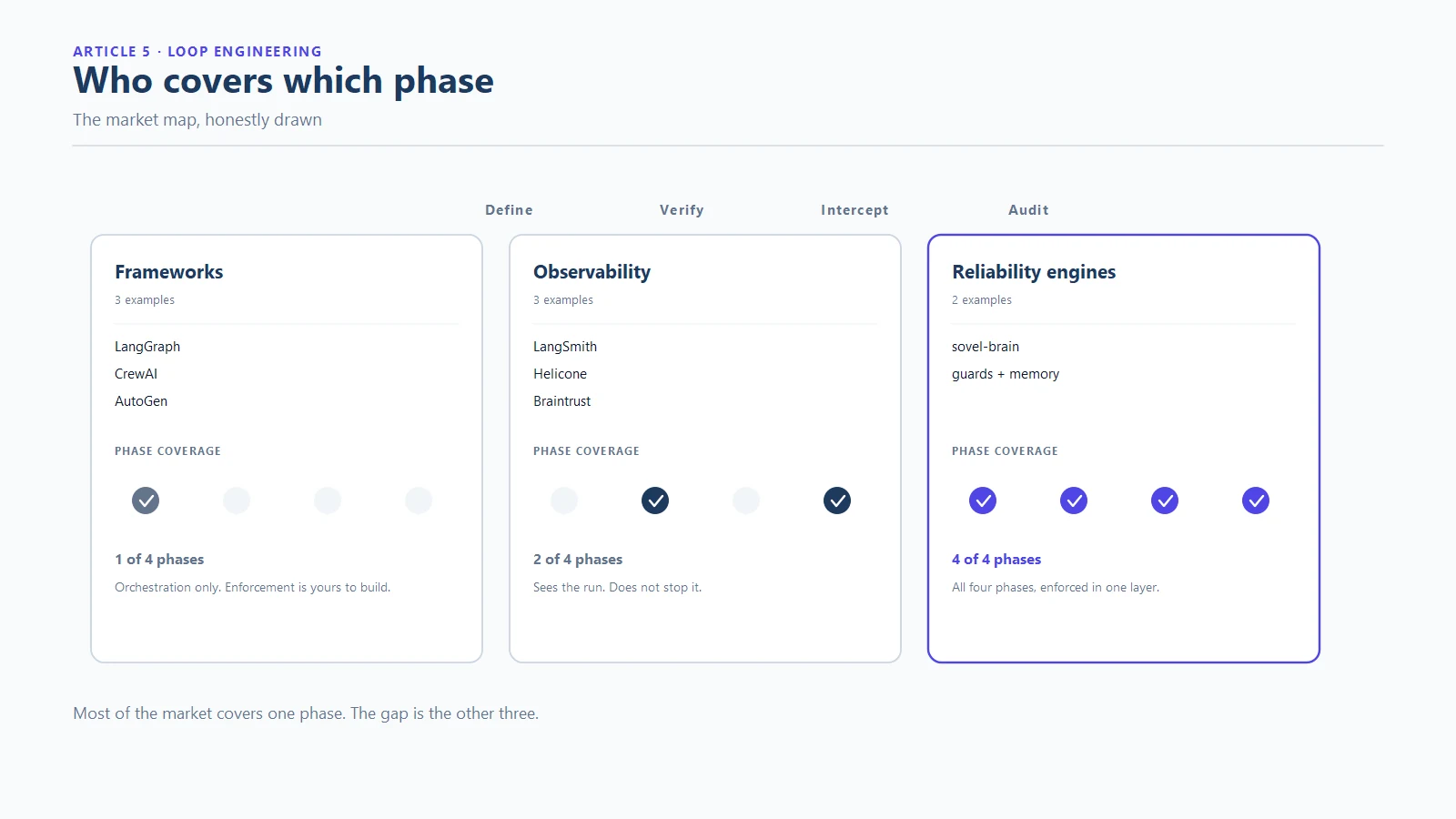
Choosing between them is a scoping decision, and loop engineering phases are the yardstick: match the tool to the phase it serves. If your team already has strong review culture and only needs records, observability alone adds value. If you are building custom agents from scratch, a framework plus your own phase 1 to 3 work is reasonable. If you are running existing agents on real work and want the cycle governed without building it, that is the reliability-engine category, and it is where SOVEL Net-Routed Agentic OS lives: loop protection with two-strike interception, guarded commands, local memory, and audit exports in five formats, all on your own machine.
Getting started with loop engineering this week
The practice scales down to a single afternoon. Start with the run you already have and add the phases in order of pain:
- Write the rules down. One page: permitted commands, retry budget, stop conditions, fallback paths. You will revise it; the point is that it exists.
- Make verification mechanical. Attach an exit-code check or a test to every step that matters. If a step cannot be verified, it should not run unattended.
- Add one interception. Even a crude script that counts identical failures and kills the run on the second one beats the status quo, which is nothing.
- Turn on recording. Log every guarded command and outcome. After a week you will have the evidence base to tune everything else.
Teams that do just this much report the same qualitative change: overnight runs stop being a gamble, and loop engineering stops being a slide-deck term. The mechanics behind step 3, two-strike interception and jitter detection, are covered concretely in our doom loop article, and the system-design view of watchdogs and safety nets lives in the agent loop middleware piece.
Five mistakes teams make when they start
The early failures of loop engineering are consistent enough to list:
- Writing rules nobody enforces. A policy document that no machinery checks is a wish. Every rule needs an enforcement point, even a crude one, or it will be honoured for exactly as long as its author remembers it.
- Verification that trusts the agent. Asking the model whether it succeeded is not verification; it is a survey of one confident respondent. Exit codes, tests and file diffs are verification.
- Intercepting too late. Waiting for five failures to be sure wastes the budget the interception was meant to save. Two strikes is a pattern; act on it.
- Audit nobody reads. Recording everything and reviewing nothing means the phase 4 evidence never feeds back into phase 1 rules. Put fifteen minutes of review on the calendar or skip the pretence.
- Boiling the ocean. Teams that try to engineer every loop at once stall in design meetings. Start with the one workflow that hurts most, prove the phases there, and let the pattern spread on evidence.
Every one of these mistakes is cheaper to avoid than to fix, and all five come from the same root: treating the discipline as documentation rather than as machinery. The discipline earns its keep when rules execute, and the moment they do, the other four mistakes become difficult to make.
Frequently asked questions
What is loop engineering?
It is the discipline of designing and governing the cycles AI agents run in: verification of each step, interception of failure patterns, fallback paths and audit records. The discipline treats the agent’s while-loop as the product, rather than any single prompt inside it.
How is loop engineering different from prompt engineering?
Prompt engineering improves the content of individual requests; the loop discipline improves the behaviour of the cycle across requests. The sharpest difference is enforcement: a prompt can suggest a retry limit, while loop machinery enforces one mechanically. They are complements, and mature teams need both.
Why did loop engineering emerge as its own discipline?
Because 2026’s agent failures turned out to be process failures, not wording failures: repeated broken fixes, forgotten decisions, runaway commands. Prompts could not enforce their way out of those, so teams started engineering the cycle itself, and the practice got a name, discussion threads and eventually its own search demand.
Does loop engineering replace human review?
No, it repositions it. The human sets policy at the start, reviews audit evidence after, and handles escalations at defined points. The human-in-the-loop automation approach works better when the touchpoints are explicit, which is exactly what the four phases provide.
What tools do I need for loop engineering?
At minimum for a working practice: a written rule sheet, a mechanical verification step, one interception mechanism and command recording. Teams that want the full stack without building it use a reliability engine such as SOVEL Net-Routed Agentic OS, which implements all four phases in one local install.
Is loop engineering only for coding agents?
The examples here are coding agents because that is where the pain is loudest, but the phases apply to any agent workflow with tool calls and budgets: research pipelines, data processing, content production. Anywhere a cycle can repeat a mistake, the discipline applies.
Govern the loop, or the loop governs you
Every agent runs a loop whether or not anyone engineered it. The un-engineered version has no rules, no verification, no interception and no audit, and it expresses those omissions as burned budgets and mystery transcripts. The practice is simply the decision to own the cycle: define the rules, verify the steps, intercept the failures, audit the evidence. Four phases, one afternoon to start, and the difference between hoping your agents behave and knowing what they did.