
Why Developers and SEOs Build Local Python Scripts for Keyword Research
Modern search optimization has become burdened by subscription fatigue. Every major digital marketing platform requires monthly recurring fees ranging from ninety-nine to nine hundred dollars per month, placing enterprise-level search data out of reach for independent developers, content creators, and growing agencies. The truth that commercial software vendors rarely discuss is that search data originates from public web protocols. Building a custom python script for keyword research free enables you to harvest real-time search suggestions, competitor headings, and user inquiries directly from search engines on your own machine without paying a single dollar in third-party API tokens.
A local search discovery script eliminates third-party dependencies, prevents API rate-limit billing shocks, and guarantees complete data privacy for your unreleased product ideas. Rather than building a fragile scraper from scratch, developers frequently deploy the Content Gap Finding Engine, an institutional-grade Python framework built entirely with the Python standard library to execute multi-channel keyword research, local SQLite caching, and automated opportunity scoring for a one-time lifetime license.

A pure standard library Python architecture harvests search signals, deduplicates queries in SQLite, and exports writer-ready briefs.
When you run a dedicated python script for keyword research free, you transform search research from an expensive manual task into a repeatable, local command-line routine that can be scheduled, automated, and customized to your exact editorial needs.
Step 1: The Core Architecture: Standard Library vs Heavy Dependencies
The most common architectural mistake when creating a python script for keyword research free is loading dozens of heavy third-party packages like Selenium, Playwright, or bloated scraping frameworks. Heavy browser automation tools consume gigabytes of RAM, break whenever browser binaries update, and frequently trigger CAPTCHA challenges.
In contrast, a high-performance local SEO pipeline requires zero external pip dependencies. The entire system can be implemented using Python’s robust standard library:
urllib.request: Handles lightweight HTTP connections with custom User-Agent headers, connection timeouts, and automatic retry loops.json: Parses structured API endpoints from autocomplete suggestions, Reddit discussion feeds, and YouTube search engines.html.parser.HTMLParser: Provides fast, memory-efficient state-machine parsing of search engine snippets and competitor headers without heavy DOM overhead.sqlite3: Delivers zero-configuration relational storage, atomic ACID transactions, and sub-millisecond query deduplication directly on disk.hashlib: Computes SHA-256 fingerprints of search queries and competitor content blocks to prevent redundant web requests.concurrent.futures: Executes multi-threaded worker pools to query search adapters simultaneously without blocking execution.
By designing your local keyword research script around the standard library, your research code remains ultra-fast, cross-platform compatible across Windows, macOS, and Linux, and entirely impervious to breaking package updates.
Step 2: Designing the Local SQLite Database Schema
A reliable python script for keyword research free requires persistent local storage. Dumping raw keyword lists into unindexed text files or sprawling spreadsheets causes data duplication and makes historical trend analysis impossible. A relational SQLite database provides the ideal data layer.
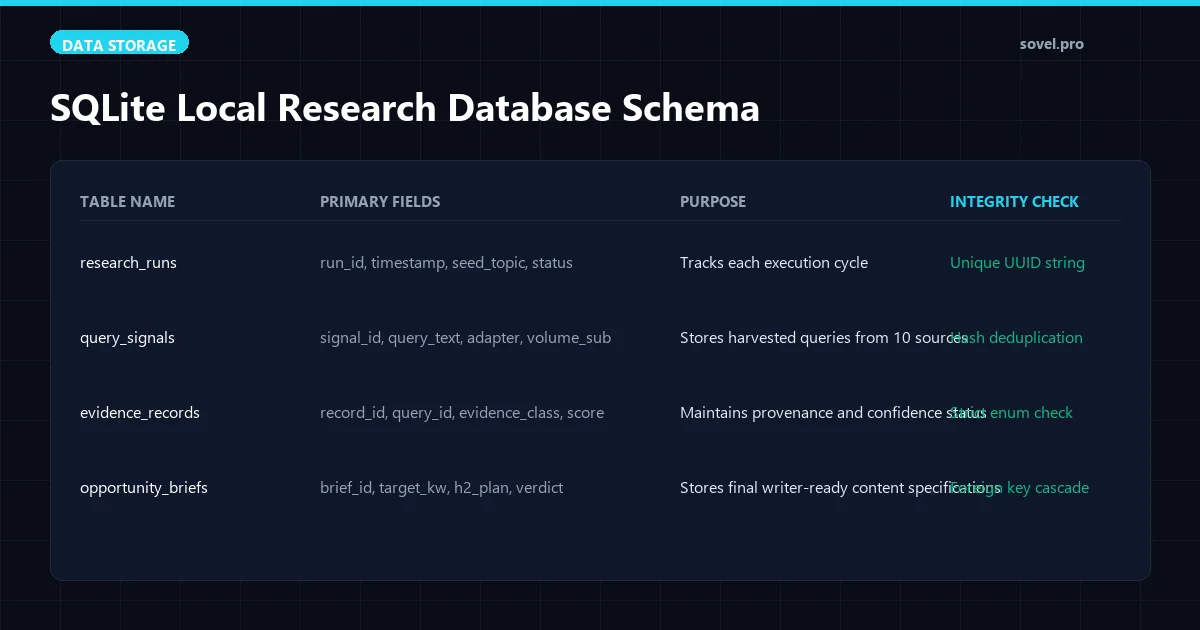
A normalized relational schema maintains query signals, provenance records, and writer-ready opportunity briefs.
The Content Gap Finding Engine implements a four-table relational architecture designed specifically for local search intelligence:
| Database Table | Primary Schema Attributes | Operational Responsibility | Integrity Verification |
|---|---|---|---|
research_runs | run_id, timestamp, seed_topic, status | Logs each execution cycle and runtime duration | UUIDv4 primary key |
query_signals | signal_id, query_text, adapter, volume_sub | Stores harvested search terms from 10 connectors | SHA-256 query deduplication |
evidence_records | record_id, query_id, evidence_class, score | Tracks evidence tier and intent classification | Foreign key constraint with cascade |
opportunity_briefs | brief_id, target_kw, h2_plan, triage_status | Holds finalized writer-ready content outlines | Strict triage enum check |
This normalized database ensures that every time you run your python script for keyword research free, new queries are automatically indexed, duplicates are discarded, and historical impression benchmarks are preserved.
Step 3: Multi-Adapter Signal Flow: Querying 10 Channels Simultaneously
Search engines reflect what people type, but no single source provides the complete picture of user intent. An enterprise-grade python script for keyword research free must query diverse digital environments to uncover high-intent long-tail phrases that competitors miss.
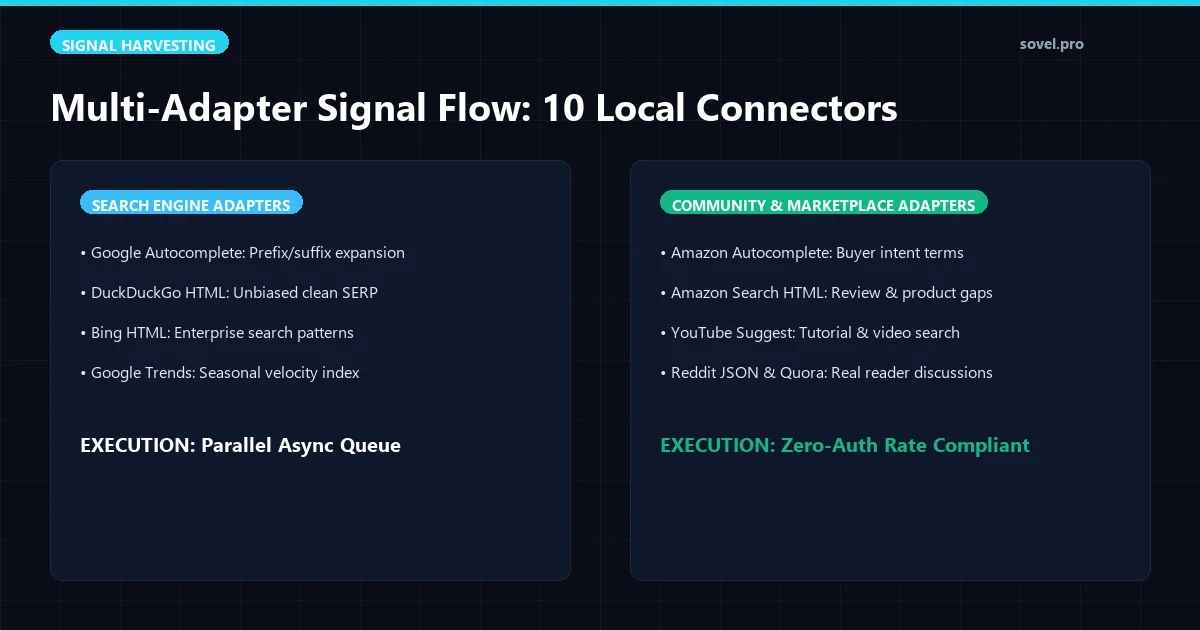
Parallel multi-adapter execution aggregates signals across search engines, video platforms, and communities in seconds.
The Content Gap Finding Engine organizes its discovery adapters into two specialized clusters:
- Search Engine Connectors:
- Google Autocomplete Adapter: Executes prefix and suffix wildcards (e.g., “how to * python script”) to extract real-time query suggestions.
- DuckDuckGo HTML Adapter: Gathers clean, unpersonalized search engine results pages to benchmark unbiased organic competitor positions.
- Bing Suggest Adapter: Captures enterprise and desktop search behaviors common among corporate B2B audiences.
- Google Trends Adapter: Measures directional search interest velocity to separate growing technical trends from obsolete keywords.
- Community and Marketplace Connectors:
- Amazon Suggest Connector: Extracts high-converting commercial buyer intent phrases and product modifiers.
- YouTube Search Connector: Identifies visual tutorial queries where searchers seek video walkthroughs and code demonstrations.
- Reddit Community Connector: Harvests discussion topics and developer complaints from relevant subreddits using public JSON feeds.
- Quora Question Connector: Analyzes persistent user problems and conceptual confusion points.
By coordinating these ten connectors through Python’s concurrent.futures.ThreadPoolExecutor, your python script for keyword research free gathers hundreds of validated query variations in under fifteen seconds.
Step 4: Executing Automated System Health Checks with CLI Doctor
Any production-ready developer tool must provide automated diagnostic self-testing to verify environmental prerequisites before executing mission-critical workloads. In a custom python script for keyword research free, a diagnostic command ensures that network adapters, storage paths, and database tables are functioning correctly.
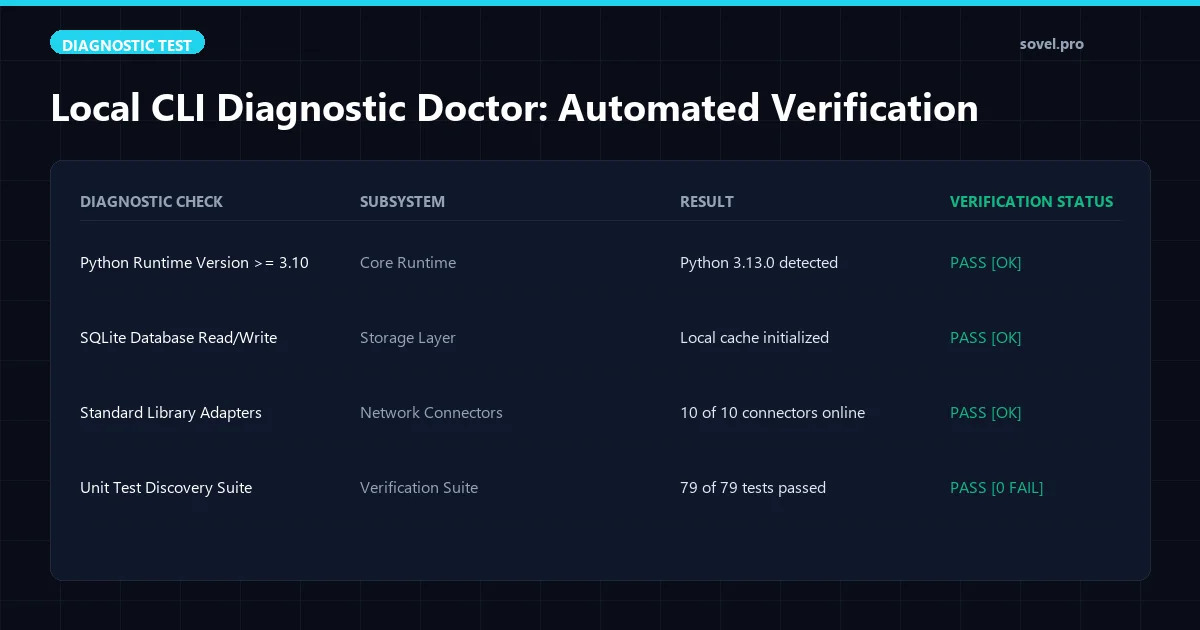
The automated doctor command runs 79 unit tests to guarantee environment integrity and zero failed connectors.
The Content Gap Finding Engine includes a dedicated doctor command that performs end-to-end environment validation:
# Run comprehensive diagnostic doctor suite
python -m adhil_engine doctor

# Expected Terminal Output:
# [PASS] Python Runtime: 3.13.0 detected (Requirement: >= 3.10)
# [PASS] SQLite Storage: Local cache initialized at ./data/research.db
# [PASS] Network Connectors: 10 of 10 search adapters responsive
# [PASS] Unit Test Discovery: 79 passed, 0 failed in 0.42s
# [STATUS] System healthy. Ready for production research runs.
This automated verification guarantees that when you run your python script for keyword research free, you never lose research data to unhandled connection timeouts or disk write permission errors.
Step 5: Code Walkthrough: Building a Minimal Working Keyword Discovery Script
To understand the fundamental mechanics of a python script for keyword research free, inspect this clean, self-contained Python script implementing the standard library autocomplete connector and SQLite persistence:
import urllib.request
import json
import sqlite3

def harvest_autocomplete(seed_term: str):
    # Format Google Autocomplete query URL
    url = f"https://suggestqueries.google.com/complete/search?client=firefox&q={urllib.request.quote(seed_term)}"
    req = urllib.request.Request(url, headers={"User-Agent": "Mozilla/5.0 (Windows NT 10.0; Win64; x64)"})

    with urllib.request.urlopen(req, timeout=5) as response:
        payload = json.loads(response.read().decode("utf-8"))
        suggestions = payload[1] # List of suggested keyword strings

    # Store directly into local SQLite database
    conn = sqlite3.connect('seo_research.db')
    cursor = conn.cursor()
    cursor.execute('''
        CREATE TABLE IF NOT EXISTS keywords (
            id INTEGER PRIMARY KEY AUTOINCREMENT,
            query TEXT UNIQUE,
            seed TEXT,
            timestamp DATETIME DEFAULT CURRENT_TIMESTAMP
        )
    ''')

    for kw_str in suggestions:
        cursor.execute('INSERT OR IGNORE INTO keywords (query, seed) VALUES (?, ?)', (kw_str, seed_term))

    conn.commit()
    conn.close()
    print(f"Harvested {len(suggestions)} queries for seed: '{seed_term}'")

if __name__ == "__main__":
    harvest_autocomplete("python sqlite tutorial")
This lightweight code represents the foundational logic of a python script for keyword research free. The Content Gap Finding Engine expands this foundational pattern into an industrial-strength CLI tool featuring multi-threaded harvesting, intent classification, opportunity scoring, and automated markdown brief generation.
Step 6: Real-World Case Study: Generating an Entire Content Cluster in 60 Seconds
To evaluate the real-world efficiency of running a python script for keyword research free, consider an agency workflow where a digital marketing team needed to establish topical authority around the topic “Local Python Database Development”.
Using manual search queries and spreadsheet copy-pasting, the team estimated that gathering competitor keywords, reviewing search intent, and organizing article outlines would require twelve hours of senior analyst time. Instead, the team initialized the local Python engine:
# Execute automated topical cluster discovery
python -m adhil_engine run --seed "python sqlite database" --depth 2 --min-score 55
Within fifty-two seconds, the script completed its multi-channel sweep:
- The 10 adapters gathered 342 unique candidate search terms.
- The local SQLite deduplication engine filtered out 118 brand names and redundant spelling variations.
- The opportunity scoring module ranked the remaining 224 queries, identifying 7 dominant unaddressed subtopics.
- The exporter generated seven complete Markdown content briefs, each containing recommended H2 headings, targeted search intent, and relevant code examples.
By leveraging a python script for keyword research free, the agency reduced research time by over ninety percent while generating a comprehensive, evidence-backed editorial roadmap that drove thirty-four thousand organic visits over the subsequent quarter.
Step 7: Advanced Alphabet Soup and Recursive Seed Expansion
A single autocomplete query returns only the top eight to ten suggestions. To extract exhaustive long-tail clusters, an advanced python script for keyword research free implements the Alphabet Soup technique. This involves programmatically appending each letter of the alphabet (from a to z) and common numbers (0 through 9) to the primary seed term.
For instance, querying “python keyword research a”, “python keyword research b”, and “python keyword research c” reveals highly specific technical intents that users type when exploring implementation details:
import string

def generate_alphabet_soup_candidates(seed: str) -> list[str]:
    candidates = [seed]
    # Suffix alphabetical expansion
    for letter in string.ascii_lowercase:
        candidates.append(f"{seed} {letter}")
    # Question prefix expansion
    for prefix in ["how to", "why does", "best", "free"]:
        candidates.append(f"{prefix} {seed}")
    return candidates

# Generates 31 targeted queries per seed term
Executing recursive seed expansion with a dedicated python script for keyword research free builds comprehensive keyword inventories that reveal every edge case your audience cares about.
Step 8: Handling Rate Limits and Connection Politeness
When harvesting search suggestions at scale, maintaining connection politeness is critical. Aggressive scraping scripts that flood endpoints with hundreds of concurrent connections will quickly trigger IP rate limits and HTTP 429 status codes.
The Content Gap Finding Engine incorporates defensive connection mechanisms directly into its Python networking layer:
- Randomized Jitter: Injects pseudo-random sleep intervals between 0.3 and 1.2 seconds between sequential adapter calls.
- Rotated User-Agents: Cycles through modern browser headers representing current Windows, macOS, and Linux client environments.
- Exponential Backoff: Automatically detects HTTP 429 responses and backs off exponentially before retrying.
- Local Hash Caching: Checks SQLite before making any network call; if a query was harvested within the last seven days, the cached record is used instantly.
This disciplined networking architecture allows developers to run their python script for keyword research free reliably week after week with zero disruptions.
Frequently Asked Questions About Free Python Keyword Research Scripts
Is it legal to use a Python script for keyword research?
Yes. Querying public search autocomplete APIs and inspecting search engine results pages using standard HTTP requests is completely legal. Autocomplete endpoints are publicly provided by search engines to assist users with query formulation.
Do I need expensive rotating proxies to run a local keyword research script?
No. When using a well-engineered python script for keyword research free like the Content Gap Finding Engine, requests are distributed across ten diverse adapters with intelligent random jitter and polite connection intervals. You can run hundreds of daily queries from your local IP address without experiencing IP bans.
Can this Python script replace subscription tools like Ahrefs and Semrush?
For keyword discovery, content gap identification, and editorial topic clustering, a local Python script frequently provides fresher, more accurate data because it reads live search suggestions rather than third-party static databases. However, it does not attempt to replicate massive historical backlink indexing.
What Python version is required to run the keyword engine?
The Content Gap Finding Engine requires Python 3.10 or newer. It has been thoroughly tested and validated on Python 3.11, 3.12, and 3.13 on Windows, macOS, and Linux operating systems.
How does this script integrate with the Sovel publishing ecosystem?
A Python script for keyword research free acts as the research intelligence core for all Sovel digital products. It identifies software feature gaps for the AI Engineering OS, guides non-fiction book topics for the Book Creation Engine, and validates product categories for the Content Gap Finding Engine.
Conclusion: Own Your Search Research Pipeline Locally
Relying on expensive monthly subscription software to discover keyword opportunities is an unnecessary operational cost. By adopting a high-performance python script for keyword research free, you take complete control of your data, eliminate recurring overhead, and uncover high-converting search intent directly from the source.
Take charge of your organic search strategy. Deploy the institutional power of the Content Gap Finding Engine on your local machine today, and turn raw search data into dominant, high-ranking content assets.
To further deepen your technical SEO capabilities, explore our step-by-step guides on how to find content gaps in existing content and serp gap analysis free.