
An ai software development checklist turns a vague AI build into ten checkable gates. This one fits code projects of any size, and you can reuse it without buying anything. I keep a printable version beside every build.
AI speed hides missing process. Files appear, features half-work, and nobody remembers what done meant. A checklist answers that with plain yes-or-no gates. Below is the ten-point ai software development checklist I use, why each point exists, and how to run it in under an hour on a normal task.
Summary
An ai software development checklist gives an AI build ten gates, each answered yes or no from written evidence. They cover outcome, requirements, plan, tasks, diffs, tests, security, docs, packaging, and rollback. Run all ten in order, in roughly an hour, on any build that leaves your machine.
Why checklists beat good intentions
Motivation fades at hour three of a build. A checklist does not. It also hands new teammates the standard without a meeting, which matters the moment a second person touches the repo. Written gates end the debate about whether something was checked; the artifact answers before anyone opens their mouth. An ai software development checklist does that job in writing too, which is why it survives team changes better than a verbal rule ever does.
The best checklists stay short. Ten points because I can read all ten in two minutes and answer each from evidence. Longer lists get skimmed, and a skimmed list is decoration. Every item here earned its place by catching a real defect on one of my builds, from a hard-coded key to a packaging blob that shipped twice.

Points 1 to 3: scope, requirements, plan
Point 1: written outcome. One paragraph naming the user, the job, and done. If you cannot write it, the build is not ready to start.
Point 2: dated requirements. Versions, limits, and prices you depend on, with the date you checked them. My Node projects pin 22.5.0 or newer because that is what my engine tooling requires (source: Node.js docs, checked 18 Oct 2026). Old version guesses cause install failures that look like code bugs.
Point 3: locked plan. Tasks, files, and tests written down, with an approval line. After the lock, scope changes need a note and a fresh yes. That gate is where scope creep goes to die, and it is the highest-value point on this whole ai software development checklist.
the seven step AI coding workflow
Points 4 to 6: tasks, implementation, tests
Point 4: bounded tasks. Each task names input, output, guard, and test. One sitting each. Big tasks hide defects in their middle.
Point 5: diff-read implementation. You read every change before it merges, looking for files you did not ask for. Models add extras, and extras break contracts.
Point 6: test evidence. The suite runs, counts are recorded, and the changed behavior is actually asserted. A green run with skipped files proves nothing about those files.
These three points carry the daily weight of the checklist. The rest protect the edges around them. Answer them from logs, not memory, and the ai software development checklist stays honest under pressure.
Points 7 to 10: security, docs, packaging, rollback
Point 7: security scan. Grep for keys and tokens, review every outbound call, confirm secrets read from environment variables. One pass, ten minutes, catches the model’s most expensive habit: helpful hard-coded example values that are actually credentials waiting to happen.
Point 8: docs match the code. Readme commands run as written, version numbers agree, and feature claims match what shipped. Docs rot is user-trust rot.
Point 9: packaging verify. Open the exact archive you will ship. Manifest right, no stray files, checksum recorded. My own engine releases carry a manifest and checksum for exactly this reason, and one mismatch once saved me from shipping a stale ZIP to a customer (source: SOVEL release checklist docs, read 18 Oct 2026).
Point 10: rollback plan. One paragraph: what the previous version was, how to restore it, and who decides. Rollback plans feel pessimistic until the day they save a launch.
preparing an AI written book for publishing
The reusable template
Copy this block into your repo as CHECKLIST.md and tick it per release:
- Outcome written (one paragraph). 2. Requirements dated. 3. Plan locked, approver named. 4. Tasks bounded with tests. 5. Diffs read, extras rejected. 6. Full suite green, counts noted. 7. Secrets and outbound calls reviewed. 8. Docs match shipped behavior. 9. Archive verified, checksum recorded. 10. Rollback plan one paragraph.
Ten lines, two minutes to read, an hour to satisfy on a normal task. The ai software development checklist costs less than one rollback, which is the only business case it has ever needed.
How it adapts by project size
For a single-file script, points 1, 3, 6, and 10 carry most of the value. For a plugin or site build, run all ten. For anything handling money or user data, add a second reviewer on points 5 and 7 and never skip the rollback paragraph.
The ai software development checklist does not change shape, only depth. Same ten questions, shorter answers on small work. That consistency is deliberate: you stop arguing about process and spend the saved energy on the actual build.

What this checklist cannot do
Honest limits again. The ai software development checklist cannot rescue vague requirements. Point 1 exists because garbage in point 1 flows through all ten gates and exits as verified garbage.
It also cannot verify live integrations by itself. A provider call that works in demo mode with mock output is not a live confirmation. Label evidence as mock, offline, or live, and run a real integration check before claiming a live feature works. I hold my own engine builds to that same labeling rule, and it has prevented two overclaims in my release notes.
Finally, it does not replace the release verdict from a reviewer. The checklist gathers evidence; a person decides pass or partial or fail with their name next to it.
A worked hour
Here is a real hour on a small export feature. Minutes 0 to 10: outcome paragraph and dated versions. 10 to 25: plan lock with three tasks. 25 to 50: task one implemented, diff read, suite run, two edge cases added after empty input crashed. 50 to 60: secrets grep clean, rollback paragraph written, verdict pass with one named limitation on encoding support.
The limitation went into the release note as partial, tracked for next sprint. That is what the checklist buys: not perfection, a written agreement between you and your future self about what shipped and what did not.
A worked example: a resend button, all ten points
Abstract gates read better against a real feature. Here is the ai software development checklist applied line by line to a small build: a resend confirmation email button on an account page of an internal tool.
Point 1, written outcome: administrators can resend the confirmation email to an unconfirmed user, and the page confirms within five seconds whether it went out. Point 2, dated requirements: the mailer provider allows 50 sends per minute (source: provider API docs, checked on the build date), and the recipient address comes from the user record.
Point 3, locked plan: three tasks. Task one, an endpoint that calls the mailer with the user’s id. Task two, button state handling. Task three, a log line per send. The approval line was signed before any code.
Point 4, bounded tasks: each task named an input, an output, a guard, and one test. The guards covered already-confirmed users and the double click, meaning the button disables while a request is in flight.
Point 5, diff read: the first diff showed an extra seed script the model created for convenience. Rejected and deleted, which is the extra-files habit point 5 exists for.
Point 6, test evidence: the suite passed 12 of 12, but reading the assertions showed the confirmed-account guard had no test. One was added, the recount read 13 of 13, both counts recorded in the task file.
Point 7, security scan: the grep found a hard-coded sender address left over from a tutorial example. The address moved to an environment variable, and the outbound call list held one destination, the mailer host.
Point 8, docs: the readme had no rate-limit note, so two sentences went in, one on what the button does and one on the per-minute limit.
Points 9 and 10: this build ships inside the site repo, so packaging verified the archive against the release note, and rollback pointed at the previous commit with the button absent, restorable with one command.
Verdict: pass, with one named limit, the resend log is a raw table for now, scheduled for the next sprint. Three defects got caught, none of them deliberate. That is the honest value of running an ai software development checklist on something small: it finds the mistakes a confident afternoon hides.
Evidence examples for each point
Newcomers ask what evidence looks like for every point. Concrete answers save an ai software development checklist from becoming theater.
Point 1 evidence: the outcome paragraph in the task file. Point 2: a dated list of versions and limits with source URLs. Point 3: the locked plan file with version, date, and approver line. Point 4: the task list with input, output, guard, and test columns filled. Point 5: the commit history showing one reviewed diff per task, or your review notes if you work alone.
Point 6: the test log with pass counts and the command that produced it. Point 7: the grep output for secret patterns plus a note on outbound calls reviewed. Point 8: the readme with commands you actually ran, dated. Point 9: the archive listing and the checksum string. Point 10: the rollback paragraph, one per release, stored with the release note.
When every point has a named artifact, an ai software development checklist review takes five minutes. When points rely on memory, the same review takes an hour of arguments and still ends with shrugs.

Common checklist failures and their fixes
I have watched the ai software development checklist fail in four predictable ways, always from implementation, never from the list itself.
The rubber-stamp failure. Ticks appear with no artifacts behind them. Fix: require a path next to every tick, and treat a missing path as an unticked point. Two weeks of that rule and rubber-stamping dies out.
The frozen checklist. Nobody updates it after the first month, so it misses the new failure your stack keeps producing. Fix: when a defect escapes, ask which point should have caught it, then sharpen that point’s wording. Mine gained the outbound-call review line after an unexpected analytics POST slipped into a build.
The giant checklist. Someone adds points until the list hits thirty and nobody reads it all. Fix: hard cap at ten. If a new point matters more than an existing one, swap, never append.
The skipped small work. The checklist runs on big releases and quietly vanishes on quick fixes. Fix: run the cheap subset, points 1, 3, 6, and 10, on every change that leaves your machine. Consistency on small work is what keeps the habit automatic on big work.
How this connects to release and testing work
The checklist is the frame; testing and release checks are the picture inside it. Point 6 is where a real test process lives, with its pyramid of unit, integration, and edge cases. Point 9 and 10 are where a release preflight checklist takes over with manifest and rollback detail.
I keep the ai software development checklist as the front page and let the deeper guides handle their sections. That layering means a new teammate learns ten questions first, then drills into whichever point they own. It also means the front page never grows past what a tired human will actually read at 2 a.m. before a launch.
Running it as a team of one
Solo work is where checklists matter most, because there is no second reviewer to catch your optimistic reading of your own code. My solo adaptation is simple: run the ai software development checklist in the morning, implement in the afternoon, then answer the ten points at day’s end from the day’s evidence.
The time split prevents the classic solo failure, which is ticking point 5 from memory at 1 a.m. If you cannot remember what the diff contained, the answer is git, not recollection. Open the diff, read it tired, and you will see why point 5 exists.
Weekend work gets the same treatment. The checklist does not know it is Sunday, and neither do the bugs your users will find on Monday.
Reviewing the checklist itself each quarter
Ten minutes a quarter keeps the list honest. Open your last dozen releases and ask two questions. Which escaped defects would have been caught by a sharper point? Which points produced artifacts nobody, including you, ever read again? This is also how an ai software development checklist earns its ten-minute read.
The first answer sharpens wording. The second answer retires dead weight. My own quarterly pass once merged two overlapping doc points into one and added the encoding edge line after a customer report. The list stayed at ten, which is the whole trick.
Treat the ai software development checklist as a product you maintain, not a poster you print. It survives by staying short, current, and slightly uncomfortable, the same qualities you want in any reviewer worth having.
Filling the template for a real project
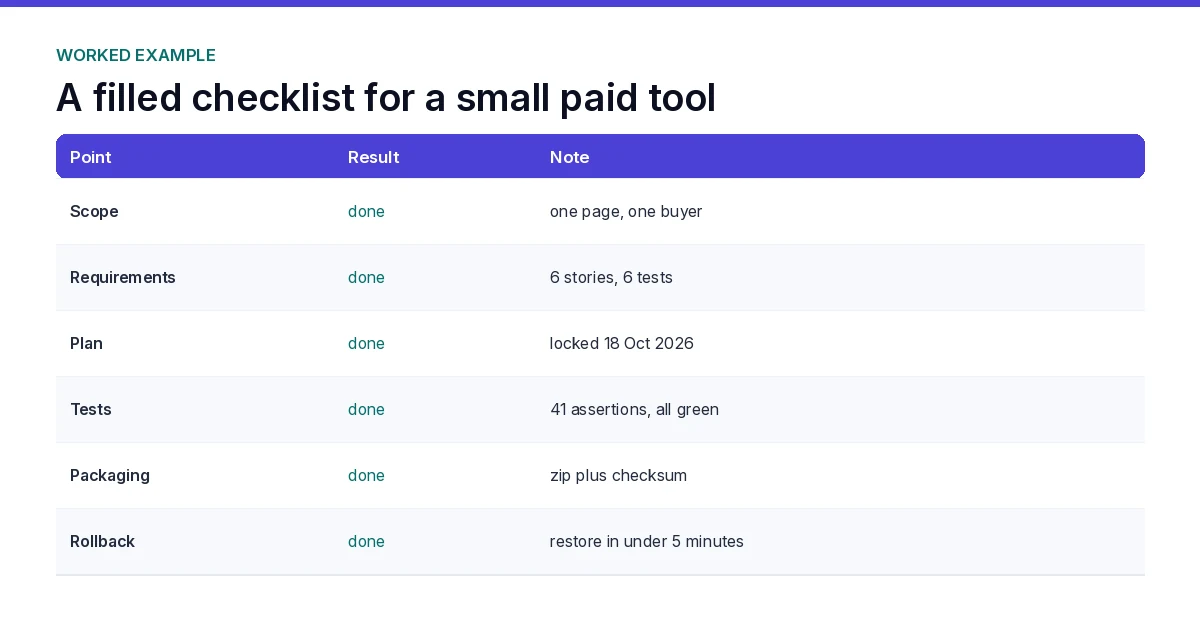
Let me walk the ai software development checklist on a real mini-project so the shape sticks: a contact-form endpoint for a small site.
Outcome: a form that validates input, sends email through the existing mailer, and rejects spam without breaking accessibility. Dated requirements: WordPress 6.x current release checked on the build date, mailer API limits noted, Node version pinned for the build tooling. Plan lock: three tasks, endpoint, validation, spam guard, each with a test named before implementation.
Task execution: one commit per task, diffs read for extras, the spam guard got rewritten once because the first version added a hidden field that broke screen readers. Tests: nine assertions across validation and delivery, counts written into the release note. Security: no secrets in code, outbound call to the mailer only, rate limit note added. Docs: the readme gained the two setup steps the first tester stumbled on. Packaging and rollback: this was a site change, so rollback was the previous plugin version stored in the repo, one paragraph.
The whole run took two focused hours, and the ai software development checklist is the reason nothing got skipped in the middle. When the form shipped, the release note already had every answer a support question could ask.
FAQ
What is an ai software development checklist?
It is a ten-point gate list for AI-assisted builds: outcome, requirements, plan lock, tasks, diff review, tests, security, docs, packaging, and rollback. Each point is answered with evidence before release.
How long does it take per task?
About an hour for a normal task once your test suite runs fast, and that includes filling every evidence line in the ai software development checklist. Small scripts take minutes. Large tasks should be split until they fit the checklist comfortably.
Do I need all ten points for a small change?
For throwaway scripts, no. For anything with users, data, or your name on it, yes. The cheap subset is outcome, plan, tests, and rollback, but the full ai software development checklist becomes the default the moment real users appear.
Where do I keep the checklist?
In the repo as CHECKLIST.md, ticked per release, with evidence paths written next to each line of the ai software development checklist. Keep it versioned with the code it governs.
How is this different from a testing checklist?
Testing is point 6. This checklist covers scope through rollback, so the tests verify the right thing and the release has a way back.
Can the checklist catch security issues fully?
It catches leaks, hard-coded secrets, and unexpected network calls in review. It is not a substitute for a dedicated security audit on sensitive products.
What happens when a point fails?
The release waits, the defect becomes one bounded fix task, and the failed point re-runs after the fix. No skipping, no overrides without a written note. A failed point is the ai software development checklist catching what it was built to catch.
Ten points, one hour, zero rework excuses. Print the ai software development checklist, run it on your next build, and keep the evidence where your next session can find it. For the same gates wired into a plan-lock loop with a ledger, the engine page on this site shows that shape end to end.