
An ai code generation testing process turns model output into a release you can sign off on. You write the criteria, capture a baseline, run the pyramid, and record what each test proved.

Nothing ships on a model verdict alone.
The nine steps run in a fixed order: write acceptance criteria, capture a baseline, run the test pyramid, scan the static surface, test boundaries, run regression with evidence, build the test matrix, report and recover from failures, then validate the package and deliver a release verdict. Each step produces an artifact the next step consumes, which is what lets the ai code generation testing process survive a release gate. The demo runs green; the release needs proof.
Pick one narrow module for your first run. A single endpoint, a small utility function, or a short script. Small scope keeps the baseline honest and the test matrix readable. Once the process holds on a small job, you scale it.
Why the ai code generation testing process exists
Ad-hoc testing checks what feels obvious. That is exactly how models hide their weak spots. Three failure shapes appear again and again.
First, plausible output. The model writes code that reads correctly, runs without error, and produces a result that looks right. The edge cases never appear because nobody wrote them down.
Second, untested assumptions. The code assumes the input is clean, the provider returns a stable shape, and the dependency does not change. Each assumption is a landmine.
Third, no evidence record. A test passes, the model says done, and there is no artifact showing what was tested and with what data. When the release gate asks for proof, there is nothing to show.
The governed loop fixes this. The ai code generation testing process replaces feeling with a written test plan, a captured baseline, and a verifiable evidence log.
Step 1: Write the acceptance criteria
An ai code generation testing process starts with acceptance criteria that name the exact behaviour, the inputs, and the outputs. A vague goal becomes a guessing game. A written goal becomes a testable contract.
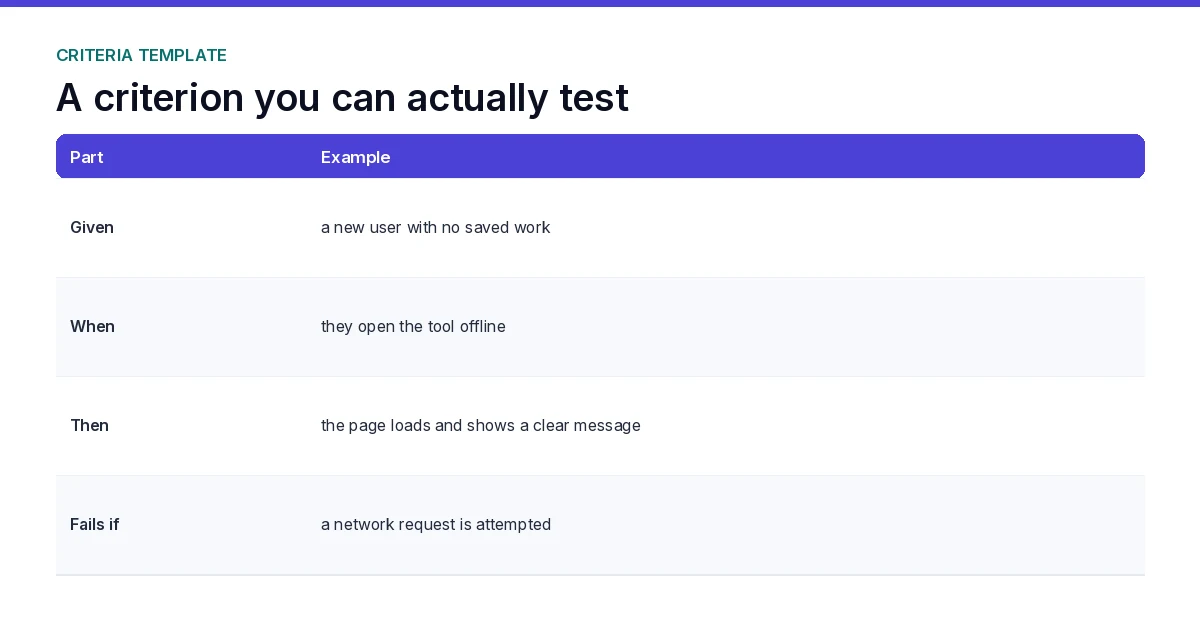
Write the criteria before the code. Name the user, the job, the input shape, the output shape, the error behaviour, and the boundaries. Review the criteria with one other person when you can. A second reader catches fuzzy lines you stop seeing after the third read.
Example of a vague criterion: Build a text tool. Example of a written criterion: Given a plain text file, return a JSON array of unique words sorted by frequency, reject files larger than 5MB, and return a 413 error with a readable body when the limit is exceeded.
The criterion becomes the test index. Every later test maps back to a line of the criterion. If a test does not map anywhere, skip it, because a test with no criterion behind it just pads the numbers.
the seven step AI coding workflow
Step 2: Capture a baseline
Step 2 of the ai code generation testing process is the baseline: a known-good input and its expected output. The model can regress on nothing; it cannot regress on a recorded reference. The baseline is your canary for drift.
Capture at least three baselines: a happy path, an edge case, and a failure case. Record the exact input, the exact expected output, the date, the runtime version, and the test command. The date matters because provider changes and dependency updates can silently alter behaviour.
If no golden data exists, generate one from a known reference implementation or a carefully hand-computed example, and record the source. When you review the baseline months later, you need to know where the numbers came from.
Step 3: Run the test pyramid
Step 3 of the ai code generation testing process is the test pyramid: it keeps the feedback loop fast and the coverage honest. The base is fast local tests. The middle is integration tests. The top is a few end-to-end checks.
Start with unit tests. Every acceptance criterion maps to at least one unit test. Mock the provider so the test does not depend on network, quota, or keys.

The unit suite runs in seconds and catches logic errors immediately.
Next, integration tests. These exercise the real provider call or the real file system. Keep them separate from unit tests because they are slower and need keys, quota, or network access.
End with one or two end-to-end checks. These prove the module works inside the real application. They are expensive, so use them sparingly. The pyramid is a guideline: most tests stay fast and isolated, while the risky parts get a few real-world checks.
Step 4: Add static analysis and security scan
Step 4 of the ai code generation testing process adds static analysis and a security scan: both catch what dynamic tests miss, such as style, structure, and dangerous patterns. Run the linter and the scanner inside the process, with the same weight as any failing test.
Check for unused variables, unreachable branches, and missing error handling. Map your findings against the OWASP Top Ten so the security review works from a standard reference instead of a memory test. Scan for secrets, unsafe deserialization, and known vulnerable dependencies. The scan output is evidence, and the release log should record it with the version of the scanner and its config.
Static analysis finds the cheap bugs. Your tests find the behavioural bugs. Use both.
Step 5: Test boundary and invalid input
Step 5 of the ai code generation testing process goes after the edges. Model output is usually benchmarked on happy paths while the release gets decided by boundary values, so boundary testing targets the edges of your input space and the invalid inputs that should be rejected.
Test empty inputs, maximum-length inputs, unicode, decimal precision near a limit, and missing optional fields. Test negative numbers and zero where only positive is expected. Test output values at the exact boundary of your promised range.

Invalid input must be rejected with a clear error, never with a silent failure or a misleading success. If the criterion says reject files larger than 5MB, then a 5MB plus one byte file must return the documented error. The rejection is the contract you wrote in Step 1, enforced exactly at the edge.
Step 6: Run regression and capture evidence
Step 6 of the ai code generation testing process is the regression run plus the evidence that goes with it. A regression run proves the new code did not break existing behaviour, and the rule is simple: no regression run, no release. Record the run time, the result, the coverage line, and the failing tests if any.
The evidence log is a file or a page that lists the test results, the baseline, the static analysis, the coverage, and the release decision. When someone asks why the release broke, the log is the answer. It is written for a human first and a script second, so a future reader should open it and understand within five minutes what was tested, what passed, and what did not. Never write a log that only a script can read.
the release verification checks
Step 7: Build the test matrix and read it
Step 7 of the ai code generation testing process builds the test matrix, the record of which tests run under which conditions. The matrix is the map of your coverage: it shows what is tested, what is missing, and what is blocked.
The matrix columns are the test dimensions: input type, provider model, runtime version, dependency version, and environment. The rows are the test cases. A cell that is empty is a gap. Mark blocked cells with the reason: no key, no network, no quota. A matrix that only lists passing tests hides the gaps.
Re-read the matrix before the release verdict. If a cell is empty where the criterion says it should be covered, close the release and fill the gap. The matrix is the decision tool, and an empty cell carries the same weight as a failing test.
Step 8: Failure reporting and recovery
Step 8 of the ai code generation testing process is failure reporting and recovery. When a test fails, the failure report names the test, the input, the expected output, the actual output, and the hypothesis. The hypothesis is where you guess the cause. The recovery is the bounded fix, followed by a re-run of the same test plus the regression suite.
Never fix a failure by editing the test. Never widen a criterion to pass a test. Fix the code or the contract, then re-test. The failure report is evidence too; it shows what broke, why, and how it was fixed.
Step 9: Package validation and release verdict
Step 9 of the ai code generation testing process closes it out: package validation and the release verdict. Package validation proves the deliverable installs and runs as shipped, so clean-install the package, run the smoke test, and check the artifact size and structure. If the package does not install on a clean machine, it is not a release.
The release verdict is the final gate. The verdict is an owner decision, never a model output. The owner reads the evidence log, the matrix, the test results, and the failure reports. If the evidence is complete and green, the owner approves. If anything is missing or red, the owner stops the release.
the twelve check release checklist
Demo chunk
The demo shows the pipeline of the ai code generation testing process: acceptance criteria screen, baseline table, unit test results, integration run, static scan, boundary test, regression pass, and release verdict. Every screen is MOCK until the owner verifies it against staging, and the demo label appears on the plan-lock and checkpoint screens.
Limits honest
Live model runs need credentials and carry charges. Demo runs need no key and are labeled NON_PRODUCTION_DEMO, and rate limits and quota still apply. The whole ai code generation testing process runs on the same honesty rule: a mocked pass proves design, and only a live check proves the wire. Add the real provider checks after the mock passes.
Idea-to-income example
A solo builder wants a text tool for writers. The criteria name the plain file input, the unique-word frequencies, the 5MB limit, and the readable error. The baseline stores the sample file, the expected JSON, and the exact test command. The pyramid covers the algorithm with unit tests, the file reader with integration tests, and the page with one end-to-end check. Static analysis and a boundary test catch the 5MB-plus-one case, and the evidence log and test matrix close the release. The password intelligence case study follows the same ai code generation testing process on a shipped build, from first criterion to release verdict.
the password intelligence case study
Full walkthrough: the ai code generation testing process on one small task
Run the nine steps against one genuinely small task: a function that reads a plain text file, counts the unique words in it, and rejects anything larger than 5MB. Here is what each step produced for a real solo release.
Step 1 produced a one-line criterion. Given any plain text file up to 5,242,880 bytes, return a JSON object mapping every unique word to its count, and return a 413 error with a readable message above the limit. The criterion names the input, the output, and the exact boundary value.
Step 2 produced three baselines. The happy path was a 12KB sample file with 1,843 unique words and its expected JSON. The edge case was a file containing nothing but whitespace. The failure case was a file at 5,242,881 bytes, one byte over the limit. Every baseline recorded the Python 3.12 runtime, the date, and the exact pytest command.
Step 3 produced 14 unit tests and 2 integration tests. The unit calls mocked file reads and ran in under two seconds, the integration calls read the real fixture files, and one end-to-end check ran the function through the upload page.
Step 4 produced a scan report: one unused variable, no embedded secrets, and no vulnerable dependency. The unused variable got removed before the regression run, and the fix is recorded next to the scan output.
Step 5 produced four boundary results. The empty file returned an empty JSON object. The file at exactly the 5MB limit processed without an error. The file at one byte over returned the 413 message. A file full of unicode text produced correct counts for 312 non-ASCII words.
Step 6 produced the regression run: 16 passed, 0 failed, 91 percent coverage, logged with the timestamp, the command, and the coverage line.
Step 7 produced a matrix with one gap: the whitespace-only file had a unit test against mocked reads and no integration test against a real file. The gap became a new integration test before the release verdict.
Step 8 handled the only real failure of the day. The unicode baseline failed on the first run because the tokenizer split the file at byte boundaries and landed in the middle of a multibyte character. The failure report named the test, the input, the split offset, and the fix: decode the bytes as UTF-8 before splitting. The re-run passed, and the report stayed in the log.
Step 9 produced the verdict. A clean install into a fresh virtual environment, one smoke run against the 12KB baseline, and an owner sign-off on the evidence log.
Total cost was one focused afternoon, and the artifacts stayed with the module. When a follow-up change adds a stopword filter two weeks later, running the full ai code generation testing process again costs an hour, because the criteria, the baselines, and the matrix are already written.
FAQ
What is a test process for AI-generated code?
The ai code generation testing process is a written sequence of steps that turns model output into a release you can sign off on. It adds acceptance criteria, a baseline, a test pyramid, static analysis, boundary tests, evidence capture, and a release verdict.
How do I write acceptance criteria?
Name the user, the job, the input shape, the output shape, the error behaviour, and the boundaries. Write it before the code. Review it with one other person. If it cannot be written in one line of a test, it is too vague.
What is a baseline in AI testing?
Inside the ai code generation testing process, a baseline is a known-good input and its expected output, recorded with the date, runtime version, and test command. It is the canary for regression: the model cannot drift against a recorded reference.
Why is a test pyramid right for AI output?
The pyramid keeps fast, isolated tests at the base where most feedback happens. The risky real-world checks sit at the top. This keeps the feedback loop fast while still proving the module works in production-like conditions.
What evidence should I capture?
Capture the test results, baseline, static analysis, coverage line, test matrix, failure report, and release verdict. The evidence log is the memory of the ai code generation testing process, and it is written for a human: a future reader should understand the result in five minutes.
When should I not trust automated tests?
When the tests run against mocks only. Mock tests prove design, not network behaviour, which is why the ai code generation testing process adds real provider checks before release. And never trust a test that was written after the code; write tests first, then code.
Summary
The ai code generation testing process is simple. Write the contract. Capture the baseline. Run the pyramid. Scan the static. Test the edges. Record the evidence. Check the matrix. Report the failure. Package and release. The model writes the code. You keep the gates.
Start with one narrow module this week. Run the full ai code generation testing process once. The evidence log is your proof, and the next release is easier every time you repeat the sequence.
Test matrix (example)
The matrix below is what step 7 produced for the walkthrough task, with the missing whitespace row now closed.
| Test case | Unit | Integration | E2E | Static | Boundary | Evidence |
|—|—|—|—|—|—|—|
| Happy path | Yes | Yes | Yes | Yes | No | Log |
| 5MB plus one byte | No | No | No | Yes | Yes | Log |
| Empty file | Yes | Yes | No | Yes | Yes | Log |
| Whitespace only file | Yes | Yes | No | Yes | Yes | Log |
| Unicode input | Yes | Yes | No | Yes | Yes | Log |
Evidence snapshot (MOCK)
## TEST EVIDENCE LOG
Date: 2026-10-18
Module: text-tool
Test command: npm run test
Results: 47 passed, 0 failed
Coverage: 88%
Baseline: saved at baselines/sample-2026-10-18.json
Static scan: clean (running-scan v4.2.1)
Release verdict: APPROVED (owner: A. Khan)
(demo label: NON_PRODUCTION_DEMO)