
AI coding automation and a governed workflow look similar from the outside. Both take prompts and emit code. Inside, they run differently: automation optimizes for speed of output, governance optimizes for confidence in release. This piece compares them across five differences and says plainly when automation is the wrong choice.
The difference matters because the wrong mode fails quietly. Automation ships fast until a dependency drifts; governance ships slower until a gate catches the drift early. Neither is universal; the job decides. This governed AI workflow vs automation comparison is written so you can pick the mode by stakes, not by habit.
Summary
A governed AI workflow vs automation comparison comes down to gates, state, and who answers for the release. Automation buys the fastest draft; governance buys the highest odds that shipped code keeps working after the demo ends. Use the five differences below in order: starting point, state, verification, gates, and failure cost.
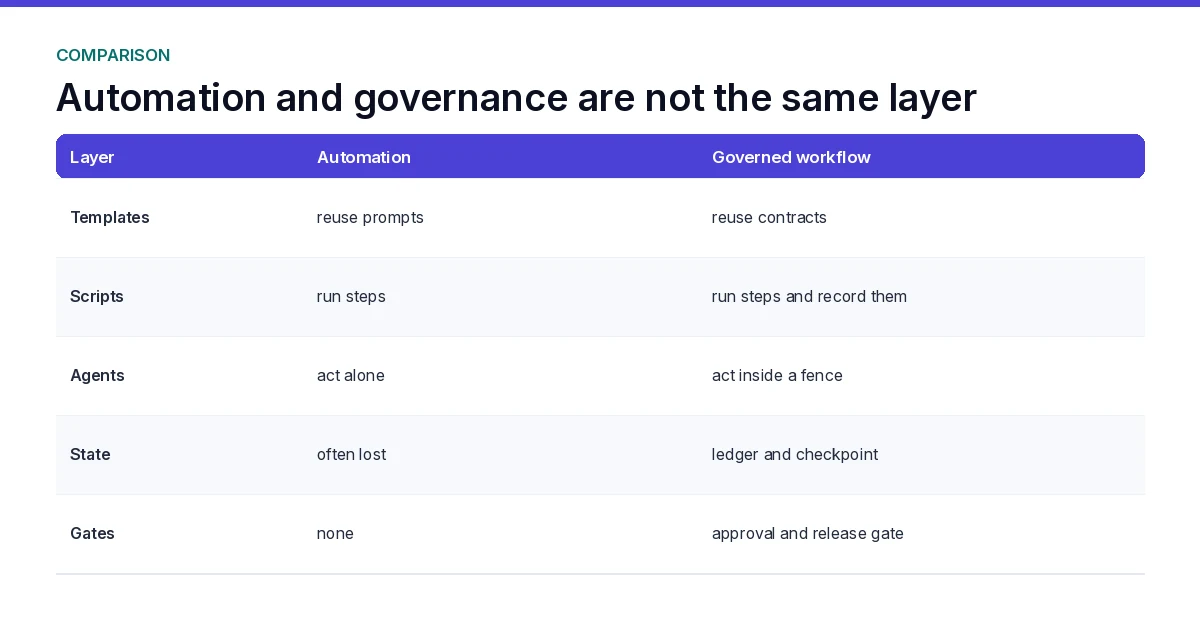
Difference 1: how work starts
Automation starts with a prompt and hopes the model fills the gaps: file structure, dependencies, edge cases, tests. The model improvises, and improvisation compounds across files. One generated file may look fine; five generated files may not agree with each other.
A governed workflow starts with a plan: tasks, inputs, outputs, acceptance tests, guards. The model executes bounded tasks inside the plan instead of inventing the project. Where automation asks “what should this do?”, governance asks “what did we agree it should do, and how will we know it worked?”
The difference between the governed ai workflow vs automation approaches shows up in the first merge conflict and the first production rollback. The governed ai workflow vs automation choice is not about tools; it is about where the gate sits in the chain.
the seven step AI coding workflow
Difference 2: state and recovery
Automation treats each session as fresh. Context drops, limits hit, and the next answer may contradict the last without either side noticing. There is no resume point except re-prompting from scratch.
A governed workflow keeps state outside the chat: task notes, checkpoints, ledger entries with hashes. When a run stops, work resumes from the last good point instead of restarting. In this governed AI workflow vs automation comparison, state is the earliest separation point: after a day of work, a fresh-context session charges a restart tax every time.
Difference 3: verification
Automation verifies by vibe: the code looks right, the demo ran once, the model said done. Tests may exist or may not; edge cases are discovered by users.
Governance verifies by gates: clean build, full suite, edge inputs, secrets scan, artifact checksum, reviewer verdict. Each task ends with a gate, and gates block release until evidence exists. In the governed AI workflow vs automation debate, verification decides whether a demo result still holds two weeks later. Gates are the mechanism, not optional ceremony. The same build, test, and release ordering is spelled out in the linked guide.
the release verification checks
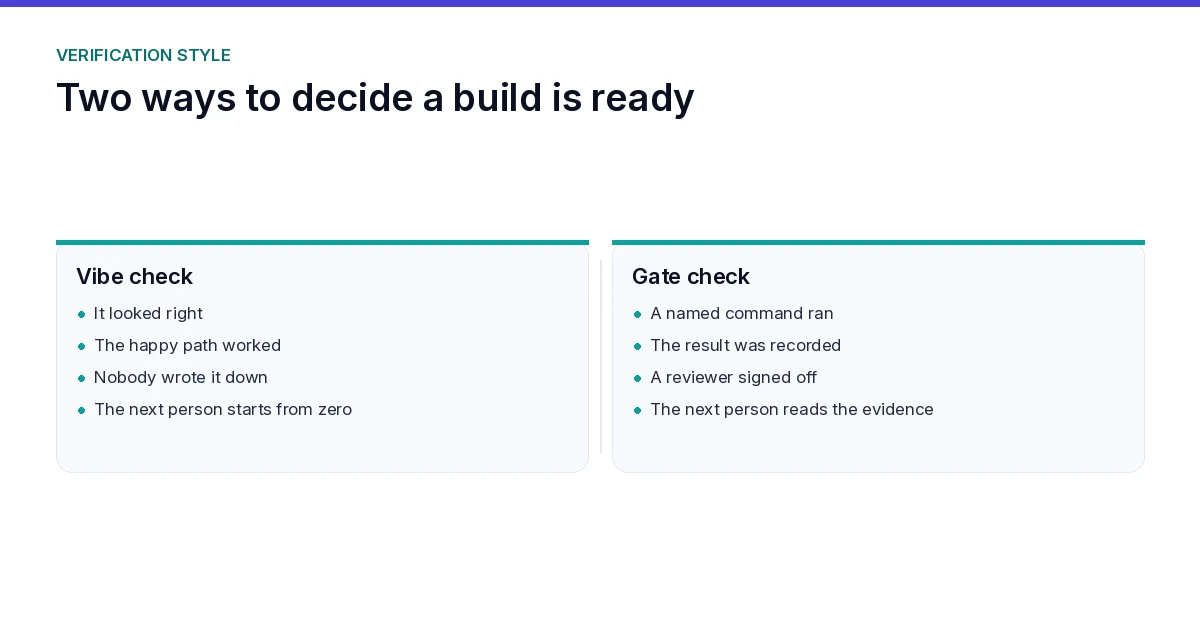
Difference 4: gates and approvals
Automation has no stopping point built in. It runs until the task is “done” as the model defines done, which may not match your definition.
Governance inserts gates before implementation moves forward: plan lock before code, verify gate after each task, re-audit after fixes, release verdict before ship. A gate can say no, and saying no is its job. When deadlines press, gates are the first thing teams drop, and the first thing they regret after a bad release. In the governed AI workflow vs automation split, a mode with no veto over shipping is not a governed mode, whatever the workflow calls itself.
Difference 5: what fails and how
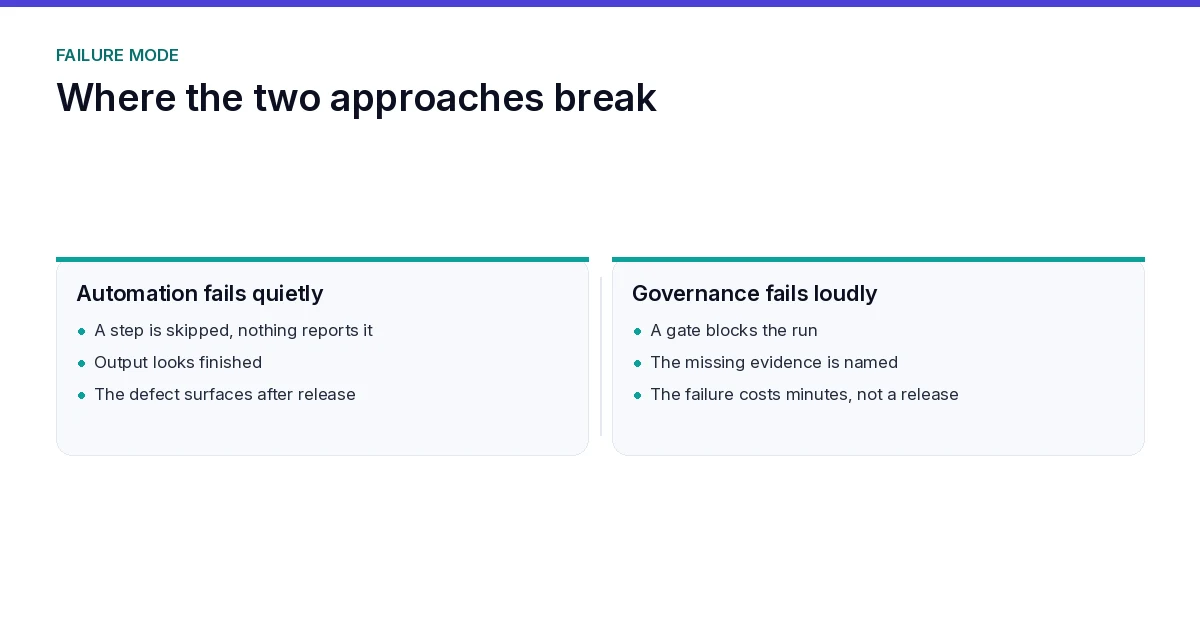
Automation fails quietly: subtle logic errors, missing error paths, dependencies added without review, secrets in logs. The failures surface after users hit them, which is the most expensive time to learn.
Governance fails loudly at the gate: build broken, test red, edge case crashed, secret found. The cost is paid before release, when fixes are cheap. Neither mode prevents all defects; automation concentrates them in production, governance concentrates them in review. These failure classes are why the governed AI workflow vs automation comparison leans toward governance once code is user-facing. For injection, broken access control, and secrets in logs, the OWASP Top Ten list is the baseline a gate set should map against.
Governed AI workflow vs automation: when not to automate
Do not automate when the task touches money, user data, or legal requirements without a human gate in the loop. Do not automate when the requirements are still changing faster than the model can track them. Do not automate when the team cannot read the diff, because a workflow nobody can audit is automation in disguise. The governed AI workflow vs automation rule for such work is short: stakes you cannot afford to eat go through a gate.
Governance is also overkill for throwaway scripts and one-line probes. Match the mode to the stakes: automation for exploration, governance for release.
Real scenario: same build, two modes
The same feature, a user password reset endpoint, lands in both modes. In automation the prompt covers “write the reset endpoint,” the model generates routes, a controller, basic validation, and a send-email call. A PR is opened within an hour. Because nothing locked the shape, the controller mixes token verification and database writes in one function. The tests cover the happy path. The client demo passes. Twelve hours later a support user reports reset links that never reach the inbox; the email service returns an unhandled promise the model never saw. The fix is a rewrite.
In governance the same endpoint starts as a plan: task 1 design the token table, task 2 write the controller with separate verification and email steps, task 3 add tests, task 4 scan for secrets, task 5 reviewer verdict. The token ledger records hashed IDs. The verify step checks each gate before moving on. The email step uses a provider client the governance tool already sanitizes. The secret scan finds a placeholder API key in the config file and the gate blocks the release. The developer fixes it in fifteen minutes while the build is still green. The client gets a clean demo on the first pass.
What differs between the two runs is blast radius, not output volume. Automation makes a single prompt look like a complete result. Governance makes the same prompt look like one step in a chain where every link is checked before the next one starts. That is the governed AI workflow vs automation choice in practice: speed now with rework later, or speed later with rework avoided. When the feature touches passwords, the governed side has a worked example: the password intelligence case study documents token handling, hashing, and email deliverability checks end to end.
the password intelligence case study
Cost and speed reality
Automation claims speed. It does deliver the first draft fast. It does not deliver a reliable release. A governed workflow spends time up front in planning and gating, which slows the first commit. The trade-off pays back when the work is more than a prototype: each gate replaces a debugging session, each audit replaces a postmortem. Measured honestly, the governed AI workflow vs automation trade is that automation wins the first commit and governance wins the third rework cycle.
The honest numbers come from measuring, not from marketing. Measure cycle time per task, not per session. Record the time from prompt to first commit, and from gate failure to green build. Automation often wins on the first metric for disposable work and loses on the second for anything user-facing. Governance wins on the second metric every time, at the cost of a slower first commit.

What neither mode can fix
Automation cannot remove provider costs, quotas, or rate limits. Multi-model consensus and auto-social collection are not native features here; live-provider runs need credentials and carry charges. Governance cannot guarantee correctness; it raises the odds and leaves a trail.
Demo mode proves the demo path only, labeled NON_PRODUCTION_DEMO wherever it appears. KPI-style promises like “70-hour to 8-hour compression” belong in marketing, not in engineering plans. Measure your own cycle time per task and let that decide.
Neither mode replaces a human who reads the diff. Neither mode replaces a reviewer who knows the product’s intent. Neither mode replaces a manager who can say no to a bad release. Those are the parts of the governed AI workflow vs automation comparison that no template can do for you.
Common mistakes
Automate release-critical paths without gates. That turns governance into a slower version of automation with no audit trail.
Governing exploration until nothing ships. Advice and spikes are cheap; gate them accordingly.
Mixing modes silently. Label each task: explore or govern, and run the matching process.
Skipping the guard when the deadline presses. Gates are the first thing teams drop and the first thing they regret.
Every mistake on that list traces to one root: treating the governed AI workflow vs automation decision as a mood instead of a check. Label each task first, then run the matching process.
Key decision: three quick checks
Before starting any task, run three checks. First, what is the stake? If the answer is disposable, automation is enough. If the answer is money, data, users, or reputation, the task moves to governance. Second, what decides the diff? If only the author reads it, automation may fit. If a reviewer and the future reader must audit it, governance does. Third, what is the stopping point? If the model decides “done” and you agree by habit, add a gate. If the task has a clear yes or no and you are willing to say no, a gate is already waiting for you.
This is the governed ai workflow vs automation comparison in practice: every task gets the right mode, and every mode gets the right guard.
The hybrid pattern
Most real teams end up using both, deliberately. Explore with automation: spike ideas, generate drafts, explore APIs. Govern the ship: plan-lock the final shape, gate every task, audit before release. The hybrid keeps speed where it is safe and control where it matters. Inside a single project, the governed AI workflow vs automation boundary shows up as a label on every task: explore or govern, written down before the prompt.
The risk is mixing them silently: automating release-critical paths without gates, or governing exploration until nothing ships.
Limits of both modes
The honest limit of the governed AI workflow vs automation framing itself: a gate raises the odds of a clean release, it does not certify good code, and no workflow setting lowers what providers charge per run.
A hybrid decision table for choosing mode
Use this table before starting any task. Read it as the governed AI workflow vs automation comparison compressed into rows: match the task characteristics to the mode, not to the team’s mood.
| Task characteristic | Explore (automation) | Ship (governance) |
|—|—|—|
| Goal | Learn if an idea is possible | Release code others depend on |
| Output needed | Draft, spike, example | Tested, reviewed artifact |
| Stakes | Low, disposable | Money, data, users, reputation |
| Who reads diff | Author only | Author + reviewer + future self |
| State needed | Chat memory enough | Ledger, checkpoints, next-task note |
| Gate required | None | Plan lock, verify, release verdict |
| Allowed to fail | Yes, cheaply | No, failures gated |
When governed wins, and when plain automation wins
Governed wins when the output ships: user-facing endpoints, billing changes, data migrations. Plain automation wins when the output is disposable: API probes, draft copy, throwaway spikes, scripts that exist to be deleted. In this governed AI workflow vs automation split, the deciding question is who pays for a failure.
Gates that actually block
In the governed AI workflow vs automation build, this is where governance becomes real: a workflow without blockers is a suggestion list nobody enforces.
A gate works only if it can stop the pipeline. A verify gate that warns but does not pause is a suggestion, not a guard. The release verdict gate must have an owner who can say no and a process that honors that no. Teams that treat gates as decoration get the results those teams earned with automation: fast, and fragile.
Three gate types deserve a standing place in the plan. The plan lock gate freezes the task shape before code is written. It catches scope drift early, when a changed requirement is still cheap to edit. The verify gate runs after each task and checks that tests pass, the build is clean, secrets are absent, and the diff is legible to a reviewer who was not in the chat. The release verdict gate decides whether the artifact is safe to ship, and it is the last chance to stop a bad release. The gate set above mirrors a software release checklist, and the link holds the itemized version.
the twelve check release checklist
The right tool for the right task
Not every task needs the same machinery. A probe that asks whether an API exists needs no plan lock and just enough state to resume if it stops. A task that changes how users are billed needs the full chain: plan lock, separate verify and email steps, secrets scan, and a reviewer verdict. The governed ai workflow vs automation choice is made one task at a time, and it is reviewed at every gate.
State and recovery in practice
State lives in the task ledger, not in the chat. Each task notes its input, output, and the gate result. A checkpoint records the last good point. When a run stops, the next session resumes from the checkpoint instead of re-reading a conversation that has lost its context. The state is simple, but it is what makes long builds survivable and what separates a governed workflow from a chat that dies with the session. Recovery speed is the quiet half of the governed AI workflow vs automation comparison: it stays invisible until the day a build dies at hour nine.
Each ledger row stores its gate result beside the test evidence from that task, so the testing process is part of the record rather than an afterthought.
FAQ
What is the difference between an automated AI workflow and a governed AI workflow?
The difference is verification and state. Automated workflows take a prompt, emit output, and move on; they have no built-in stopping point, and a run can end when the model says it is done rather than when a check passes. Governed workflows use explicit gates: plan lock before code, verify after each task, re-audit after fixes, release verdict before ship. Governance also keeps state outside the chat with task notes and hashed checkpoints, so a stopped run resumes instead of restarting. In short, the governed AI workflow vs automation difference is evidence: one mode emits output, the other emits checks the output must survive.
When should a team automate and when should a team govern?
The governed AI workflow vs automation split runs on stakes. Automate exploration: spikes, drafts, API probes, throwaway scripts. Govern anything that touches money, user data, legal requirements, or release to production. Low, disposable work can be automated; work others depend on should pass through a gate.
Can an automated workflow become governed?
Yes, and that is usually the right shape. Start a task as automation to explore and generate a draft. Once the shape is agreed, switch to governance: plan-lock the final form, gate every task, audit before release. The risk is mixing them silently, so label each task. In governed AI workflow vs automation terms, one project can hold both modes as long as every task knows which mode it is in.
How do gates actually stop a bad release?
A gate interrupts the workflow. A verify gate checks that tests pass, the build is clean, secrets are absent, and the diff is legible before implementation moves forward. A release verdict gate decides whether the artifact is safe to ship. Each gate can say no, and that is the point: speed is wasted by a ship that fails after release.
How does this article stay factually honest?
Every claim is made against a measurable behavior or a known limitation: gates block release, demo mode is labeled NON_PRODUCTION_DEMO, no provider cost or rate limit is claimed as removed, and no KPI compression number is presented as fact. The governed AI workflow vs automation comparison above is written as claims a reviewer can re-run, not as product marketing.