
Find local business leads by working from pages that were built to list them. A chamber of commerce listing, a trade association member page and a town business index all publish names, addresses and websites on purpose, and none of them asks you to log in. Read three of those pages with care and you have a working list for the week.
The short answer: you find local business leads by naming the area you serve, choosing one public page that lists businesses inside that area, reading each business’s own site, and checking the phone number and address before you record them. The listing gives you the names. The company site gives you the evidence. A purchased database gives you neither a source nor a date.
That order matters. A row without a source URL cannot be checked, and a local list that cannot be checked goes stale within a month. The five steps below take about two hours for the first fifteen names, and they hold up on the hundredth. They are also the sequence I use in a town I have never worked in before.
What are the five steps to find local business leads?
The sequence is the method. Skip a step and the list still looks fine, which is exactly the problem.
- Define the area you serve and write the place names down.
- Choose one public page that lists businesses inside that area.
- Read each profile page and the links it publishes.
- Check the phone number and the address against the company’s own site.
- Build a working list with a source URL and a date for every field.
Local business prospecting gets easier in week three, when the list already exists and you are only adding to it. The first attempt to find local business leads is the expensive one, because every decision is new.
Step 1: draw a service area map before you search
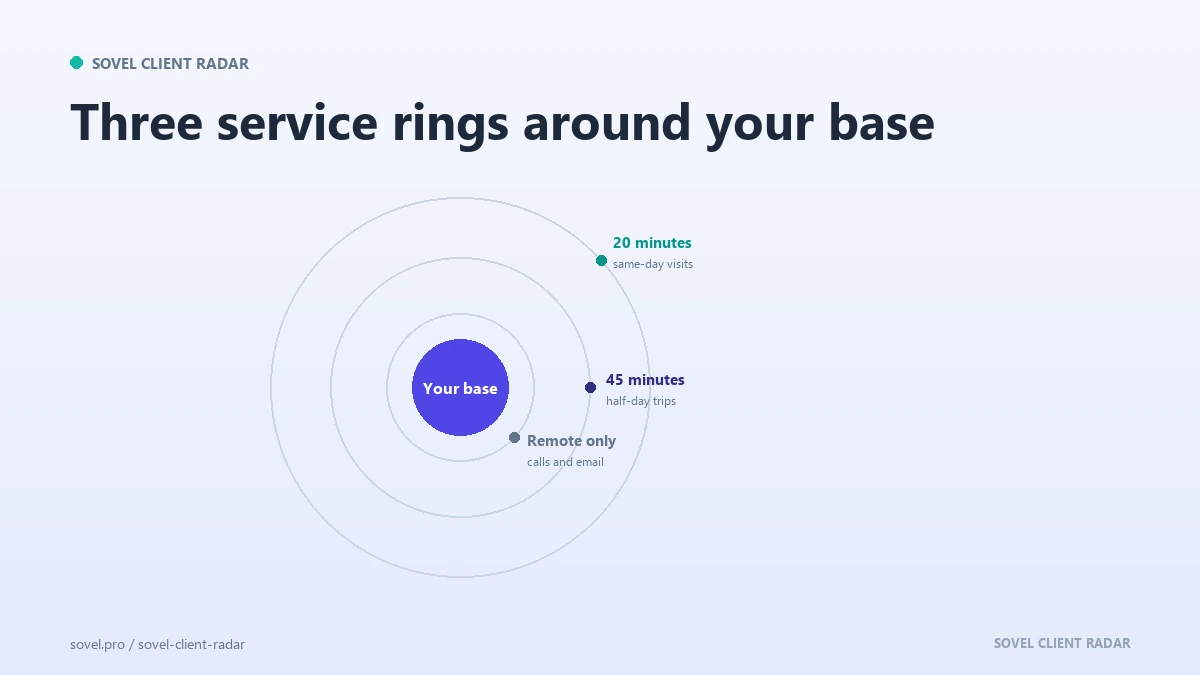
A service area map is the first thing to build before you try to find local business leads. Draw three rings around the place you work: the spots you can reach in about twenty minutes, the ones forty-five minutes out, and everything you would only serve remotely.
Then write the place names inside each ring. Write the six suburbs and three towns you would actually drive to, not the city name. That list becomes the location input for every search you run afterwards, and it stops the drift that turns a local list into a national one halfway through an afternoon.
A named town can be checked. A radius on a map cannot. Two businesses on the same street can sit in different council areas, and one of them may already be served by someone you know. Drawing the service area map first is the plain answer to how to find local clients without guessing at a boundary you never defined.
Keep the inner ring for the first month. A tight area produces shorter drives, more repeat visits and easier referrals, and it makes local business prospecting a habit you can keep on a Friday afternoon. It is also where most people find local business leads worth a call, because a twenty-minute drive makes the first meeting easy to arrange. Widen the ring only when the inner one is exhausted.
Step 2: name the page that lists local businesses
Three page types do most of the work, and each one reaches a different kind of business. Choosing between them is the first decision in how to find local clients in a town you have never worked in.
A chamber of commerce listing names its members, usually with a website link, a town and sometimes a phone number. Membership costs money, so the businesses on it are active enough to pay for visibility. It is also the fastest place to find local business leads in a town where you know nobody.
A trade association member list is smaller and more specific. A federation of master builders or a regional dental group publishes the businesses that hold a licence, an accreditation or a place in the trade. The list is short, which means you can read all of it.
A town or district business index covers the shops that never join a trade body. A local newspaper, a business improvement district or a tourism board often keeps one, and it is usually the densest source for retail and hospitality.
Check three things before you trust any of the three. Does each row carry a website link? Does the page show a last updated date? Does it list a town per member? A page that fails all three is a flyer, not a source, and it will not help you find local business leads that survive a second look.
Record the page URL, the section you read and the date. When a colleague asks where a name came from, the answer is a link rather than a memory.
If you run the route through SOVEL CLIENT RADAR, the seed-page option takes that URL directly. The engine follows up to twelve same-host profile pages, treats the external links as candidate businesses, and drops rows that point back at the directory itself. A page that blocks the request is recorded as a blocked seed and the run continues without it. That is how you find local business leads on a network where a search engine answers with an anti-bot page instead of results.
Step 3: read the profile and the links it publishes
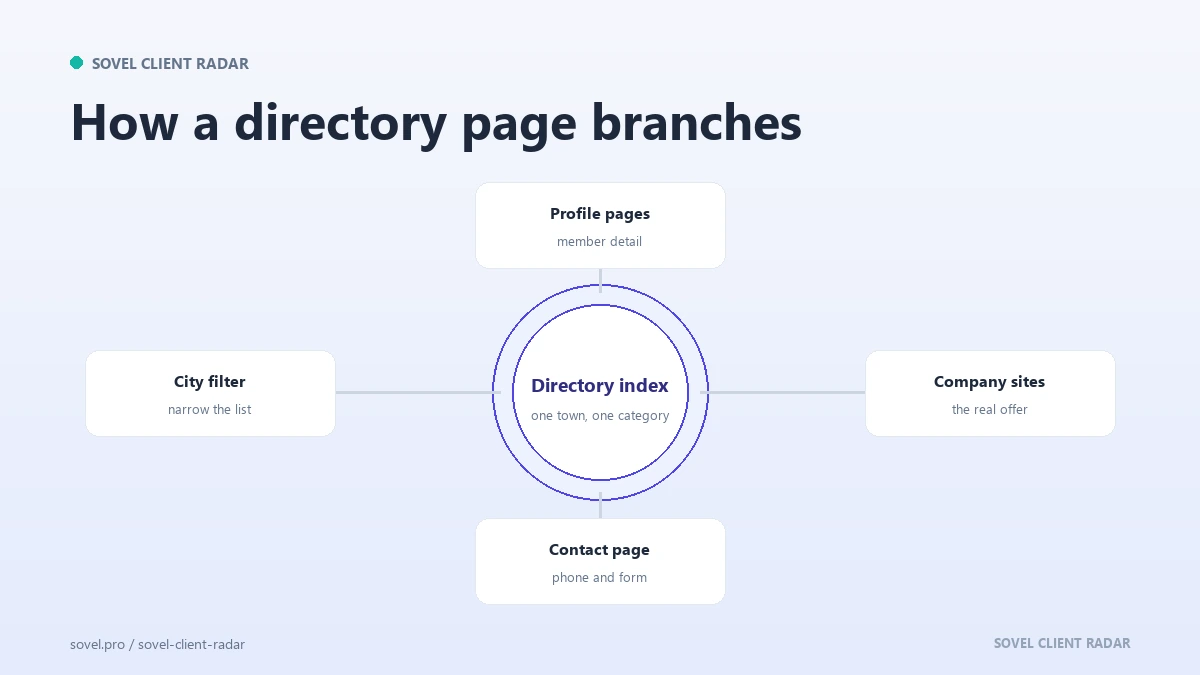
Every listing you use to find local business leads has two halves. The profile page is a summary written by the directory. The company site is the source. Read both, then decide which one to trust for each field.
On the profile, take the name, the category, the town, the phone number, the website and any date the page shows. On the site, take the services page, the contact page, the team page, the blog and the footer.
The footer usually carries the registered company name, and that name is what you need when two listings look like one business or one business looks like two.
Watch for the mismatch. A profile that says emergency plumbing and a site with no phone number anywhere is a lead with a problem you can name in the first line of an email. A site with one page per service and nothing about the town is a different problem, and it is the one described in the topical authority guide: thin coverage of the subject the business claims to own.
Read the links the profile points to, including supplier, partner and sister company pages. A member page that links to a supplier, a partner or a sister company gives you a second name and a reason to mention it. Two directories that list the same business with different addresses tell you the business moved and did not update one of them. Both details are the reason to slow down when you find local business leads from a directory, because the second name is often warmer than the first.
That comparison is the whole job. Anyone can copy a name. Finding local business leads that are worth writing to means reading enough to notice the difference between a business that publishes carefully and one that abandoned its site in 2019.
Step 4: run phone number verification on every row
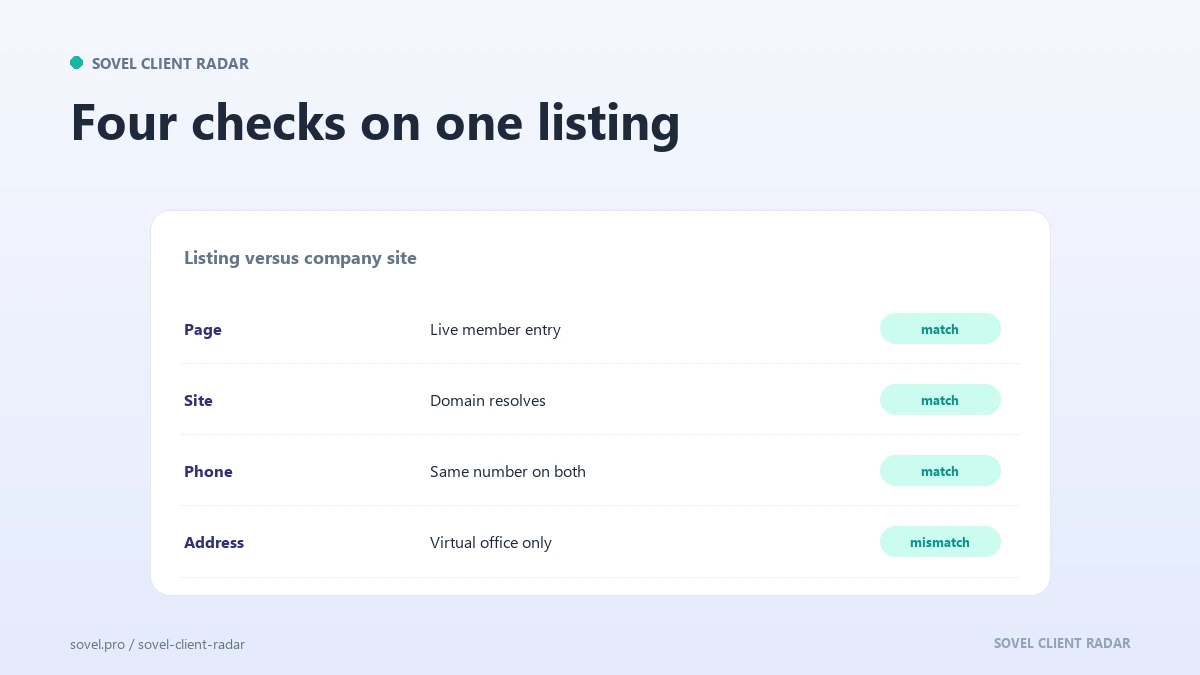
Phone number verification is cheap, and most lists skip it. It is also the step that separates a list you can defend from a list of names somebody copied in a hurry to find local business leads. Three checks, about a minute per row.
Digit count and country code first. A number written as 020 7946 0958 and the same number written as +44 20 7946 0958 are one line, and a list that keeps both has a duplicate that will cost you a second email.
Local match second. An area code from another region is a warning. It can be a call centre, a virtual office, or a trader who moved two towns over and never updated the listing.
Source third. A number on the company’s own contact page beats a number on a five-year-old directory. When the two disagree, the company page wins and the directory row gets a note.
Then call once, in business hours, and say who you are. A number that rings out three times in a week is not a contact. Phone number verification is also the step that protects your reputation, because the first thing a stranger hears should not be the wrong company name.
Step 5: build a working list you can defend
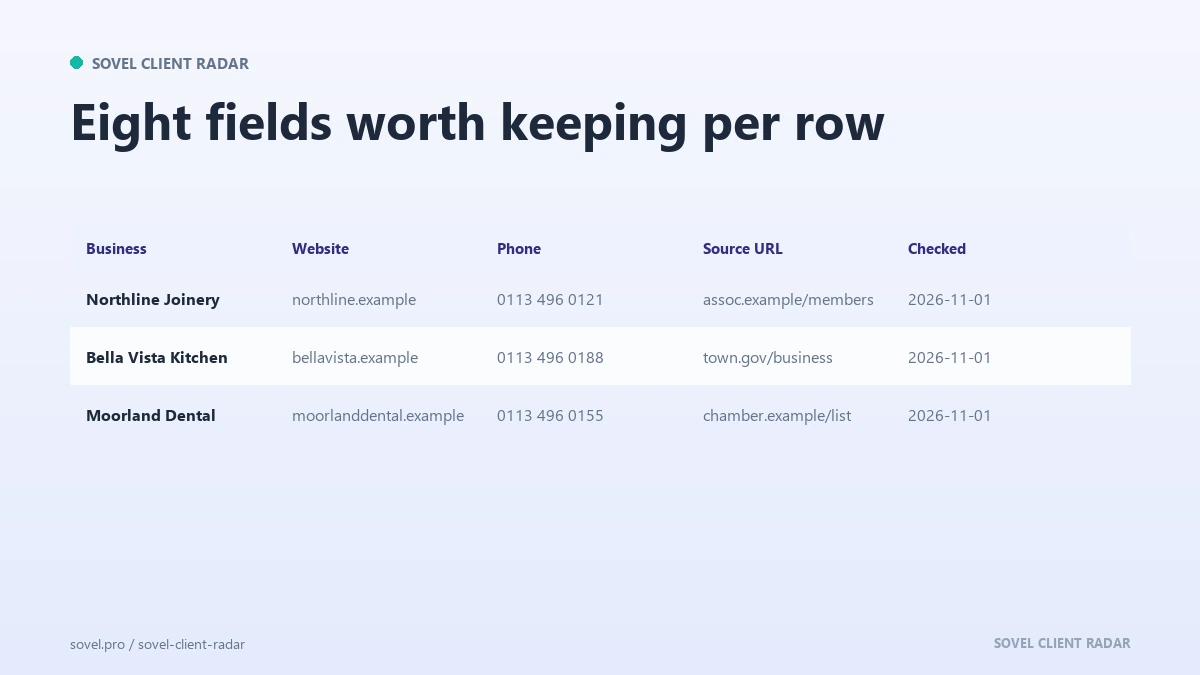
Eight columns are enough to hold every row you collect when you find local business leads: business name, domain, town, phone, source URL, retrieval date, one sentence of context, and a status.
One row per domain. When two directory entries describe the same business, keep the stronger source and note the second.
The context sentence has to be something you saw. “Added a bathroom showroom page in March” is context. “Probably needs marketing” is noise, and noise is what makes an email sound like a template with a name pasted into it.
Status uses six words: new, checked, contacted, replied, parked, dropped. That small vocabulary is what stops you writing to the same plumber twice in a fortnight.
Which local discovery route should you start with?
Three routes cover most local markets, and the choice changes how you find local business leads in practice.
| Route | What it gives you | Effort | Watch out for | Best for |
|---|---|---|---|---|
| Chamber of commerce listing | Members with a website and a town | Low | Membership skews to established firms; some lists sit behind a member login | Service businesses in one town |
| Trade association member list | Businesses that already pay for their trade standing | Medium | Broad coverage, thin local detail | Trades, clinics and studios with an accreditation |
| Town or district business index | Dense local coverage, including small shops | Low | Stale rows and duplicates | Retail, hospitality and personal services |
Start with the route that names a town on every row. That single field lets you find local business leads in a defined area rather than a whole country, and it makes a list sortable, comparable and easy to divide between two people.
If the town is small, a roundup article such as a local best-of list works as a fourth route. Read it the same way: the names are candidates, and the linked sites are the evidence.
Once the list exists, the harder question is which of those businesses is worth a pitch. The local SEO prospecting guide covers six signals to check before you write anything.
What are the common local traps?
Six of them, and every one shows up in a list built in a hurry by somebody trying to find local business leads before lunch.
A parked domain. The site resolves to a holding page or a for-sale notice. Drop the row.
A hidden address. Service-area businesses hide a home address on purpose. Verify by phone instead, and never put a street address in your notes that the business does not publish.
A franchise page. The local page belongs to the brand and the owner is not named. Treat the franchise as one buyer with a corporate gate, or leave it alone.
A duplicate under an old trading name. The business renamed, the directory did not.
A closed business. A listing from 2019 for a shop that now houses something else. The company’s own site is the only reliable check, and a site that redirects to a booking platform is usually a business that has been absorbed. Checking that one row is worth more than ten new names when you find local business leads in a town that has changed since the directory was printed.
Two businesses, one number. A pair trading under two names from one unit. One row, two brands, one contact.
Google’s own guidelines for representing a business are worth reading once. A profile that breaks them, with a name stuffed full of keywords or an address that does not exist, usually belongs to a business that has been edited by someone careless. That mismatch is a reason to look closer. It is never a fact to copy into your list.
Should you call or email a local business?
Call the ones with a phone number and no contact form. Email the ones with a named person and a published address. That split covers most local businesses, and it saves the awkward week spent writing to a shop that has never read its own inbox. It also fixes the order in which you find local business leads: the research comes first, and the channel follows the evidence.
Local business prospecting is unusual because the phone still works. A plumber answers between jobs. A restaurant does not. Read the site to see which one you are dealing with: a booking form and opening hours suggest email, a mobile number and a service list suggest a call.
Either way, the first line comes from the research. “You added a second showroom in March” works on a call and in an email. “I help businesses like yours grow” works on neither.
How do you keep the list fresh?
A refresh calendar beats good intentions, and it is the only way to find local business leads that still trade. Check the inner ring monthly, the middle ring quarterly, and anything you are about to write to on the day you write.
The refresh is cheap. Reread the source page, confirm the site still loads, and confirm the phone number has not changed. Three minutes per row, and the row either keeps its date or gets dropped.
If you use the engine, a repeat run of the same topic returns only names you have not seen before, so a monthly run adds new businesses instead of repeating the old ones. The local business prospecting habit then becomes maintenance work, which is the only kind that survives a busy month.
Which edition fits your work?
Three lifetime licences run the same engine, and the difference is how much ground you cover in one run when you find local business leads for several towns.
If your patch is one town and a spreadsheet on Friday afternoon, Personal at ₹5,999 is enough: 50 leads per run on one machine. If you work a whole county and want the optional AI second opinion on each lead, Pro at ₹12,999 raises the cap to 200. If you run local campaigns for several clients at once, Agency at ₹39,999 gives five machines and 500 leads per run.
Every edition includes the full feature set, and none of them limits how many runs you make in a day or a month. The SOVEL Client Radar product page lists what each licence contains. If you plan to start from more than one directory, the directory prospecting walkthrough covers profile pages, external links and domain deduplication.
FAQ
Where do I start if I have no list at all?
To find local business leads for the first time, pick one town and one member list. Copy ten members into a spreadsheet with the source URL and the date, then check each website before you add a phone number. Ten verified rows are enough for the first week.
Are Google Maps results usable for this?
Read them as a cross-check, not as a source you copy wholesale. A profile confirms the business exists and shows the name it trades under. The phone number and address still need checking against the company’s own site, and a map listing should never be the only URL in your record.
How many local leads should I collect per area?
Fifteen to twenty verified rows for a single town is a working month. That is enough to find local business leads for a steady round of conversations. More than that and you stop reading the sites properly, which defeats the purpose. Add a second town before you add a second hundred rows.
Do I need an API key to find local business leads?
No. Chamber lists, member pages, town indexes and company sites are public pages, and the seed-page route reads them without a key or a login. An optional search key exists for a wider index, but it is off by default and paid by you at the provider.
How do I check a phone number quickly?
Before you use a row to find local business leads, compare the digits and the country code, check the area code against the town, then confirm the number against the company’s contact page. Finish with one call during business hours.
What about franchises and multi-location businesses?
Treat the brand as one buyer and the local branch as an address. A franchise is the one case where you cannot find local business leads from the branch page alone. The owner or the marketing lead usually sits at head office, so a message to a branch inbox rarely reaches a decision maker.
How often should I refresh a local list?
Monthly for the streets closest to you, quarterly for the wider area, and once more on the day you plan to send anything. A list refreshed on send day is the cheapest way to find local business leads that still exist.