
Local SEO prospecting starts where a local business list ends. You have twenty names in a spreadsheet and no idea which three deserve an email. The six signals below answer that question from public evidence: a Google Business Profile nobody updates, a phone that waits too long for a usable page, a location page that names a town and says nothing about it.
The short answer: local SEO prospecting is the work of reading a local business’s public presence for signs that it is losing visibility in local search, then ranking the businesses by how many signs you can show. Six signals carry most of the decision: the profile gap, mobile page speed, missing local schema markup, thin location pages, ignored reviews, and a site that stopped changing.
None of the six needs a paid tool. Each one leaves a URL, a screenshot or a quote, which is what separates a finding from an opinion about a website.
What makes a business a local SEO buyer?
Three conditions have to be true before a name belongs on your shortlist. The business serves a defined area, its website is meant to produce enquiries, and there is a visible gap between the two. That is the filter every step of local SEO prospecting applies.
A plumber with a service page, a phone number and a town is a buyer. A software company with a global site is not, even if its design is dated, because it does not compete for a map result in one place.
The third condition is the one that decides the order. A business with every signal already fixed is a poor prospect for this service, and local SEO prospecting should push it down the list. The strongest prospect has the most visible gaps that someone can fix in a month.
Where the list comes from is a separate job. The find local business leads playbook covers collection, from chamber pages to town indexes. This article starts after the list exists.
How do you find local SEO clients in one trade?
Pick one trade and read its public pages once. A trade body, a supplier page and a local roundup list the same businesses from three angles, and the overlap between them is your starting set.
The question of how to find local SEO clients gets easier when the trade has a small number of obvious places where its members gather. Accountants have institutes. Dentists have associations and equipment suppliers. Restaurants have districts and delivery platforms. Choose the trade where you can name three sources from memory.
Collect thirty names, then run the six checks on ten of them. That ratio matters, because local SEO prospecting rewards depth on a short list, and a hundred unchecked names produce nothing you can send.
If you sell to several trades, run them one at a time. Mixing trades in one list makes the comparison meaningless, since a restaurant profile and a solicitor profile carry different expectations and different gaps.
That is the short answer to how to find local seo clients at the start of the work. The rest of this article covers which of those names to keep.
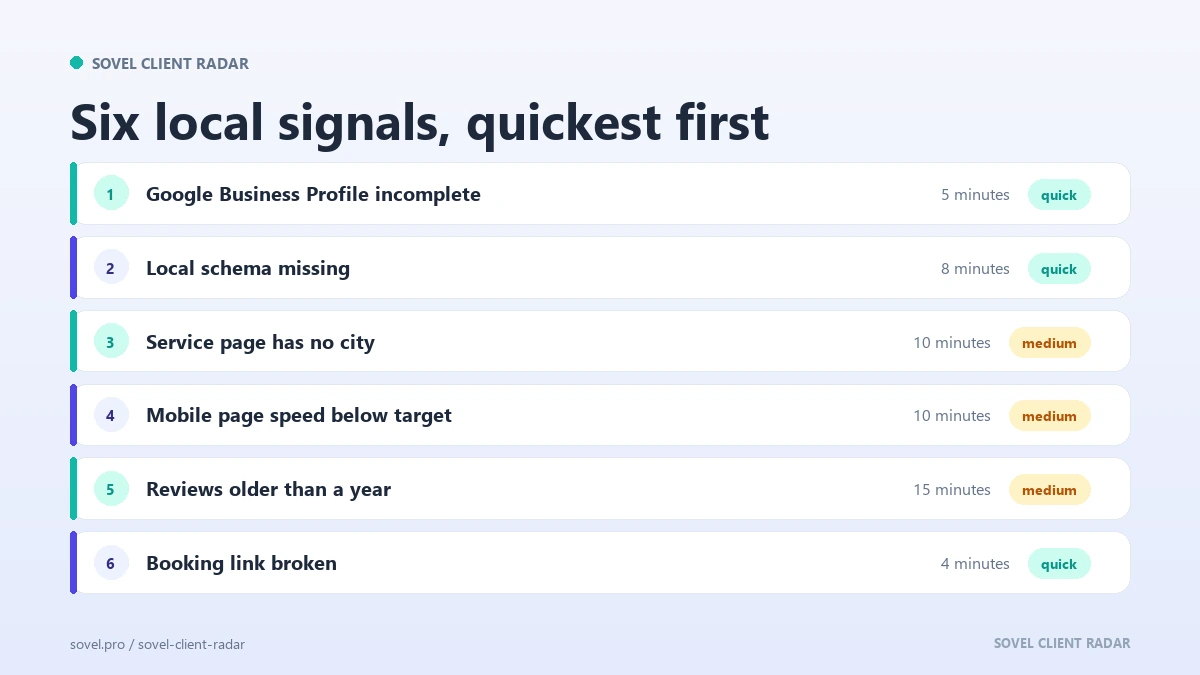
Signal 1: the Google Business Profile gap
The profile is the cheapest signal to read in local SEO prospecting, and the one owners ignore most often.
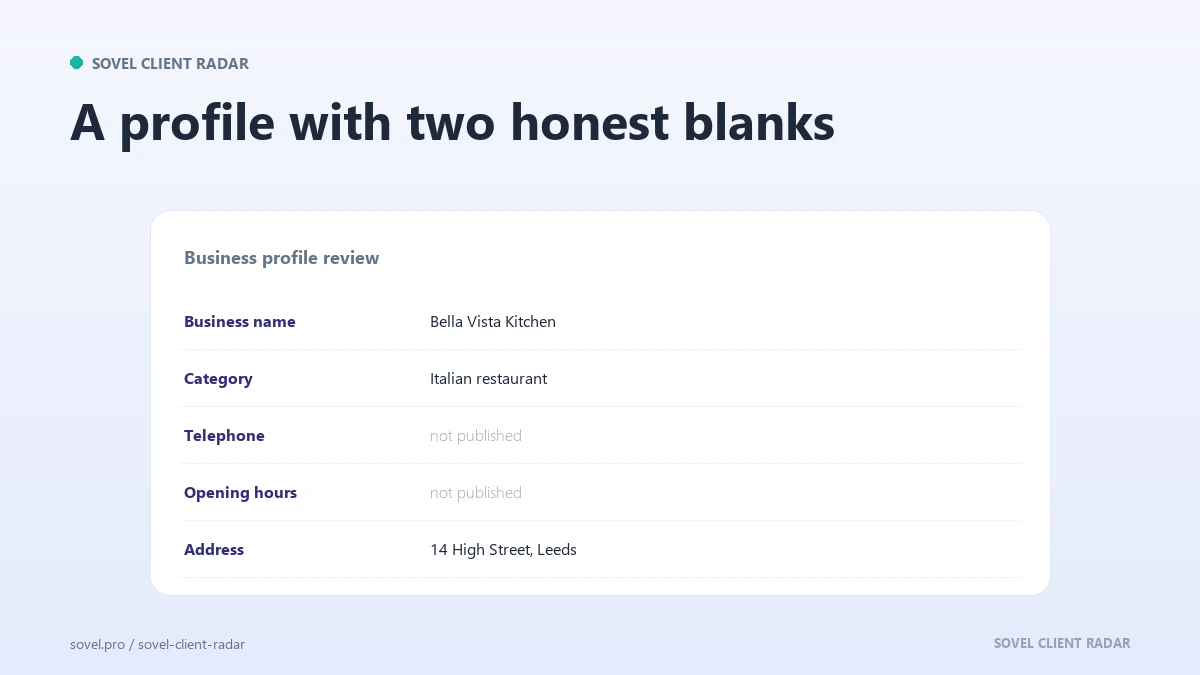
Open the profile and check five things: the primary category, the opening hours, the photo count and the dates on those photos, the posts, and the questions section. A profile with one old photo, no hours, no posts and unanswered questions is a profile nobody maintains, and for a business that depends on nearby customers, that is a visible problem.
The Google Business Profile also tells you whether the name and address match the company’s own site. A profile that breaks the platform’s own rules, with a keyword-stuffed name or an address that does not exist, belongs to a business that has been edited by someone careless. That mismatch is a factual opener rather than an insult.
Treat the gap as a reason to talk, not a diagnosis. The owner may be busy enough not to care, and knowing that before you write is worth more than a clever subject line.
Signal 2: mobile page speed
Load the site on a phone, on mobile data, away from office wifi. Count the seconds until the page is usable, then scroll: does the layout jump, is the phone number reachable without pinching, does the form take a minute to fill?
Mobile page speed is the signal clients feel the moment you show them a screen recording. A free page speed test or a browser performance panel gives you a number, and the number matters less than the comparison with a competitor two streets away.
Record the URL, the device, the network, the time to a usable page, and a screenshot of the slow state. When a customer taps a result and waits, the business pays for that wait in lost calls, and the payment is invisible on the owner’s side.
That invisibility is the sales argument. A slow site does not send an error report to the owner, and local SEO prospecting is often the first time anyone shows them the delay on their own phone.
Signal 3: missing local schema markup
View the page source and search for the business type and the address fields. If neither appears, the site is telling search engines less than it could about a real, physical business.
Local schema markup is the machine-readable description of the business: name, address, phone, hours, coordinates and the type of business. The LocalBusiness type on schema.org lists the properties that carry weight, and each one has a plain equivalent on the visible page.
Four checks cover it. Is there any LocalBusiness markup at all, does it include the postal address, does it match what a visitor sees, and does it appear on location pages or only the homepage.
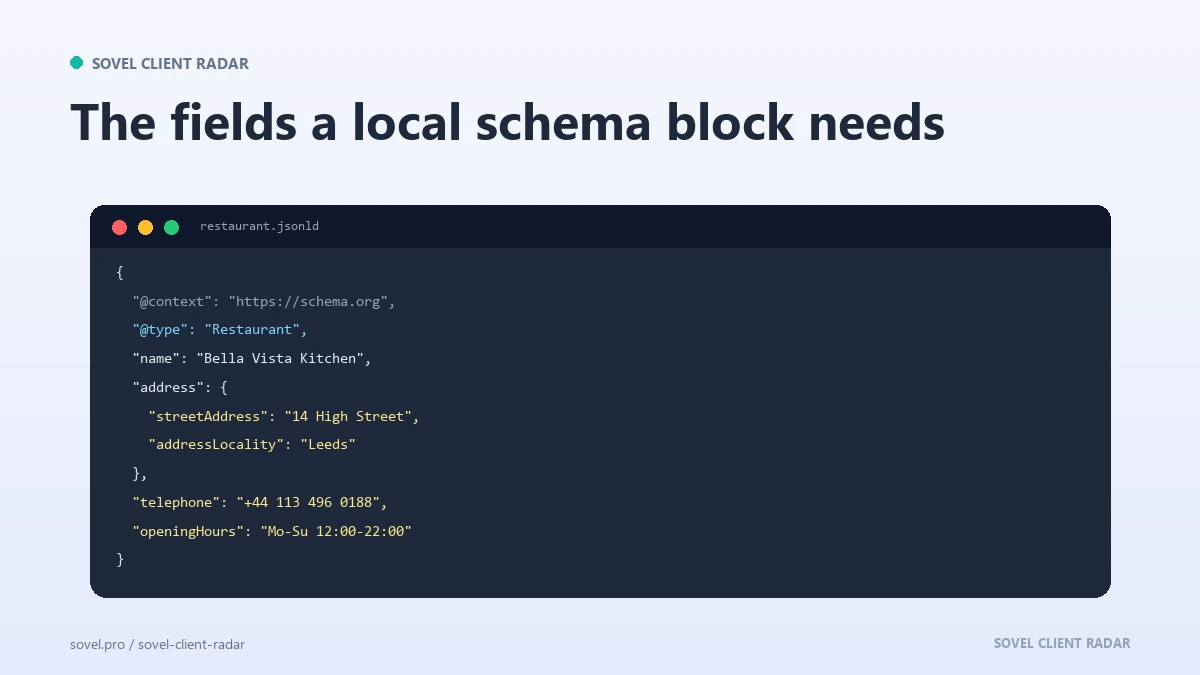
Missing markup is clean and verifiable, which is why it belongs early in any local SEO prospecting shortlist. Mismatched markup is better still, because a schema block that names one phone number while the page shows another changes how the business appears in search results and in AI answers. The same reading habit sits behind AI answer work, where a machine has to understand the entity before it can recommend it.
Signal 4: thin location pages
A business with five branches and one page that lists them all has a page problem. Each location needs its own page with its own address, phone, hours, photos, staff and directions.
Count the locations the site claims, count the location pages that exist, then read one. A page that repeats the same paragraph with the town name swapped is the page this work was invented for, and you can quote the sentence in the email without being rude.
The test is simple: does the page say anything that is only true of that place? Parking, the nearest landmark, the local team, the services that sell in that area. If the answer is no, the page is a placeholder and the business is paying for a page that cannot rank. That finding is the most persuasive one in local SEO prospecting, because it is a page the owner already paid to build.
Signal 5: review response gaps
Reviews are public, which makes this the fastest signal to confirm and the easiest to show.
Read the last ten reviews and note which ones have a reply. A long review history with no replies tells you the owner is not watching. Replies to praise that ignore complaints tell you something sharper: someone is posting without reading.
A business with a handful of reviews and a considered reply on each is doing the work, and that business is a harder sell. Put it lower and move on.
Add the response time to your record when the page shows it. A reply that arrived four months later is a detail a client will recognise, and it is the kind of detail that makes local SEO prospecting feel personal to an owner who still remembers the complaint.
Signal 6: site freshness
Open the blog, the news page and the footer. Note the last post date and the copyright year, then check the services page for anything that names a season, an offer or a year that has passed.
A site whose newest content is three years old is a site the owner stopped investing in. That does not prove the business is failing, and it does not prove the owner will buy, which is why freshness is the weakest of the six signals on its own.
Pair it with one of the other five before you use it. Freshness plus missing schema is a story about a site nobody maintains. Freshness alone is a sentence about a calendar, which is why it sits last in any local SEO prospecting checklist.
What if the business has no website at all?
Then five of the six checks have nothing to read, and the name needs a different offer. A business with a profile, photos and hours but no site is trading entirely inside a platform it does not control.
That is still a lead, and it is often an easy first conversation, because the profile proves the owner already cares about being found. Local SEO prospecting should tag that row as a website project and route it to the person who sells one, rather than sending a schema audit to a business with no pages.
Write the row down either way. A name that fails one offer is often the right name for another one six months later.
The six signals side by side
Read the table as a checklist, because local SEO prospecting rewards evidence you can show rather than points you can add.
| Signal | How to check it | What it means | Strength |
|---|---|---|---|
| Profile gap | Read the profile fields, photos, posts and questions | The business is not managing the surface customers see first | High |
| Mobile page speed | Load the site on a phone and time it | Visitors leave before the page is usable | High |
| Missing local schema | Search the source for the business type and address | Machines get less information than the page already shows | Medium |
| Thin location pages | Count locations, then read one page | Each branch competes with a placeholder | High |
| Review response gap | Read the last ten reviews and the replies | Nobody is watching the public conversation | Medium |
| Site freshness | Check the blog, the footer and the offers | The site stopped being maintained | Low on its own |
No single row closes anything. Local SEO prospecting works by stacking evidence, and the stack is what you put in front of the owner: three findings, each with a URL and a date.
Two signals on one business is a conversation. One signal is a hunch, and a hunch in an email reads like a template.
How do you record a signal so it survives scrutiny?
Four fields per signal: what you saw, the URL where you saw it, the date you looked, and a screenshot or an exact quote. That record is the product in local SEO prospecting, because the client can check every line of it.
The quote has to be real. A sentence you half remember is worse than no sentence, and a screenshot of a page that changed last week is a liability. Capture the state at the time you looked.
SOVEL CLIENT RADAR stores each signal with its class, weight, source URL and retrieval date, writes them to a signals file beside the lead spreadsheet, and shows the strongest one in the report. The pain score behind the ranking comes from the gaps it actually found on the homepage: no blog, no schema, no sitemap, no machine-readable summary file. When a check did not finish, the note says so instead of claiming the gap. That habit is what makes local SEO prospecting repeatable across a hundred names.
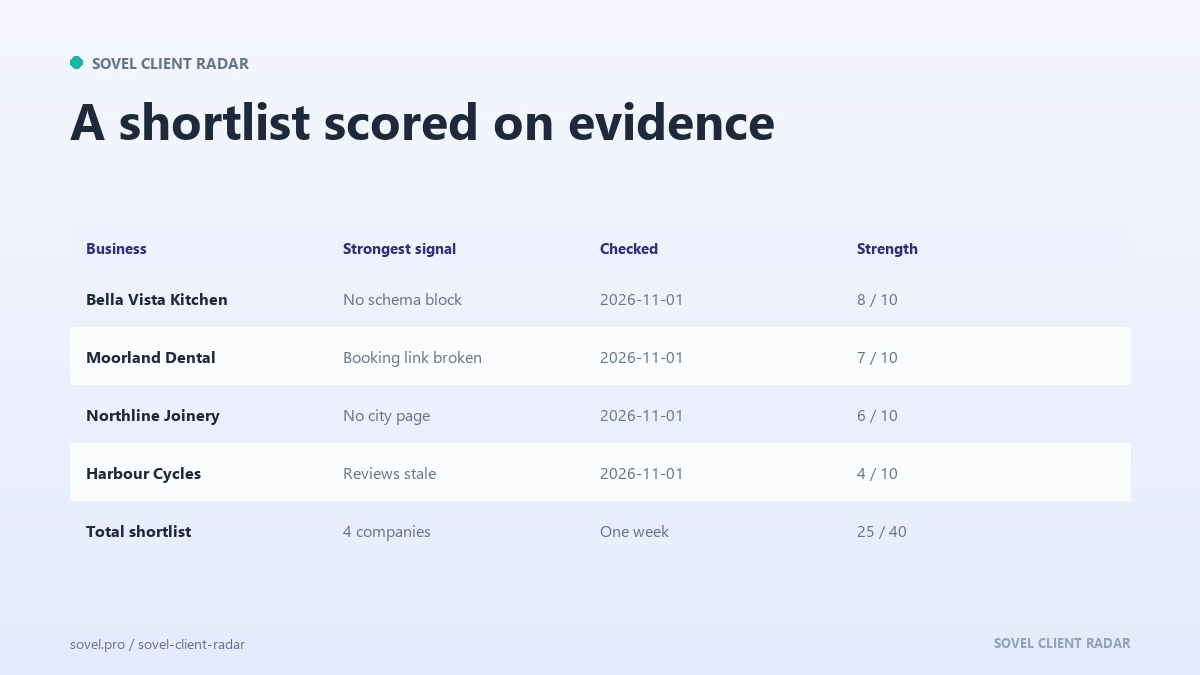
How many signals before you pitch?
Three. One signal is a hunch, two is a conversation, three is a case. That line is the whole of local SEO prospecting in one sentence.
The three do not have to be the same three. A thin location page plus a slow phone plus no replies is a strong opening for a multi-branch retailer. A missing schema block plus an old blog plus an unclaimed profile is a strong opening for a single-location clinic.
Then apply the reverse rule. If a business has a fast site, complete markup, a maintained profile and replies on every review, drop it. Local SEO prospecting gets faster when you decide quickly that a name is not a buyer.
Should you run a local search audit before you write?
Yes, in a one-page form. A local search audit is the short version of local SEO prospecting: three findings with a URL and a consequence each, not a forty-slide deck.
The full audit comes after a reply. Before that, it is unpaid work for a stranger, and the detail usually scares people rather than persuading them. A short local search audit also protects you, because thin findings make a thin audit, and you learn that before you spend a day on it.
Keep the same six checks in the same order every time. A repeatable local search audit is what lets you compare two businesses honestly, and it is the fastest way to explain the work to a client who has never bought it.
Which edition fits your work?
Signals are only useful if they are recorded, and the recording is where software earns its place. Local SEO prospecting at ten names is a spreadsheet job. At two hundred names, it is a filing problem, and the filing is what breaks first. SOVEL CLIENT RADAR reads each candidate’s homepage, contact page, sitemap and machine-readable files, scores the leads on fit, pain, reachability and timing, and writes the evidence beside every claim.
The licence tiers differ in seats and in how many leads one run can return. A solo consultant who checks a handful of towns fits Personal at ₹5,999 with 50 leads per run. A small studio working a county fits Pro at ₹12,999 with 200 leads per run. A team running local campaigns for several clients fits Agency at ₹39,999 with five machines and 500 leads per run. Every edition includes the AI layer, which stays off until you add your own provider key, and every edition is a one-time licence with no daily or monthly run limit.
The SOVEL Client Radar product page has the full comparison. When the audit turns into a design conversation, the website redesign leads guide covers the visual signals that sit next to these.
FAQ
What does local SEO prospecting actually mean?
Local SEO prospecting is the step between collecting local business names and writing to them. You check each business’s public presence for signs of weak local visibility, record the evidence, and rank the names by how many fixable problems you can show. It uses public pages, so it needs no login and no paid seat.
Which of the six signals matters most?
The profile gap and thin location pages carry the most weight, because both are visible to the customer before they ever reach the site. Mobile speed comes next. Schema markup and review replies are supporting evidence, and freshness only counts when it sits beside another signal.
Can I check these signals without paid tools?
Yes. A browser, a phone and a spreadsheet cover all six. Paid rank tracking and crawl tools save time on large sites, but a business with one location does not need them, and the free checks leave better evidence because you saw the page yourself. That is the whole toolkit for local SEO prospecting at small scale.
How many signals should I find before pitching?
Three is the working number. One signal is a hunch and reads like a mail merge. Three signals with URLs and dates read like homework, and homework is what gets a reply from an owner who has heard from ten agencies this month.
What about franchises and multi-location businesses?
Treat the brand as one buyer and each branch as an address. The local pages are usually templated, so thin location pages are common and easy to prove. Franchises are also where local SEO prospecting pays best, because one agreed fix repeats across every branch. The decision usually sits with a marketing lead at head office rather than the branch manager.
How do I prove a signal when the owner disagrees?
Show the artefact, not the argument. A screenshot with a date, a quote from the page, or a screen recording of the site loading on a phone ends the discussion faster than any explanation. If the page has changed since you looked, say so and recheck it rather than defending an old capture. That honesty is what lets local SEO prospecting survive a second meeting.
Should I send a full audit in the first email?
No. Send three findings with a link and one line each, then offer the full audit if they want it. A first email that carries the full audit gives away the work before anyone has agreed there is a problem, and most owners stop reading at the second chart.