
A free lead magnet generator sounds like the obvious first stop: the asset you need costs nothing, and every vendor advertises a way in. The honest picture is more complicated, because every free lead magnet generator option in this category is real, usable and limited in predictable ways: watermarking or branding you did not choose, output caps, assets that live inside someone else’s app, and quality checks that simply never run. The short answer: a free lead magnet generator is genuinely enough when you are testing a promise, publishing occasionally, and willing to finish the asset by hand; it stops being enough when production becomes regular, the material is client-confidential, or your time starts costing more than the tool would.
This guide walks the five free routes that actually exist in November 2026, what each one gets you, where each one stops, and the specific moments at which the paid route earns its keep. The trade-offs are stated plainly rather than as upgrade pressure, because a buyer who knows the limits of free chooses well, and a buyer who knows them does not need to be nudged.
What a free lead magnet generator actually gets you
Strip the marketing and a free lead magnet generator gets you three things: a working draft of the asset, a rendering step you did not have to build, and a taste of the vendor’s workflow before any money changes hands. What it does not get you, on almost every free lead magnet generator plan in this category, is the full pipeline: the features that cost money are usually the ones at the end of the job, clean exports without branding, form integrations, volume, and the ability to keep the finished asset outside the vendor’s app. The freemium model behind this is well understood: free tiers are designed to be good enough to demonstrate value and constrained enough to demonstrate the paid tiers.
That framing matters because it changes what “free” is for. A free tier is a demonstration environment and, for light use, a production environment. It is a budget strategy only as long as its limits sit outside the work you actually do. The five routes below differ enormously in where those limits sit, which is why “free” alone is not a decision, it is a category, and choosing among the free lead magnet generator routes means choosing which limits you can live with rather than whether limits exist.
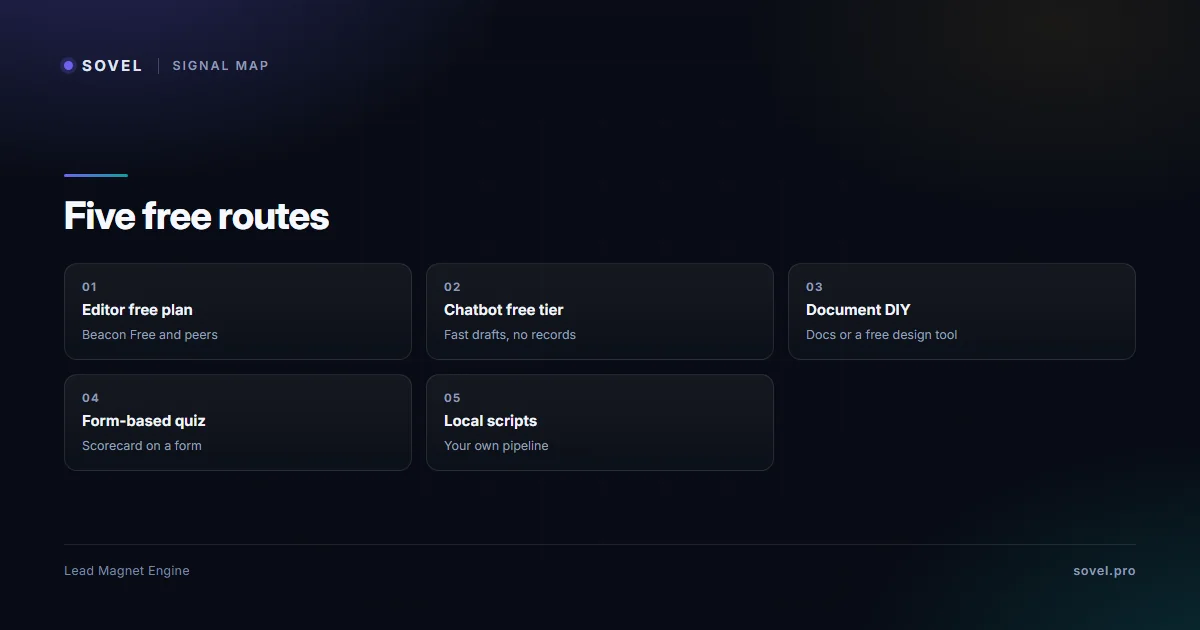
The five free routes, honestly
| Route | What you use | What it automates | Where it stops |
|---|---|---|---|
| Hosted editor free plan | Beacon’s free plan | Rendering, templates, basic export | Branding, volume, integrations |
| Free chatbot tier | Any free chatbot | Drafting text fast | Structure, files, records |
| Document DIY | Docs or a free design tool | Nothing; you do it all | Your own hours |
| Form-based quiz | A form builder’s free tier | Scoring and delivery logic | Question design, result copy |
| Local script route | Your own code or scripts | Whatever you script | Setup time, maintenance |
1. The free plan of a hosted editor
Beacon offers a genuine free plan (its pricing page lists it alongside the paid tiers, checked November 2026), and it behaves the way free lead magnet generator plans behave: you get the editor, the templates and a usable export, with the paid features clustered at the points where production gets serious, branding control, higher volume, integrations. For a first lead magnet, it is a legitimate route: the asset is real, the design is handled, and the cost is zero. The limits that bite first are cosmetic (vendor branding on a document that represents your business) and structural (the content structure is still yours to invent).
2. The free tier of a chatbot
Every major chatbot’s free tier will draft a checklist, a framework outline or an email course structure in minutes, and as a free lead magnet generator route it is the fastest way to test whether an idea has substance. The limits arrive immediately after the draft: no format enforcement, no files beyond copy-paste, no record of where the content came from, and no quality gate between you and your subscribers. Everything after the chat window is hand work: structuring, formatting, fact-checking, exporting, attaching. As a testing bench it is excellent; as production software it is a chat history. The best free lead magnet generator for testing ideas, in other words, is the one already open in a browser tab.
3. The document DIY route
Google Docs, a free design tool like Canva, and a PDF export produce a finished asset with zero vendor constraints, zero branding and zero monthly anything. This route is the free lead magnet generator that automates nothing, which is both its freedom and its bill: the hours it costs are the hours you would have paid a tool to compress. For people who already write well and publish slowly, DIY is often the honest optimum, and it beats a free tier of anything when total control matters. It fails quietly when the asset needs structure discipline, because nothing in a blank document enforces a format, and unenforced format is the difference between an asset people finish and one they abandon.
4. The form-based quiz route
A form builder’s free tier can host a scored assessment, which is the audit scorecard format delivered through infrastructure you already have. The scoring logic and result routing are automated; the questions, the scoring weights and the result copy are hand work. As a free lead magnet generator route it is narrow but genuine, and it suits service businesses whose promise is self-diagnosis. The limits: free tiers of form builders typically cap responses or logic depth, and a quiz is one format, not a production method.
5. The local script route
The final free route is writing your own: scripts that turn a structured brief into a document, templates that enforce your own format rules, a pipeline you own end to end. This is how most production engines start, and it is the only free lead magnet generator route where nothing leaves your machine. Its costs are setup time and maintenance, and its ceiling is your own engineering hours. The SOVEL LEAD MAGNET ENGINE product page is what this route looks like when someone finishes it and ships it; for buyers who reach this route and then stall at maintenance, a finished local engine is the practical exit.
What free actually costs: the time bill
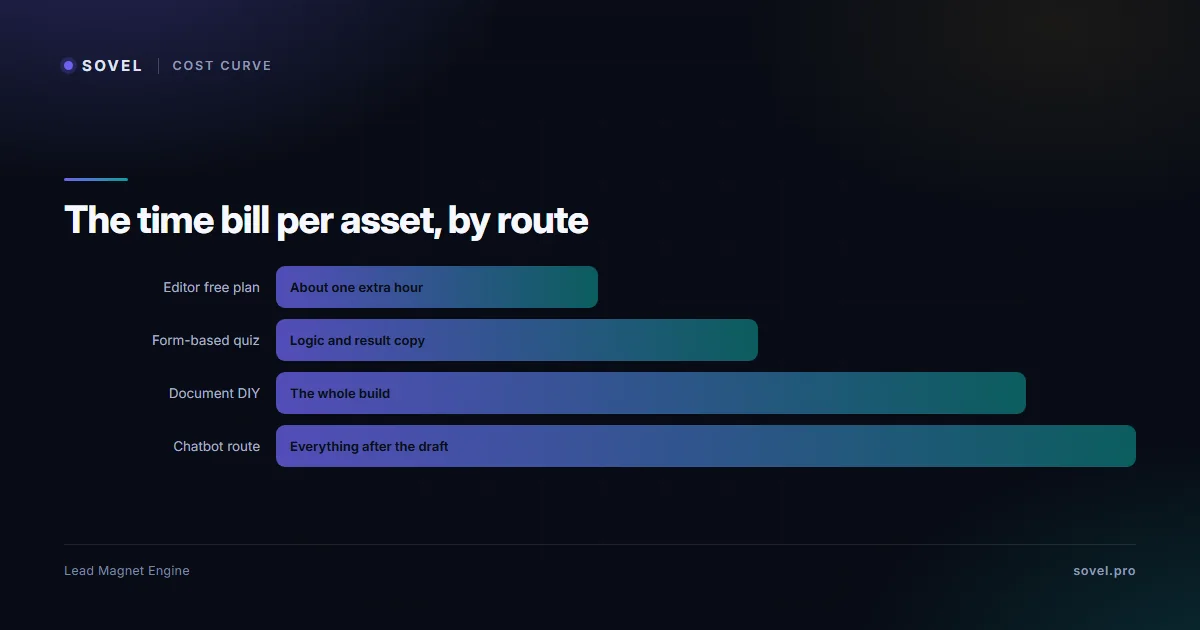
The visible price of free is zero, and the real price of a free lead magnet generator is the opportunity cost of the hours the free route adds back into your week. Every limit described above converts into time: vendor branding to design around, structure to invent, drafts to reformat, exports to rebuild, records to reconstruct after the fact. A free tier of a hosted editor might cost an extra hour per asset; the chatbot route routinely costs two or three, because everything after the draft is hand work; DIY costs the whole build.
Run the arithmetic against your own publishing rhythm. One lead magnet this quarter makes free routes rational almost regardless of the time bill. Four assets a month makes the time bill the largest line item in your production budget, which is the moment the arithmetic flips: a paid tool is not a luxury at that volume, it is the cheaper option per asset. The honest test is simple: track the hours on your next free-route asset, multiply by your hourly value, and compare that number to the price of the paid route that removes the hours. If the comparison embarrasses the free route, it was never free. Free lead magnet generator pricing is paid in hours, and the paid route is paid in money; at volume, hours cost more.
Where free stops: the limits that bite
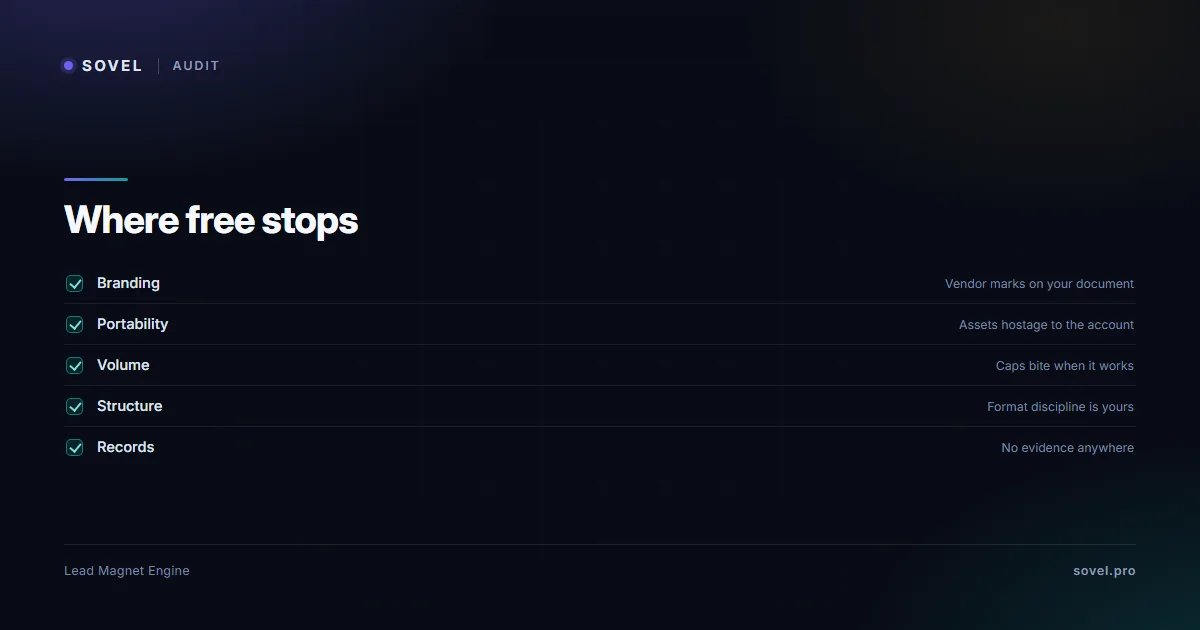
The limits of a free lead magnet generator are not secrets, but they arrive at different moments depending on the route, and knowing which limit bites first prevents most upgrade regret:
- Branding and cosmetics. Vendor branding on a document carrying your name is the first limit most free editor plans impose, and it matters more for client-facing work than for personal projects.
- Portability. Assets that live inside a free app, rather than as files you own, are hostage to the plan; if the free tier changes or the account lapses, the asset goes with it.
- Volume. Response caps, export caps and output caps are the standard levers; they bite exactly when the asset starts working, which is the worst possible moment.
- Structure. Every free route leaves format discipline to you, and format discipline is the difference between an asset people finish and an asset people abandon.
- Records. No free lead magnet generator route keeps an evidence record of where content came from, which moves the entire fact-checking burden onto you and keeps it there.
None of these limits is a flaw in the free plans; they are the deliberate boundary between free and paid, drawn by every vendor in the category. The mistake to avoid is treating the boundary as a moral question. It is a fit question: the limits are irrelevant until your work crosses them.
Quality: the gate free routes never run
Every route above has one gap in common, and it is the one that costs the most downstream: none of them runs quality gates. Repetition, placeholder text, tone drift, coverage gaps, unverifiable claims, a paid production pipeline checks these mechanically before the draft reaches you; a free lead magnet generator ships them straight to you, and you catch them or your subscribers do. This is not an accusation of the free plans; it is simply what was not purchased. Quality machinery is expensive to build, and free tiers price it out.
The practical consequence: a free-route asset needs a manual review pass that paid pipelines partially automate. Read the draft against the promise, check every verifiable claim, kill the repetition, and confirm the format holds, which is thirty minutes of focused work on a good draft and much longer on a bad one. The SOVEL LEAD MAGNET ENGINE product page documents what a governed gate actually stops: runs that fail their own checks, before export. If you run a free lead magnet generator route, you are the gate, and budgeting review time is part of the route’s real cost.

When free stops being enough
Four moments mark the exit from a free lead magnet generator, and they arrive in a predictable order. The first is client work: the moment material belongs to a client, most free routes are disqualified by privacy rather than capability, because client material should not sit in a hosted free account or a chat history. The second is cadence: publishing on a schedule converts the time bill from an occasional cost into a standing one. The third is consistency: when the assets must match each other, free routes’ lack of enforced structure shows as drift between them. The fourth is scale of claims: when the asset starts making claims a reviewer must be able to trace, routes without records stop being defensible.
The migration path is usually the same: from chatbot drafts to a document template, from a template to a free editor plan, and from the free plan to owned production, either a paid hosted tool or a local engine. Each step trades money for the specific limit that was biting, and the buyer who knows which limit bites first skips the intermediate steps. It is worth saying plainly that skipping steps is legitimate: there is no merit badge for walking the whole ladder, and a team that knows it needs provenance and privacy from day one should start at owned production rather than rehearsing every free route first. The feature-level comparison of the paid tools is in the lead magnet generator software guide, and the full price math is in the lead magnet software pricing guide.

The moments paid earns its keep
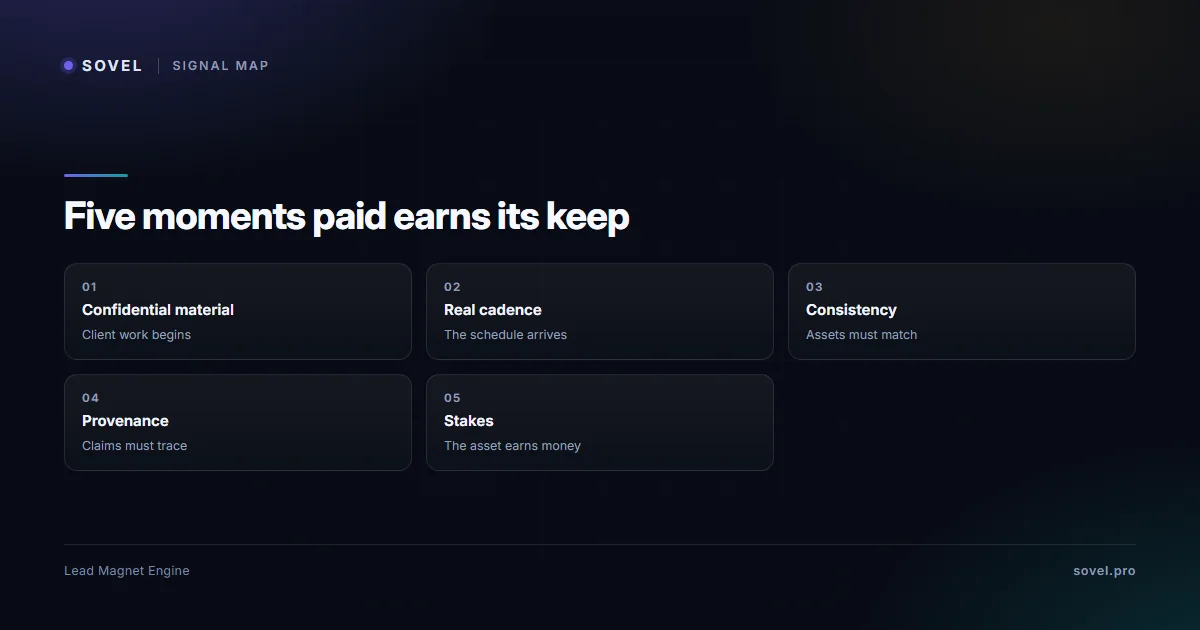
Paid earns its keep at specific, nameable moments a free lead magnet generator cannot cover, and listing them honestly serves both sides: readers who hit none of these moments should stay free, and readers who hit one should stop paying the time bill.
- The moment the material is confidential. Client work, unreleased plans, anything covered by an agreement: hosted free routes are out, and a local route is the honest answer.
- The moment the cadence is real. A schedule turns time into the dominant cost, and software that removes hours pays for itself in weeks at that point.
- The moment consistency matters. Repeated formats across briefs need enforced structure, which is exactly what no free route provides.
- The moment the claims need provenance. Evidence records, run manifests and verification notes exist in paid governed pipelines because someone auditable has to be able to answer “where did this come from”.
- The moment the asset becomes an asset. When a lead magnet starts generating conversations worth money, the tooling behind it should be as reliable as the promise it supports.
If none of these moments has arrived, the free routes above are not a compromise, they are the right answer, and the honest free tier of a good editor will serve for months. When one arrives, the free lead magnet generator comparison above tells you exactly which limit you are paying to escape, and the pricing guide tells you what the escape costs. Choosing with the limits named is the difference between upgrading because the work demanded it and upgrading because a countdown timer said to.
FAQ
Is a free lead magnet generator actually usable for real work?
Yes, within its limits. A free plan or a DIY route produces a genuine, publishable asset when you are testing a promise, publishing occasionally, and willing to do the structuring and review by hand. The limits that surface are branding, caps, portability and the absent quality gate, and each one is tolerable at low volume and expensive at high volume. Track the hours on your first free-route asset; the number decides the question for your specific work.
What does a free lead magnet generator cost in practice?
Zero in money and real in time. The free route adds back the hours a paid pipeline automates: structuring, formatting, fact-checking, reformatting exports, reconstructing records. At one asset per quarter the time bill is irrelevant; at four assets a month it becomes the largest production cost you have. The honest comparison is hours times your hourly value against the paid tool’s price, not zero against a number.
Which free route should a beginner start with?
The chatbot free tier for testing the idea, then the DIY document route for producing the first real asset. That combination is the cheapest free lead magnet generator education there is, because it teaches both halves of the skill: what substance looks like and what structure costs, with no money spent. The guide on how to create a lead magnet walks the production side in six stages; run it by hand once and every paid tool’s value becomes obvious on its own terms.
Do free lead magnet generator plans put their branding on my document?
Usually, yes, on hosted free plans: vendor branding is the standard first limit, and removing it is typically a paid feature. DIY routes and local scripts carry no branding because no vendor is involved. If the document represents your business to clients, factor the branding into the route decision rather than discovering it at export time, and check the free plan’s export terms before you build, because export rules are where the rest of the cosmetic limits usually hide.
Can a free lead magnet generator handle client-confidential material?
The hosted and chatbot routes cannot be recommended for it, because the material leaves your machine and lives in vendor infrastructure or chat histories outside your control. The DIY document route and the local script route keep material on your machine, which makes them the only free lead magnet generator routes fit for client work at all, and a local production engine is the finished version of the same privacy model. For client work, the privacy boundary usually decides the route before features are even compared.
When does upgrading from free actually pay for itself?
At the moment your publishing cadence or your client work makes the time bill larger than the tool’s price. For most solo publishers that moment arrives somewhere between one asset a quarter and four assets a month; for consultants, it arrives with the first client whose material cannot leave their machine. The lead magnet software pricing guide works through the arithmetic with real numbers, and the feature comparison of the paid tools earlier in this guide shows what the money buys at each tier.
—
*Free-plan details in this guide reflect vendor pricing pages as of November 2026; free tiers change often, so verify the current limits before relying on them.*