
Lead magnet software pricing looks simple in every ad: one number, one tier, one monthly bill. The honest version has at least six costs, and four of them never appear on the pricing page: the billing-cycle gap, the cap economics that force tier jumps, the seat multiplication for teams, and the exit cost when you stop paying. The short answer: compare lead magnet software pricing on the total you will actually pay across a year of real usage, not on the sticker number; a tool at $49 per month costs ₹5,856 in its first month alone, which is more than the one-time price of several tools that never bill again.
Every number in this guide was checked against the vendors’ own pricing pages in November 2026, and the source is named for each. This page is the lead magnet software pricing home for the site: the feature comparison of the tools lives in the lead magnet generator software guide, the free-route trade-offs live in the free lead magnet generator guide, and no other page on this site carries third-party prices, so this one is maintained instead of going stale.
What lead magnet software pricing actually shows
The pricing pages themselves are honest; they are just incomplete. Here is the verified lead magnet software pricing field as of 9 November 2026:
| Tool | Model | Verified price | Source, checked |
|---|---|---|---|
| Beacon | Subscription | Free / $19 Lite / $49 Professional / $99 Agency | beacon.by/pricing, 9 Nov 2026 |
| Designrr | Subscription | $29 Standard / $39 Pro / $49 Premium / $99+ Business; yearly from about $22/mo | designrr.io/pricing, 9 Nov 2026 |
| ScoreApp | Subscription | $30-39 Starter / $99 Business / $149 Pro | scoreapp.com pricing, 9 Nov 2026 |
| MagnetKit | One-time | $49 T1 / $99 T2 / $149 T3 (tiered by monthly output allowance) | deal-marketplace listing, June 2026 |
| SOVEL LEAD MAGNET ENGINE | One-time | ₹1,999 Personal / ₹4,999 Pro / ₹19,999 Agency | this site’s checkout |
Beacon, Designrr and ScoreApp all publish their tiers openly, which is worth saying: the subscription vendors in this category are not hiding their numbers. What the pages do not show is how the tiers interact with real usage, and that interaction is where the other six costs live. A free plan that brands your documents, a professional tier that caps at the moment your funnel starts working, a business tier priced for teams you do not have yet: these are lead magnet software pricing outcomes, and they are predictable enough to plan for.

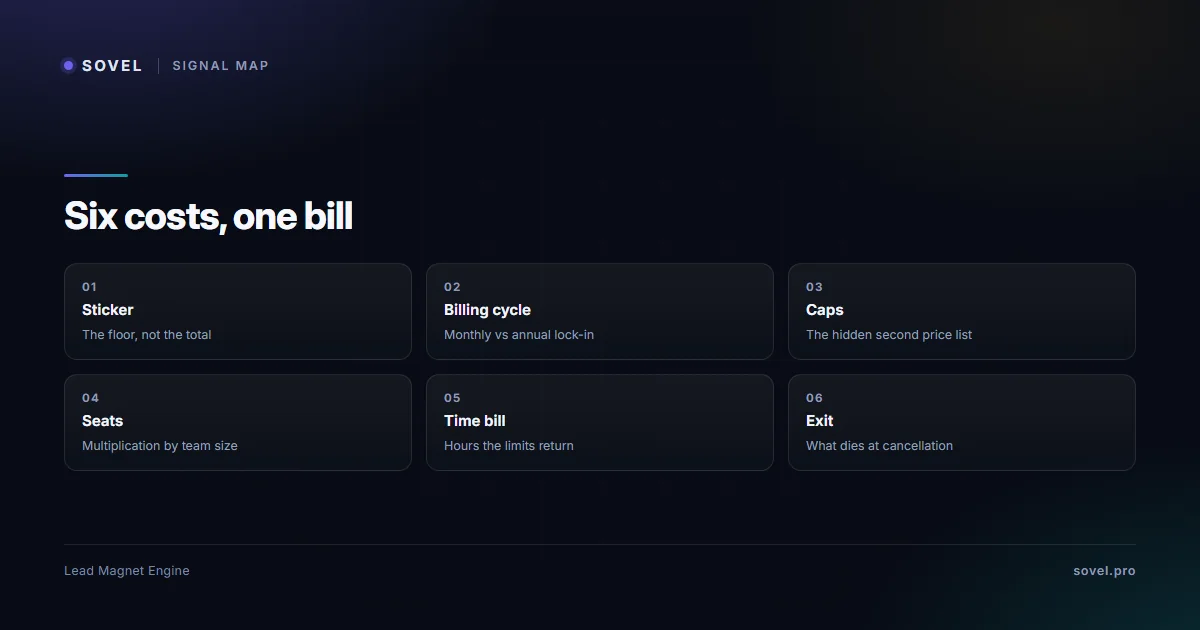
The six costs, one at a time
1. The sticker price
The number on the pricing page, per month, per tier. It is the only cost most buyers compare, which is why comparisons mislead: a $19 entry tier and a $49 professional tier are different products aimed at different volumes, and the tier you actually need is usually determined by costs three and four below. When you evaluate lead magnet software pricing, read the sticker as the floor, never the total; that is the first rule of the category. The entry tier is the demonstration product; the tier that matches your real usage is where the real comparison begins.
2. The billing-cycle gap
Monthly billing versus annual billing is a pricing decision disguised as a discount. Designrr’s yearly billing brings the entry price to roughly $22 per month against $29 monthly, which is real savings if you stay, and a real trap if you leave: annual billing is a twelve-month commitment to a tier you chose after one demo. The gap also hides escalation, because vendors count on tier changes at renewal. The honest lead magnet software pricing evaluation is against monthly billing, and only switch to annual once the tool has survived a full month of your real workload.
3. The cap economics
Caps are how tiers are built: Beacon’s tiers step $19, $49, $99; MagnetKit’s one-time tiers step $49, $99, $149 with monthly output allowances of 35, 70 and 140 per its listing. Caps bite at the worst moment, exactly when the asset starts converting. The cap question to ask any vendor is specific: at what usage level does my funnel force the next tier? If the honest answer is “roughly when it works”, the effective price of the tool is the higher tier, and lead magnet software pricing should be evaluated there. A price list without its caps is a menu without prices for the dish you will actually order. In lead magnet software pricing, caps are the hidden second price list, and the sticker is only the first.
4. The seat multiplication
Team pricing multiplies, and seat counts are where lead magnet software pricing scales past the sticker for growing teams: ScoreApp’s business tier at $99 and pro tier at $149 exist because multi-seat usage is the platform’s real market, and Beacon’s $99 agency tier is priced for the same buyer. A solo buyer comparing a $49 professional tier against a $149 team tier is comparing different purchases. Count seats honestly: a five-person agency on a per-seat or team-tier model pays multiples of the sticker, which is why team-shaped tools cost team money. The seat count you have in twelve months, not today, is the right number to price against.
5. The time bill
The cost every pricing page omits: the hours the tool’s limits add back to your work. Structure to rebuild by hand, drafts to reformat, exports to redo, records to reconstruct; in the free-route guide these were the free tier’s time bill, and paid tiers reduce it unevenly. A design tool removes rendering hours and leaves structure hours; a funnel platform removes delivery hours and leaves content hours. Price the time honestly: at even twenty hours of avoidable rework per month, a tool costing $99 that removes half the rework is cheaper than a $29 tool that removes none of it, whatever the sticker comparison says. Any honest lead magnet software pricing comparison includes the time bill, because it is the only cost your workload sets.
6. The exit cost
The cost of leaving. With subscriptions, the exit question is what stays live: assets hosted on the vendor’s platform usually stop working when the subscription stops, which means the subscription never truly ends while the funnel earns. With a one-time licence, the software is already paid for and stays installed; the exit cost is zero because there is nothing recurring to exit. This is the cost that turns “cheap monthly” into “permanent monthly” for anyone whose lead magnets keep working, and it is the second rule of lead magnet software pricing: ask what dies at cancellation before asking what the first month costs.
One-time versus monthly: the actual math
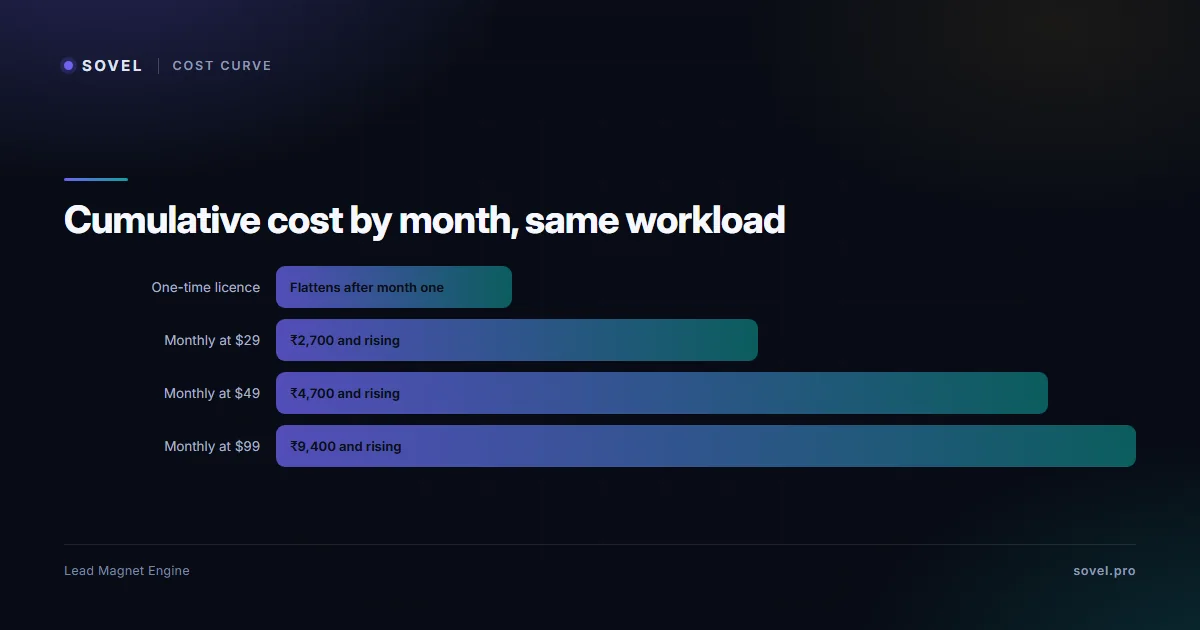
The lead magnet software pricing comparison that matters is cumulative cost against the same workload. Take Beacon’s Professional tier at $49 per month, about ₹4,700 at the roughly ₹94 per dollar rate used for India comparisons. The SOVEL LEAD MAGNET ENGINE product page prices Pro at ₹4,999 one-time: a little over one month of Beacon Professional, forever, with no further bills. At the Agency tier the gap widens: ₹19,999 one-time is roughly 2.1 months of Beacon’s $99 agency tier, and less than one month of Designrr’s $99+ business tier. A subscription becomes cheaper only in a world where you cancel while the assets are still live, which the exit cost above explains almost nobody does.
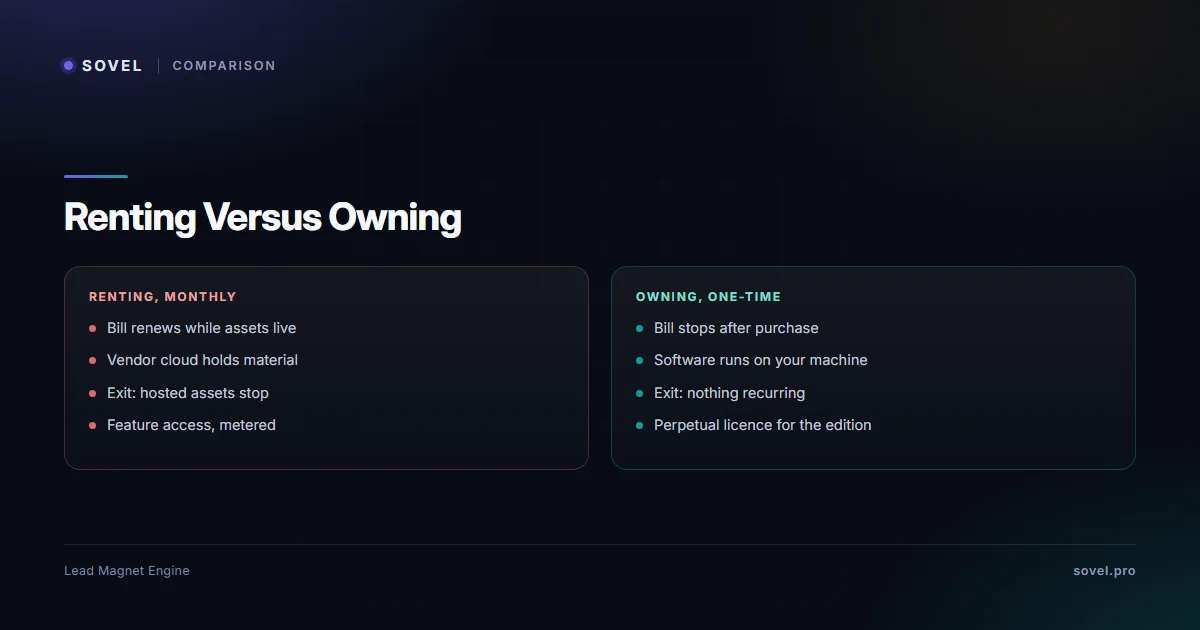
The math has an honest other side. Subscriptions fund continuous hosted service: server bills, uptime, support staff, and features shipped monthly. If you need vendor-hosted forms, live funnels and design hosting, the monthly bill buys real infrastructure, and cancelling it means losing that infrastructure. A one-time licence buys a different thing: software that runs on your machine with no server bill to cover, which is exactly why the price can stop renewing. The two models are priced for different workloads, which is the fairest thing lead magnet software pricing can say about itself: workload first, price second.
What a one-time lead magnet generator price must fund
A one-time price has to pre-fund what a subscription spreads across months: support, bug fixes and updates for the life of the edition. That is the structure underneath lead magnet software pricing on the one-time side: the price funds the years, not the month; that is why a serious one-time lead magnet generator costs more than $10 and less than a year of a hosted professional tier. The price sits between the two failure modes, too cheap to fund support and too expensive to be an easy first purchase. MagnetKit’s verified one-time ladder, $49 to $149, is the market’s answer to that question, and it has held since the deal listing in June 2026.
The funding question is the right question to ask any one-time vendor, including this one: what does the price cover, for how long, and what happens to updates. The engine’s answer is documented on its product page: lifetime updates for the edition, support tiers by edition, and a receipt that records what was purchased. A one-time price without published support terms is a subscription in disguise, delayed; a one-time lead magnet generator with published terms is a genuine alternative model, and lead magnet software pricing gets more honest the more visibly those terms are written.
Lead magnet software without subscription: who it actually fits
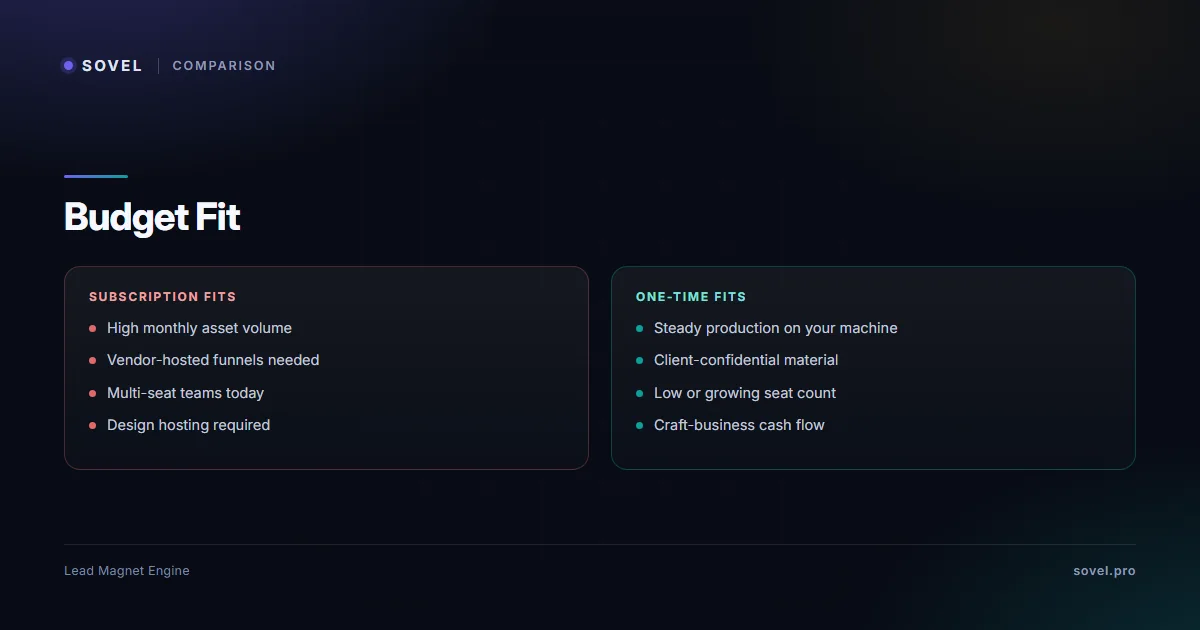
Lead magnet software without subscription is not for everyone, and the one-time lead magnet generator category behind it is small but real, so the fit question is worth answering precisely. It fits consultants and freelancers whose production is steady but whose income is lumpy, because a perpetual licence matches a craft business’s cash flow better than a monthly bill does. It fits agencies that price maintenance separately and resent paying rent on their own production tools. It fits technical buyers who host nothing and want software that runs on hardware they already own. It does not fit teams that need vendor-hosted funnels, live form infrastructure and someone else’s uptime guarantee; those buyers should pay the subscription and be glad the infrastructure exists.
The privacy line reinforces the same split: software without subscription that runs locally keeps client material on your machine, which the local AI content generation guide treats as a hard requirement for client work. A one-time licence and a local execution model travel together naturally, because the vendor has no server to run and therefore no reason to hold your material. If you have been searching for one-time lead magnet generator pricing, that pairing, perpetual licence plus local execution, is the combination that makes the model durable rather than a discount gimmick, and it is also the cleanest lead magnet software pricing story in the category: the bill stops, the software keeps working.
The founding price question
Founding pricing is a one-time model’s launch mechanism, and it deserves the same honesty as everything else in lead magnet software pricing. The engine’s founding window prices the first 50 customers at ₹1,499 Personal, ₹3,999 Pro and ₹14,999 Agency, against regular prices of ₹1,999, ₹4,999 and ₹19,999; international buyers see $29, $69 and $199. The receipt records the price actually paid, the licence term is identical at both prices, and when the first 50 orders are filled the window closes and the regular prices resume. Nothing about the product changes at the boundary; only the price does.
Two honest notes about founding windows in general, including this one. First, a founding price is a bet by the maker that early buyers will fund the product’s support life, which is why it can be genuinely cheaper and still sustainable. Second, scarcity claims deserve skepticism everywhere: if a countdown timer refreshes forever on some other site’s page, that vendor has answered the honesty question for you. The window here is tracked by order count, not by timer, and the SOVEL LEAD MAGNET ENGINE product page states the current status rather than implying one.

A budget-fit method you can run in ten minutes
Before comparing any two tools, run this sequence once; it converts lead magnet software pricing from a sticker contest into a workload match. One: write down your real monthly asset count for the next year, not your aspirational one. Two: write down your seat count for month twelve. Three: write down whether any of the material is client-confidential, because that single yes eliminates hosted routes for that material. Four: for each candidate, take the tier that matches those two numbers and multiply by twelve for subscriptions, or take the one-time price once. Five: add the time bill estimate from cost five above. The totals, not the sticker prices, are the honest comparison, and the free-versus-paid boundary is covered separately in the free lead magnet generator guide.
Run that method across the verified table above and most buyers land in one of two groups. High-volume, hosted-funnel, multi-seat buyers belong in subscriptions, where the monthly bill funds infrastructure they use daily. Steady-production, local, low-seat buyers belong with a one-time licence, where the bill stops and the software keeps working. The six costs exist precisely to put each buyer in the right group, which is the whole job of lead magnet software pricing research: to decide the group before the sticker price decides instead.
FAQ
What does lead magnet software pricing actually cost per month?
For the verified field in this guide: Beacon runs free to $99 per month depending on tier, Designrr $29 to $49 monthly with annual billing from about $22, and ScoreApp $30 to $149. The tier that matches real usage is usually mid-range, which makes $19 to $49 per month the realistic band for a working subscription, or ₹1,800 to ₹4,700 per month at the India comparison rate. Annual billing improves those numbers only if you stay the full year.
Is one-time pricing really cheaper than a subscription?
Across a working lifetime, almost always, because a one-time licence stops billing while subscriptions compound. Concretely: the engine’s Pro at ₹4,999 one-time equals roughly 1.1 months of Beacon’s $49 professional tier, and its Agency at ₹19,999 equals roughly 2.1 months of Beacon’s $99 tier. The exception is short-term use: if you genuinely need a hosted funnel for three months and will cancel everything, the subscription is cheaper. The honest variable in lead magnet software pricing is how long your assets stay live, and for most businesses the answer is years.
Why is lead magnet software pricing so tiered?
Tiers are how vendors price their caps: export limits, branding removal, integrations and volume are distributed across tiers so that successful usage upgrades itself. The structure is not a scam; it is price discrimination, and it works because usage grows with success. The buyer’s defense is to price the tier their month-twelve usage actually needs, not the tier their month-one usage suggests, and to ask each vendor directly what usage forces the next tier.
What should a founding price for a one-time tool look like?
Published terms, a real cap, and no countdown theatrics: a founding price should state who it applies to, how many units it covers, what happens at the boundary, and that the licence term is identical at both prices. The engine’s window prices the first 50 customers at ₹1,499, ₹3,999 and ₹14,999 with the licence unchanged, and the receipt records what was paid. Any founding price that cannot answer those questions is a marketing timer rather than a pricing model.
Does lead magnet software without subscription exist for agencies?
Yes. The engine’s Agency edition is ₹19,999 one-time for five machines with multi-client rights and an onboarding call, which is roughly two months of a hosted agency tier’s billing and then never again. The fit conditions from the budget-fit section still apply, and they are the same conditions that decide every lead magnet software pricing question: agencies that need vendor-hosted funnels should stay subscribed, and agencies producing governed drafts on their own machines are the natural buyers. The feature comparison in the software guide shows what each model automates.
How do I compare two tools’ pricing fairly?
Compare totals at your real workload, not sticker prices at the demo tier; that is the comparison lead magnet software pricing rewards. Take the tier your month-twelve usage needs, multiply by twelve for subscriptions, take the one-time price once for perpetual licences, add the time bill each tool’s limits create, and then compare. Run the ten-minute method earlier in this guide and write the two totals side by side. The tool with the smaller total at your workload, not the smaller number on the pricing page, is the cheaper tool.
What happens to my lead magnets if I stop paying a subscription?
Whatever was rendered and exported as files stays yours; whatever lives inside the vendor’s platform stops working. That is the exit cost, and it is the reason subscriptions persist even after the buyer stops actively using the tool: live funnels and hosted assets keep the bill necessary. One-time licences have no exit cost, because nothing recurring exists to stop. Ask every vendor specifically what dies at cancellation, write the answer into the comparison, and you will have covered the least advertised corner of lead magnet software pricing before choosing.
—
*All third-party prices in this guide were checked against vendor pricing pages on 9 November 2026 and the deal listing dates to June 2026; prices change, so verify current tiers at the sources named. India comparisons use roughly ₹94 per US dollar.*