
Lead magnet format selection is not a packaging decision. Each format gives the reader a different job. A checklist asks for action. A framework asks for understanding. A case study asks for belief. A scorecard asks for diagnosis. A mini course asks for practice.
Choose the wrong format and the reader either drowns or leaves. A five-step checklist cannot teach a method. A fifteen-section course cannot fit into a lunch break. The format has to match the moment.
This lead magnet format selection guide covers nine practical formats, the job each one does, the section count that fits and the review depth each one needs. It ends with a simple selection method you can use before the first draft.
What is lead magnet format selection?
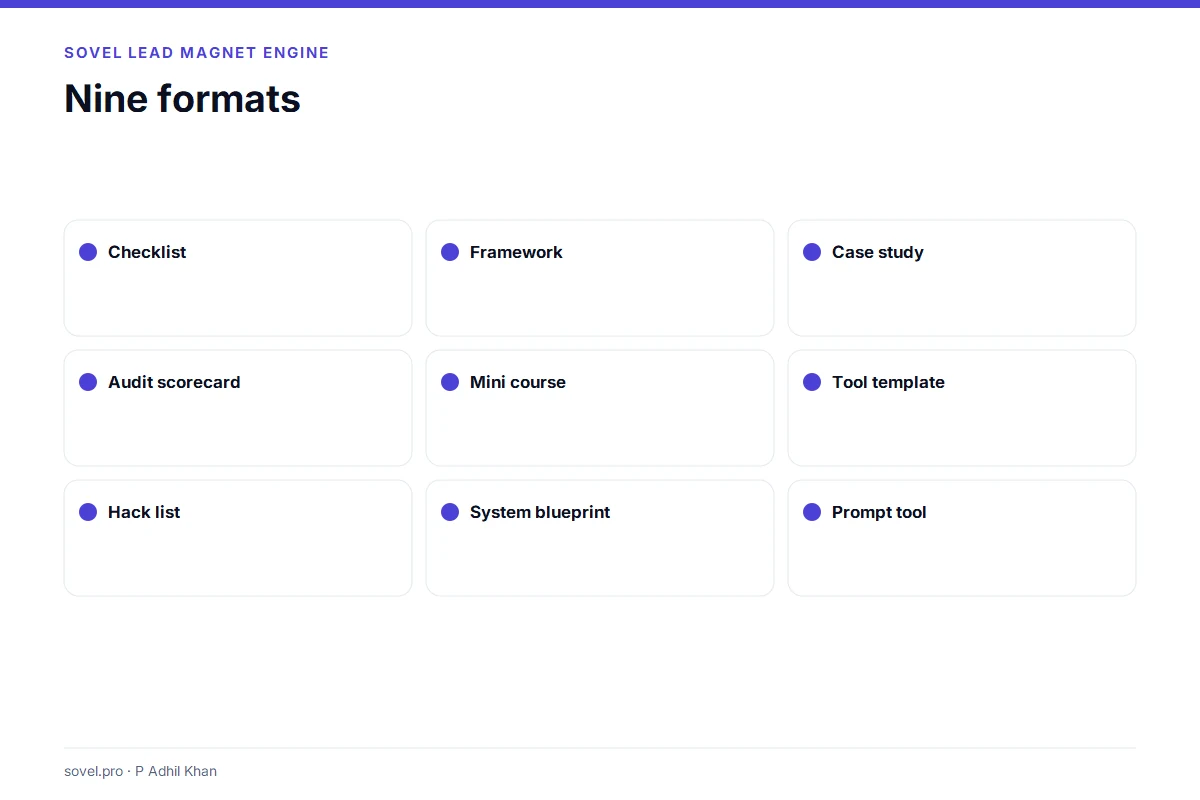
Lead magnet format selection starts with the structures used to deliver a lead magnet. The common ones are checklist, framework, case study, audit scorecard, mini course, tool template, hack list, system blueprint and prompt tool.
The format is not the file type. A PDF can hold a checklist or a case study. The format is the reader’s job and the section structure. The file type is the handoff.
A useful format selection answers three questions. What does the reader do with it? How long will it take? What changes when they finish? If the format cannot answer those questions, it is a layout looking for a purpose.
Checklist: the fastest format
A checklist is the most common lead magnet format because it is easy to start and easy to finish. The reader gets a set of checks, runs them and marks what is missing.
A checklist works when the reader already knows the job and needs a reminder. An onboarding audit, a launch check, a security review or a content QA pass. The checklist does not teach the job. It keeps the reader from skipping a step.
Five sections is usually enough. Each section has one check, a reason, an example and a closing rule. If the checklist runs to fifteen sections, the reader will skim. If it runs to three, it may not cover the job.
A checklist is a weak fit for a reader who needs to understand why the steps exist. That reader needs a framework or a mini course.

Framework: the teaching format
A framework explains a method. It gives the reader a way to think about the problem, not just a list of steps. The reader should be able to apply the framework to a new situation after reading.
A framework works when the topic has parts that need to be connected. A content production framework, a client onboarding framework, a research framework. The value is the relationship between the parts.
Five sections is a good default. Each section names one part of the framework, explains why it matters, shows how it connects to the others and gives an example. The closing rule tells the reader when the part is complete.
A framework is a weak fit for a reader who needs a quick action. That reader wants a checklist. A framework asks for more attention and gives more understanding.
Case study: the proof format
A case study shows what happened. It gives the reader a concrete example of the method in use. The value is the evidence, not the theory.
A case study works when the buyer needs proof before action. A consultant selling an onboarding audit, an agency selling a content system, a creator selling a course. The reader wants to see the before, the change and the result.
Five sections is enough: context, problem, approach, result and lesson. The result should be specific. “Onboarding time dropped from 14 days to 9” is stronger than “onboarding improved”.
A case study is a weak fit when the result is not measurable or the client cannot be named. A disguised case study can work, but the reader needs to know what was changed.
Audit scorecard: the diagnosis format
An audit scorecard helps the reader find a gap. It asks a set of questions, scores the answers and returns a diagnosis. The value is the decision, not the score.
A scorecard works when the reader suspects a problem but does not know where to start. A content audit, a security review, a funnel review. The questions should be specific enough to produce a useful diagnosis.
Seven sections is a common default. Each section has a question, a scoring rule, a reason and a next action. The score is a summary. The next action is the product.
A scorecard is a weak fit when the reader needs a quick win. The diagnosis takes time. The reader has to answer the questions honestly.
Mini course: the practice format
A mini course builds a habit. It gives the reader a sequence of lessons, exercises and checkpoints. The value is the practice, not the information.
A mini course works when the reader needs to learn by doing. A writing course, a research course, a client onboarding course. The lessons should be short enough to complete in one sitting and specific enough to produce a result.
Fifteen sections is a common default. Each section has one lesson, one exercise and one checkpoint. The reader should be able to finish a section in twenty to thirty minutes.
A mini course is a weak fit when the reader only needs a reference. A checklist or a framework is faster.
Tool template, hack list, system blueprint and prompt tool
The remaining formats cover specific jobs.
- Tool template gives the reader a reusable asset. A worksheet, a brief, a scoring sheet. Five sections is enough.
- Hack list gives the reader a set of small improvements. Ten short items. The value is the specificity, not the length.
- System blueprint shows how the parts of a workflow fit together. Five sections. The reader should be able to draw the system after reading.
- Prompt tool gives the reader reusable instructions for an AI tool. Five sections. The prompts should be tested, not imagined.
These formats are narrower than a course and more practical than a framework. They work when the reader has a clear job and wants a reusable asset.
How do you approach lead magnet format selection?
Start with the reader’s moment. A reader in the middle of a task needs a checklist. A reader planning a system needs a framework or a blueprint. A reader who needs proof needs a case study. A reader who needs a diagnosis needs a scorecard. A reader who needs practice needs a mini course.
Then check the evidence. A case study needs a result. A scorecard needs a scoring rule. A framework needs a tested method. A checklist needs specific checks. If the evidence is missing, choose a format that does not pretend to have it.
Then check the review depth. A case study with a client result needs a client approval. A scorecard with a benchmark needs a source. A prompt tool needs a test run. The format sets the review burden.

What section count fits each format?
The section count is a promise. A checklist with five sections says the job has five checks. A mini course with fifteen sections says the topic needs practice.
| Format | Typical sections | Reader time |
|---|---|---|
| Checklist | 5 | 10 to 20 minutes |
| Framework | 5 | 20 to 30 minutes |
| Case study | 5 | 15 to 25 minutes |
| Audit scorecard | 7 | 20 to 40 minutes |
| Mini course | 15 | 3 to 5 hours |
| Tool template | 5 | 15 to 30 minutes |
| Hack list | 10 | 10 to 15 minutes |
| System blueprint | 5 | 30 to 45 minutes |
| Prompt tool | 5 | 15 to 30 minutes |
The counts are defaults, not laws. A short checklist can have three sections. A deep framework can have seven. The count should match the job, not a word target.

What does a strong section look like in every format?
Every format uses the same six-part section anatomy: headline, opener, mechanism, framework, example and closing rule. The content changes. The shape stays.
The headline names the check or idea. The opener states the problem. The mechanism explains why it matters. The framework shows how to do it. The example makes it concrete. The closing rule tells the reader when the section is done.
This anatomy is what makes a lead magnet reviewable. A reviewer can compare sections because they follow the same shape. A reader can scan because the shape is predictable.

Which format needs the deepest review?
A case study needs the deepest review because it makes a claim about a result. A scorecard needs a close second because the scoring rule can mislead. A prompt tool needs a test run because an untested prompt is a guess.
A checklist needs a factual review but less narrative review. A framework needs a logic review. A mini course needs a sequence review. A system blueprint needs a completeness review.
The review depth should match the risk. A public checklist with no client data can be reviewed by the writer. A client case study needs the client, the editor and the legal reviewer.
How does lead magnet format selection fit a client project?
A client project starts with the result the client can prove. If the client has a before-and-after metric, a case study is a strong lead magnet format. If the client has a diagnostic framework, a scorecard is a strong fit. If the client has a repeatable process, a checklist or blueprint is a strong fit.
The next question is the reader’s time. A busy operator may give you ten minutes. A reader who is planning a quarter may give you an hour. Lead magnet format selection should match the time the reader will actually spend.
The third question is the review. A case study needs client approval. A scorecard needs a tested scoring rule. A prompt tool needs a test run. Lead magnet format selection carries different review burdens, and the client should know that before the draft starts.
A practical client project uses one primary format and one support asset. The primary asset is the lead magnet. The support asset is a checklist, a worksheet or a short prompt. Two formats can work together if the reader still has one clear job.
Lead magnet format selection should not be driven by what sounds impressive in a proposal. A fifteen-section mini course is a poor fit for a reader who wants a one-page audit. A three-section checklist is a poor fit for a reader who needs to learn a method.
The format decision is a commercial decision. It affects the production time, the review time and the client’s ability to deliver. A consultant who explains that trade-off looks more credible than one who promises a course for every brief.
What is the most overused lead magnet format?
The ebook is the most overused lead magnet format. It is easy to describe and hard to finish. Many ebooks are checklists with padding, or frameworks with no example. The reader downloads the file and never opens it.
A shorter format often works better. A checklist that fits on two pages, a scorecard that produces a diagnosis, a framework that fits on one page. Lead magnet format selection should earn the reader’s time, not test their patience.
The second overused format is the generic guide. It explains a topic without giving the reader a job. A guide can work when the topic is new, but it needs a clear promise and a specific reader.
The fix is not to avoid ebooks. The fix is to choose the format that matches the job and to cut the sections that do not earn their place. Lead magnet format selection is a tool for the reader, not a display of effort.
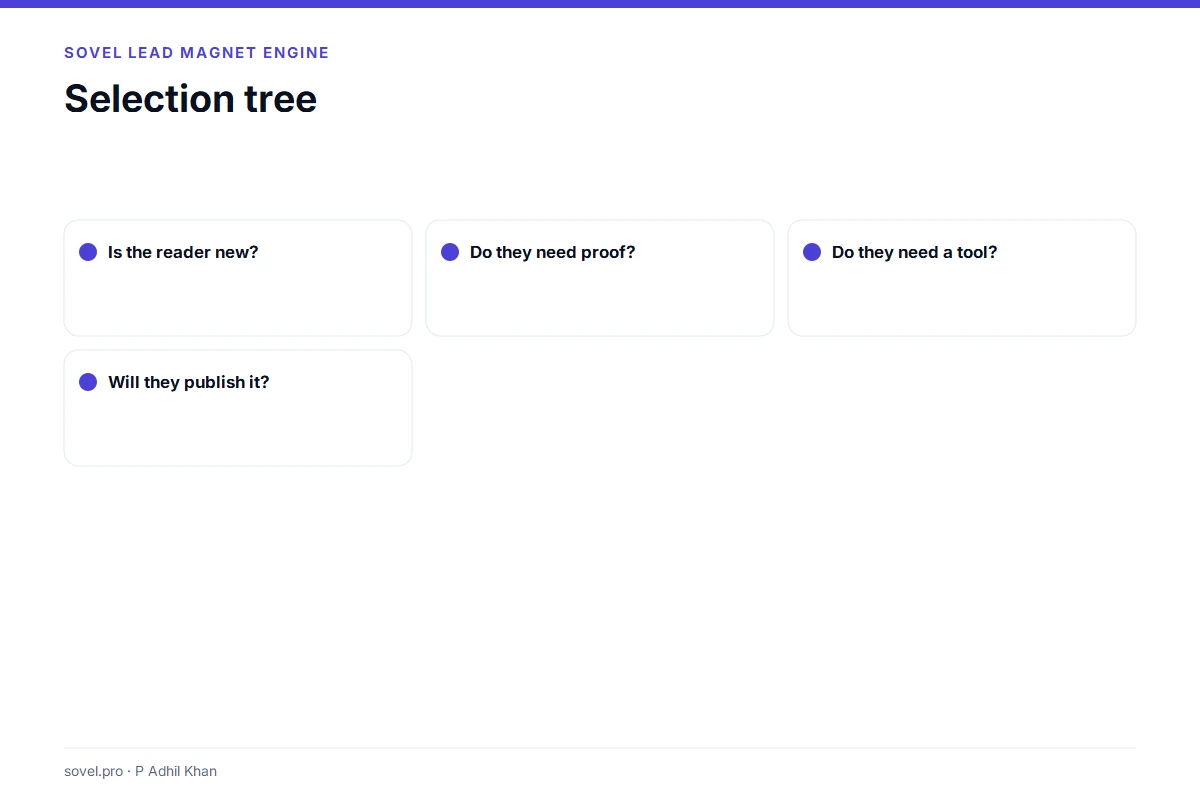
A final check before drafting: say the lead magnet format selection out loud with the reader in the room. If the format sounds like work the reader did not ask for, choose a simpler one. The best lead magnet format selection feels obvious after the reader sees them.
For current design-tool pricing, see Beacon pricing and Designrr pricing.
Frequently asked questions
How should a consultant approach lead magnet format selection?
A checklist, framework or audit scorecard works for most consultant projects. Lead magnet format selection should match the client’s reader and the result the client can prove.
Is lead magnet format selection the same as choosing a file type?
No. A PDF, DOC or HTML file can hold any format. Lead magnet format selection is about the structure and the reader’s job. The file type is the handoff.
How many sections fit a lead magnet?
A checklist usually has five sections. A scorecard has seven. A mini course can have fifteen. Lead magnet format selection should use the count that matches the reader’s time and the job.
Which lead magnet format is easiest to write?
A checklist is the easiest to draft and the easiest to review. It is also the easiest to make generic. The checks have to be specific.
Which format converts best?
Conversion depends on the offer and the audience, not the format alone. A case study can convert a skeptical buyer. A checklist can convert a busy operator. Test the format with the reader.
Can lead magnet format selection combine two formats?
Yes. A checklist can include a short framework in the intro. A case study can end with a scorecard. Lead magnet format selection can combine two formats if the reader still has one clear job.
Does lead magnet format selection need images?
Images help when they explain a structure, a step or a comparison. Lead magnet format selection does not need decoration. Use an image where the reader would otherwise have to hold too much in their head.
How do I choose a format for a client?
Ask what the client’s reader needs to do after reading. Then choose the format that supports that action. Do not choose a format because it looks impressive in a proposal.
The format decision
Lead magnet format selection is a decision about the reader’s job. A checklist for action. A framework for understanding. A case study for proof. A scorecard for diagnosis. A mini course for practice. A template, hack list, blueprint or prompt tool for a specific reusable asset.
Choose the job first. Choose the section count second. Choose the design last. That order keeps the lead magnet useful after the download.
Choose the format by the reader’s job, then check the review burden. The SOVEL Lead Magnet Engine page shows all nine formats. For the seven-step sequence, read the lead magnet creation workflow. For the final quality pass, read the lead magnet quality checklist. For client projects, read lead magnet software for consultants.