
A lead magnet quality checklist is the last gate before a draft reaches a reader. It catches the problems that a spellchecker misses: a vague promise, an unlabelled claim, a section that repeats another, a link that goes nowhere and a file the client cannot edit.
The checklist is not a guarantee of quality. It is a floor. A draft can pass every check and still be dull. It can also fail one check and still be useful. The point is to make the failure visible before the reader sees it.
This guide gives you eight checks, the order to run them and the evidence you need to pass. It also explains why a quality checklist should be part of the production workflow, not a final panic.
What is a lead magnet quality checklist?
A lead magnet quality checklist is a set of tests applied to a draft before publication. It covers the promise, the evidence, the structure, the language, the links, the images, the review status and the export.
The checklist is different from a style guide. A style guide says how to write. A quality checklist says what must be true before the draft can leave the building.
A useful lead magnet quality checklist has three traits. It is specific enough to produce a yes or no answer. It is short enough to run in one sitting. It is honest enough to block a draft that fails.

Check 1: Is the promise specific?
The first check is the promise. A reader should know what they will get and what they will be able to do after reading. “Learn marketing” is not a promise. “Run a seven-point onboarding audit this week” is a promise.
A specific promise has a reader, a result and a time frame. It does not need to be dramatic. It needs to be clear.
A lead magnet quality checklist should test the promise in the title, the intro and the first section. If the three do not agree, the reader will feel the mismatch even if they cannot name it.
A promise that is too big is worse than a promise that is small. A small promise that is kept builds trust. A big promise that is not kept teaches the reader to ignore the next asset.
Check 2: Is every claim labelled?
The second check is evidence. Each number, name, date and comparison needs a source or a label. A claim without a label is a guess wearing a suit.
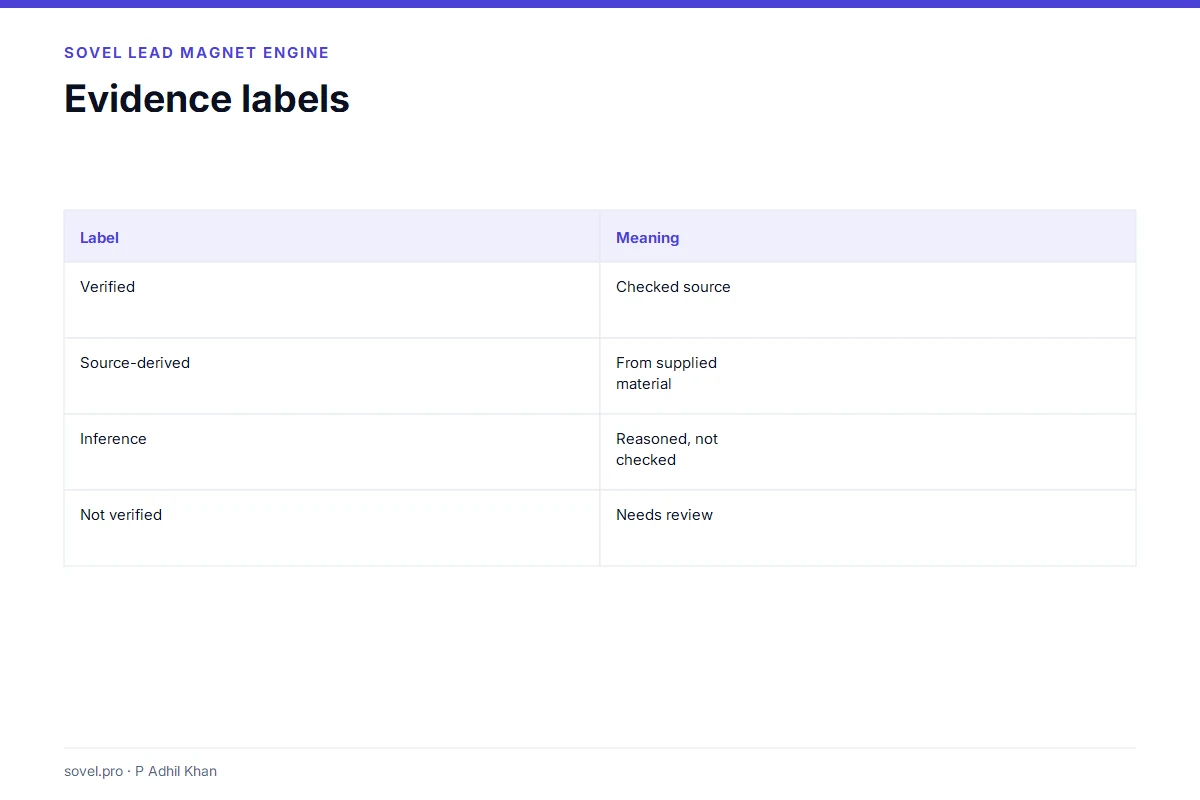
Use four labels:
- Checked. Someone opened the source.
- Supplied. The claim came from the client material.
- Reasoned. The claim follows from the material but was not checked.
- Open. The claim still needs a human check.
A lead magnet quality checklist should sample at least five claims. If the draft makes a strong claim with no label, the draft is not ready. If the draft labels everything as verified without a source, the labels are decoration.
The evidence ledger is the fastest way to run this check. Open the ledger, pick the claims that would cost the client money if they were wrong, and check the label.
Check 3: Does every section have one job?
The third check is structure. Every section should have one job. Merge two sections that teach the same thing, and remove a section that has no job.
A lead magnet quality checklist should read the headlines in order. The headlines should tell a story. If the order feels random, the reader will stop.
The section anatomy helps. A headline, an opener, a mechanism, a framework, an example and a closing rule. If a section is missing two or more parts, it is probably a note, not a section.
The check is not about length. A short section can do one job well. A long section can do three jobs badly.
Check 4: Is the language clear?
The fourth check is language. Clear writing is not simple-minded writing. It is writing that does not make the reader work to understand the point.
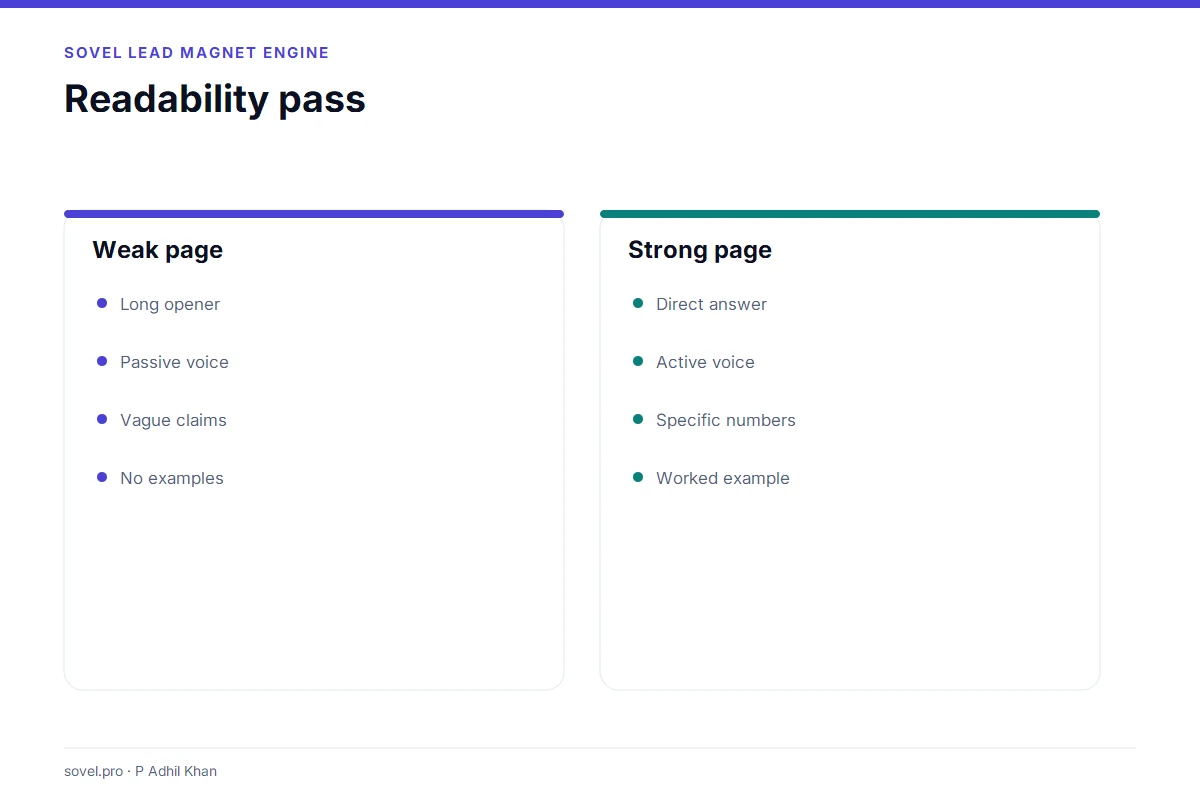
A lead magnet quality checklist should look for long sentences, passive voice, vague claims and stock phrases. It should also look for hype. A sentence that promises a revolution in a checklist about onboarding is a warning.
Read the draft aloud. If you run out of breath, the sentence is too long. If you cannot explain a sentence to a colleague, it is too abstract. If the sentence could open any article on the topic, it is filler.
Check 5: Do the links resolve?
The fifth check is links. Every internal link should point to a live page. Every external link should point to a source that exists and supports the claim.
The checklist should test the links in a browser, not just in the editor. A link that returns a 404 is worse than no link because it wastes the reader’s trust.
Check the anchor text too. A link that says “click here” tells the reader nothing. A link that names the source helps the reader decide whether to click.
The external link should be relevant. A link to a random blog that summarizes a study is weaker than a link to the study. A link to a page that has not been updated in five years is a freshness risk.
Check 6: Are the images useful and accessible?
The sixth check is images. Every image should do a job. A diagram explains a structure. A screenshot shows a step. A chart shows a comparison. A decorative image that adds nothing is a distraction.
A lead magnet quality checklist should check the alt text. The alt text should describe the image for a reader who cannot see it. It should not be a keyword dump.
Check the file size too. A large image slows the page. A compressed image loads faster and looks the same at the size it is displayed.
Check the caption. A caption should add context, not repeat the alt text. If the image is self-explanatory, the caption can be short.
Check 7: Is the review status visible?
The seventh check is review status. The reader should know whether the draft is final, reviewed or still a draft. A lead magnet that looks finished but has not been reviewed is a risk.
A lead magnet quality checklist should confirm that the draft label is present. It should confirm that the reviewer is named. It should confirm that the claims that need a source are flagged.
The review status is not a legal disclaimer. It is a communication tool. It tells the reader what to expect and tells the team what still needs work.
Check 8: Is the export usable?
The eighth check is the export. The PDF should open on a phone. The DOC should open in Word. The HTML should load without a server. The Markdown should survive a CMS paste with its tables intact.
A lead magnet quality checklist should test every format the client will receive. A PDF that looks fine on a desktop can break on a phone. A DOC that opens in LibreOffice can lose a heading in Word.
The export should include the editable source and the review record. A PDF alone is not a handoff. The client needs a file they can change and a record they can check.

How do you run a lead magnet quality checklist?
Run the checks in order. Promise, evidence, structure, language, links, images, review, export. The order matters because a failure early makes the later checks less useful.
If the promise is vague, do not spend time checking the links. Fix the promise first. If the evidence is missing, do not polish the language. Fix the claims first.
Use a simple score. Pass, fail or needs review. Do not use a ten-point scale unless the team agrees on what each point means. A checklist with ambiguous scores is a checklist nobody uses.
Record the result. A short note next to each check is enough. The note helps the next reviewer and the client. It also shows that the check was actually run.

What should a lead magnet quality checklist not do?
It should not replace a fact-check. A checklist can label a claim, but someone still has to check the source. It should not replace a legal review. A checklist can flag a risky claim, but a lawyer decides.
It should not replace a client review. The client knows the business and the audience. The checklist knows the structure and the evidence.
It should not become a bureaucratic ritual. If the team fills the checklist without reading the draft, the checklist is theater. The value comes from the reading.
How does a lead magnet quality checklist fit an engine?
An engine can run part of the checklist automatically. It can check the section count, the repeated sentences, the missing examples, the placeholder count and the link list. It can write a report that names the failures.
The engine cannot run the promise check. It does not know whether the promise matters to the reader. It cannot run the evidence check. It does not know whether the source is credible. It cannot run the client review. It does not know the business.
A useful division of labour gives the mechanical checks to the engine and the judgement checks to the human. The engine produces a first pass. The reviewer spends time on the parts that need judgement.
That division is why a quality checklist belongs inside the production workflow, not after it. If the engine can catch a repeated section before the reviewer opens the file, the review starts at a higher level.
What does a sample pass look like?
A sample pass has a note for each check. The promise is specific. The evidence has five labels and two flagged claims. The structure has five sections with one job each. The language is clear. The links resolve. The images have alt text. The review status is visible. The export opens in Word and on a phone.
The note does not need to be long. “Promise: specific, reader and result named” is enough. “Evidence: 7 claims, 5 verified, 2 flagged” is enough. “Links: 4 internal, 2 external, all 200” is enough.
The sample pass is useful because it shows what “done” looks like. A checklist without an example becomes a debate about standards. An example makes the standard concrete.
A failed pass should name the failure and the owner. “Promise: vague, owner: writer” is better than “promise weak”. The owner and the action make the next step obvious.

What should the reviewer read first?
Read the promise first. If the promise is vague, the rest of the review is guesswork. Then read the section headlines. If the headlines do not tell a story, the structure needs work before the sentences.
Then read the claims. Pick the three that would cost the client the most if they were wrong. Check the label and the source. Then read the intro and the closing. The intro should answer the reader’s question. The closing should give the next step.
Read the draft once on a phone. The screen is smaller and the distractions are real. A section that feels fine on a desktop can feel endless on a phone. The phone read is a useful test for a lead magnet.
What is the smallest useful review?
One promise, five claims, four links and one DOC. If those pass, the draft is ready for a second reader.
The checklist is short on purpose. A long checklist gets skipped. A short checklist gets used.
A used checklist beats a perfect one.
The checklist is a floor, not a ceiling.
Use it before every client send.
For accessibility and search guidance, see the W3C accessibility introduction and Google Search Central.
Frequently asked questions
What is a lead magnet quality checklist?
A lead magnet quality checklist is a set of tests for the promise, evidence, structure, language, links, images, review status and export. It is the last gate before publication.
How many checks should a lead magnet quality checklist have?
Eight checks are enough for most drafts. A regulated or client-facing asset may need more. The checklist should cover the risks that matter for the project.
Who should run the lead magnet quality checklist?
The writer can run the first pass. A second reviewer should run the evidence and link checks. The client should review the business claims. The checklist does not replace any of those roles.
Can a lead magnet quality checklist be automated?
Parts of it can. A tool can check links, image alt text, repeated sentences and missing sections. A human still has to check the promise, the evidence and the tone.
What is the most common failure?
The most common failure is a vague promise. The draft is well written and the reader still cannot tell what they will get. Fix the promise before the polish.
How long should the checklist take?
A short checklist can take twenty minutes. A client asset with several claims can take an hour. The time should match the risk.
Does a lead magnet quality checklist guarantee a good lead magnet?
No. It catches visible problems. It cannot make the idea interesting or the evidence true. It raises the floor.
What should I do after a failed check?
Fix the failure and run the check again. Do not move to the next check until the current one passes. The sequence is the point.
The publish gate
A lead magnet quality checklist is a gate, not a ceremony. It protects the reader from a draft that looks finished and is not. It protects the writer from a client question that has no answer. It protects the client from a claim that was never checked.
Run the eight checks. Record the result. Fix what fails. Then publish. The checklist is short enough to use and specific enough to matter.
Use the checklist before the next client send, not after the complaint. The SOVEL Lead Magnet Engine page shows the draft and ledger. For the production flow, read the lead magnet creation workflow. For the format choice, read the nine lead magnet formats. For client work, read lead magnet software for consultants.