
Before you ship code a model wrote, verify AI generated code against evidence, not confidence. When you verify AI generated code release is the moment the “done” message stops mattering. These 7 release checks give you a clear verdict: pass, partial, or fail. I use them on every build and they catch real defects early.
AI output looks finished and often is not. A confident “done” message is not evidence. A passing demo is not a test suite. This guide walks the 7 checks I run before any release, with the exact records I keep and the limits I state out loud. The order matters, because each check assumes the one before it passed.
Summary
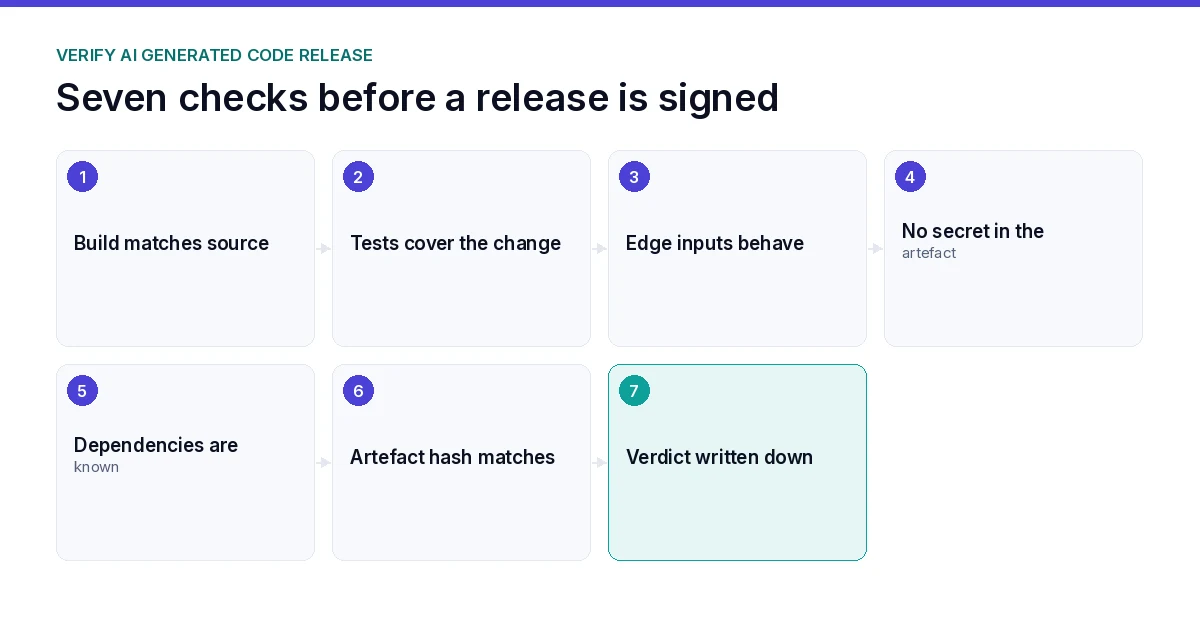
Verify AI generated code release with seven evidence checks before anything ships. The checks cover build, tests, edge inputs, secrets, dependencies, packaging, and a written verdict. Each check leaves a record you can read later instead of trusting a done message.
Why AI code fails in ways human code does not
AI generated code has its own failure shapes, and a verify AI generated code release run is what surfaces them. Knowing the patterns tells you which checks matter most.
Common patterns: invented APIs that almost exist, error paths that never run, extra files nobody asked for, and copied patterns that break your project’s contracts. A model aims to look correct in the reply. Your release needs actually correct on your machine, with your data, under your error conditions.
One habit prevents most of it. Treat every generated file as untrusted until a check confirms it. That single stance keeps verify AI generated code work honest.
Check 1: Build and load on a clean environment
The first check in a verify AI generated code release run is blunt. Does the code build on a machine that has never seen it? Clean means a fresh clone, fresh install, no leftover caches.
Run the documented install and build. If the package lists scripts, run them. Node projects here target Node.js 22.5.0 or newer, matching the engine requirement I use on my own builds (source: official Node.js docs, checked 18 Oct 2026). Version drift breaks installs quietly, so pin the runtime in your notes.
A clean build failure is a gift. It costs minutes now and saves a rollback later. Record the exact command and output. That record is the first page of your release evidence.
the official Node.js download page
Where the verify AI generated code release step sits in your loop
If you already lock a plan and split work into tasks, this verify pass is the gate that closes each task. When you verify AI generated code release, you are finishing the loop, not starting paperwork. The plan says what should exist, the task produced files, and the checks decide whether those files earn a release.
Place the verify step right after implementation and before any merge to your main branch. Do not wait for a release day to run all seven checks at once. Running them per task keeps each failure small and the fix obvious. By release time, the final verify AI generated code release pass is mostly a re-read of records, not a scramble.
Teams that skip this placement pay twice: once when defects pile up in review, and again when users find what review missed. One gate per task keeps both costs near zero.

Check 2: Tests pass and cover the claims
The second check asks the model’s work a direct question: do the tests pass, and do they cover what the task claimed?
Run the full suite, not a filtered subset. Note counts: how many tests ran, how many passed, how many were skipped and why. A suite that skips the new code proves nothing about it.
If coverage for the new file is thin, add a test before release, not after. Two focused tests on the new logic beat fifty generated tests on old code. Keep the output log next to the task notes so the claim and the proof sit together. Thin coverage quietly downgrades everything that follows in the verify AI generated code release pass.
Check 3: Edge and invalid inputs
Models test the happy path in their heads and move on. Your users will not oblige them.
List the edges before you run anything: empty input, huge input, wrong type, unicode, zero, negative, missing file, duplicate submit, offline mode. Feed each one through the new code and watch behavior. A crash on empty input ships to a real user within a week of release, in my experience.
Record which edges you tested and what happened. “Empty string returns validation error” is a record. “Looks fine” is not. This check alone justifies the whole process because it is where generated code fails loudest, and an edge record is what a verify AI generated code release audit reads first.
Check 4: Secrets, logs, and data leaks
The fourth check reads the diff with security eyes only. You are hunting for leaks, not style.
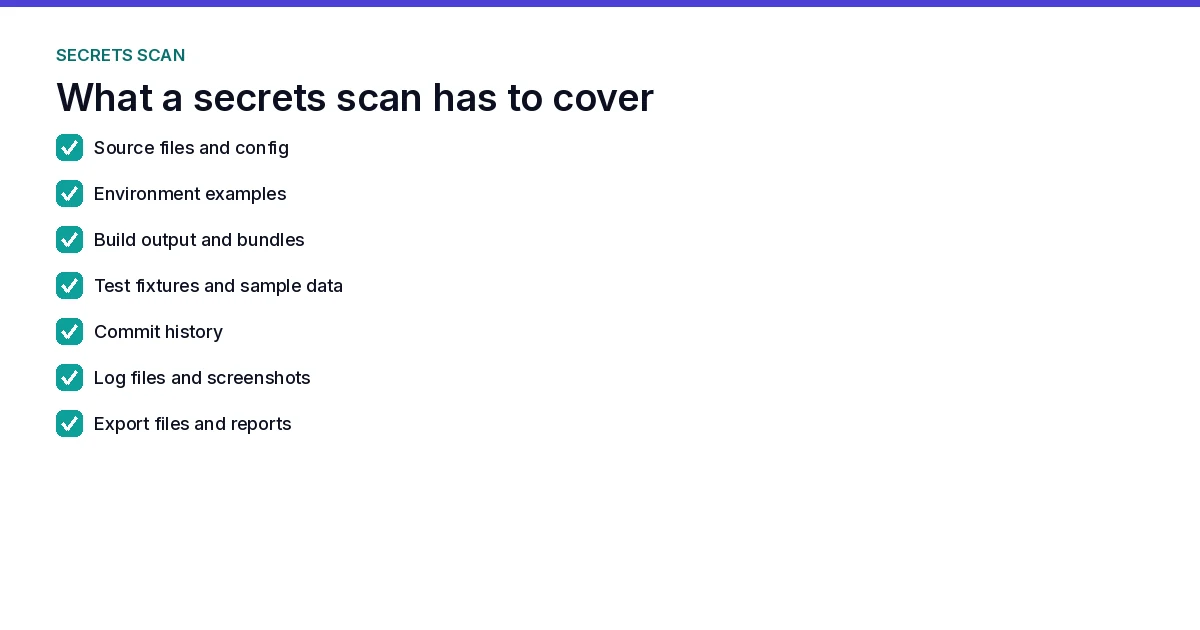
Grep the new files for keys, tokens, passwords, and emails. Confirm no value gets written to logs, URLs, or error messages. Check that any secret reads from environment variables or a vault path, never from a hard-coded string the model “helpfully” included as an example.
Also review network calls. Every new outbound request should be expected, documented, and limited. One review pass with a leak checklist catches what scanners miss because the model’s leak usually looks like a plausible default value, not an attack. This is the part of a verify AI generated code release pass that protects your users rather than your schedule.
Check 5: Dependencies and versions
Generated code loves dependencies. Sometimes the love is justified. Often it is not.
For every new package, ask three questions. Does this solve what a 20-line standard-library function could not? Is the version pinned? Is the maintainer active? A dependency added for one utility function is a liability you will carry for years.
Check the license too. Copyleft in a component you planned to sell becomes a legal question you do not want. List every addition with version and license in the release notes. When in doubt, write the small function yourself and keep the dependency graph flat. Answering these three questions badly at this stage sinks the verify AI generated code release later.
Check 6: Artifact and packaging verify
The sixth check verifies what you will actually ship, not what sits in your working folder.
If the project builds an archive, open that exact archive. Confirm the manifest lists the right files, checksums match, and no stray file rides along: no .env, no test databases, no editor swap files, no personal notes. A clean source folder can still produce a messy package if the build script globs too widely. In my verify AI generated code release notes, the artifact row is where packaging problems show up first.
Check 7: Reviewer evidence and verdict
The last check is human. A second set of eyes reads the diff against the task, with the records from checks 1 to 6 in hand.
The reviewer does not re-run everything. They read the claims and the evidence side by side. Does the test output cover the claimed behavior? Do the edge records show real inputs? Does the dependency list match what the diff added? Gaps here are questions, and questions are cheap before release.
Then write the verdict in one line each: pass, partial, or fail. Partial means shipped with a named, tracked limitation. Fail means back to a bounded fix task. No verdict means no release, whatever anyone’s deadline says. That one-line record is the final deliverable of every verify AI generated code release.
The verdict table I keep
Every verify AI generated code release I sign off carries a small table. Check name, command or method, result, evidence file. Six rows plus a verdict line. Anyone on the team can audit the release in five minutes without asking me questions.
This table is also how you improve the checks. After a defect escapes to users, ask which row should have caught it. The answer usually points at a missing edge case or a skipped test, and the table gets one line stronger.

What these checks cannot do
Honest limits first. These checks raise the odds of a clean release. They do not prove correctness in some absolute sense, and they do not replace the plan you locked before building. Even the best verify AI generated code release routine stays inside that boundary.
They also do not verify claims about live services. A provider adapter existing in your codebase is not proof that live authentication works. A demo run with mock output proves the demo path only. Label each evidence type as you collect it: mock, offline, component, live. I keep that labeling rule on my own engine builds too, and it has saved me from two embarrassing overclaims (sources: SOVEL engine usage docs, read 18 Oct 2026).
Nor do checks fix a bad idea. If the requirements were vague, the checks will verify vague work accurately. Garbage verified is still garbage. Start upstream with a locked plan.
verifying AI generated content
The records worth keeping
Every verify AI generated code release pass leaves a small paper trail. Keep five things: the task note, the test log, the edge list with results, the dependency diff, and the verdict line. Together they fit in one folder or one ledger entry, and they turn release decisions into reading instead of guessing.
Store them where the next session can find them. If your project keeps state in a local database or reports folder, append there. When you resume after a break, or hand work to another client on the team, those records replace memory. I have recovered whole releases from five files after a machine reset, and the only reason it worked is that the verify AI generated code release evidence lived outside the chat window.
Retention is simple: keep release records for as long as you support that version. Delete them early and your future bug reports become archaeology.

A short worked example
Last month I shipped a small parser change written by a model in one pass. Check 1 failed immediately: the package script pointed at a test file that never existed in the archive. That was a packaging bug, found in two minutes, fixed before any user saw it.
Checks 3 and 4 then earned their keep: empty input crashed the parse step, and a sample key sat in a debug log line. Two bounded fixes, one re-run, clean verdict. The whole verify AI generated code release pass took forty minutes and prevented a rollback that would have cost an afternoon.
That is the trade. Forty minutes of checks against hours of firefighting. Do it enough times and the habit runs itself.
Five mistakes that weaken any verify pass
Watch for these, they show up in every team I have audited.
Skipping the clean environment. If you test only in the folder where the model worked, leftover files cover the packaging bugs you needed to see. A fresh clone is the honest test.
Trusting filtered test runs. A green subset tells you nothing about the files you just changed. Run the full suite and note what was skipped.
Treating scans as judgment. Secret scanners and linters inform the verify AI generated code release decision; they do not make it. A clean scan with no edge tests is still an unverified release.
Waiting for release week. All seven checks at once on Friday afternoon is how mistakes slip in. Per-task gates keep the same checks calm and quick.
No written verdict. An unstated conclusion decays into memory by the next day. One line, pass or partial or fail, ends the discussion with a record both sides can read. That line is what makes a verify AI generated code release auditable instead of argued about.
How long the verify pass should take
Timebox it. For a normal task under a hundred changed lines, the seven checks take me twenty to forty minutes once the suite runs fast. Long builds stretch check 1, and that is a build-system problem worth fixing separately, not a reason to skip the pass.
If your verify AI generated code release pass regularly eats half a day, the task was probably too large. Split the next one smaller and the checks shrink with it. Small tasks are the cheapest way to keep verification cheap.
Track your own numbers for a month. Mine settled at about half an hour per task, which is far less than the two-hour rollbacks I used to run before this habit existed.
A template you can copy today
Steal this five-line release record and adapt the names:
Task: what changed and why. Checks run: build, tests, edges, secrets, deps, artifact. Results: pass counts and notable failures. Fixes applied: one line each, with the re-run result. Verdict: pass, partial, or fail, with the approver name and date.
That block goes into your release note, commit message, or ledger entry. When the verify AI generated code release question comes up in a support thread next quarter, you answer from the record instead of reconstructing events from memory. New team members read one record and understand the standard without a meeting.
Print it, pin it in your repo docs, and keep every release to the same shape. Consistency is what makes the records searchable, and searchable evidence is what makes releases boring in the best way.
the twelve check release checklist
FAQ
How do I verify AI generated code before release?
Run seven checks in order: clean build, full tests, edge inputs, secret and log scan, dependency review, artifact checksum, and a reviewer verdict of pass, partial, or fail. Keep the evidence next to each claim. That is the complete verify AI generated code release routine in one line.
What is the fastest useful check when time is short?
Clean build plus the full test suite. Those two catch install breaks and obvious regressions. If either fails, release is blocked regardless of anything else. Any rushed verify AI generated code release should start at that minimum.
How many tests are enough for generated code?
Enough to cover the code the task claimed to change, with the new logic exercised directly. Test count matters less than whether the changed behavior is actually asserted.
Can I rely on the model saying the task is done?
No. A done message is a claim, and no verify AI generated code release should rest on it. Treat the message as a request to run your checks. The evidence decides, not the message.
Do these checks work for non-code deliverables?
The shape transfers: build, test, edge, leak, dependency, artifact, verdict. Adapt each check to the deliverable, and keep labeling evidence as mock, offline, or live.
What is a partial verdict?
Partial means you ship with a named limitation that is written down and tracked. It is honest shipping, not a loophole. If you cannot name the limitation, you are at fail.
When should I skip this process?
For throwaway scripts you will delete today. For anything with users, data, money, or your name on it, run the full verify AI generated code release process.
Clean releases come from small gates, run every time. Verify AI generated code with these seven checks, keep the evidence, and let the verdict, not the deadline, decide. If you want the same gates built into your workflow with a ledger and plan-lock, see how the governed loop runs in the engine docs on this site.