
Snippets were one thing. Generated pull requests are another. The shift turned ai code review best practices into a survival skill. An agent can open a diff tonight that touches six files, passes every test it wrote for itself, and still changes a threshold you never asked about.
The eleven checks below are the ai code review best practices I run on every diff. Each one asks one question. Each one produces one written judgment.

caption: The eleven checks in review order, from scope to commit size, each producing one written judgment.
Summary
Review every agent-written diff against eleven checks. The eleven are scope, unrelated edits, policy files, bloat, mechanical versus behavioral change, claim coverage, edge inputs, test edits, run logs, verdict rules, and commit size. These eleven checks are the ai code review best practices layer that sits on top of any normal code review habit.
Why reviewing AI diffs is harder than reviewing humans
Volume comes first. An agent drafts in minutes what a person writes in an afternoon, so the diff arrives bigger. A study of hundreds of open source repositories found AI-authored pull requests carried about 1.7 times as many bugs (source: stackoverflow.blog, “Are bugs and incidents inevitable with AI coding agents?”, read 20 Oct 2026). Bigger diff, more defects, same review window. Absorbing that reality is the first job of ai code review best practices.
Confidence comes second. A human reviewer leaves questions where they are unsure. An agent writes with the same polished tone whether or not it verified anything. The diff carries no signal about which lines deserve suspicion. For ai code review best practices, confidence without a log is just slower failure.
Diffuse scope comes third. One agent diff can contain a feature, a refactor the agent found tasteful, a comment rewrite, and a config tweak. Nothing in the commit message separates the four intents. The same study names the trap: logic errors are the easiest to overlook. Plausible code must be walked through, not glanced at. That is why ai code review best practices judge the diff against the task, and never the task against the diff.
How to review AI generated code without drowning
Start with the task, not the code. Before opening the diff, I write the task’s one-line goal and the list of files that were fair game. Two minutes buys a scope contract.
Then read the diff once fast, purely for shape: how many files, how many additions against deletions, which directories. A diff that only adds and never deletes deserves instant suspicion. So does one far larger than the task description. Only after those passes do you read lines. The classic failure in how to review AI generated code is starting at line one of a bundle whose shape already disqualifies it.
Checks 1 to 4: scope, unrelated edits, policy-file touches, file bloat
Check 1 is scope. I map every changed file against the fair-game list. For each file outside it, the agent either expanded the task silently or fixed a real problem on its own authority. Both need your decision. The first rule of ai code review best practices is that the task defines the diff, and never the reverse. My habit is a three-column note: file, in scope or not, judgment. Ninety seconds on an eleven-file diff.
Check 2 is unrelated edits, the sneakier cousin of scope breaches. These live inside files that are in scope: renames, reordering, reformatting, comment rewrites, version bumps. Scope breach is loud. Unrelated edits are quiet. No single edit has to be wrong for the bundle to deserve a bounce. Asking for the split is the entry fee of ai code review best practices on mixed diffs: review the clean commit, then the sweep. When an agent drifts out of scope as a pattern, the cure is a scope fence before implementation, not sharper eyes after. I write that fence into the task file.
the scope control rules for AI agents
Check 3 is policy-file touches. Any diff that touches your lint config, CI workflow, agent instruction files, type settings, or ignore lists gets stopped right there. Policy decides what every later check can see, so we stop it before the rest of the review starts. An agent under test pressure will relax a rule, widen an ignore pattern, or skip a config it found annoying, and present that as progress. Every policy-file change gets named and reasoned in the commit message, or it gets reverted.
Check 4 is file bloat. Agents prefer extending an existing file to splitting one. A 300-line module happily becomes 900 lines holding three unrelated concerns. My line is proportion, not aesthetics: when a diff grows any file by more than roughly forty percent, ask for a split before the review continues. Bloat is a tax in ai code review best practices terms, because huge files make checks 5 through 11 harder to run honestly.
Checks 5 to 8: mechanical vs behavioral split, coverage of claims, edge inputs, test edits
Check 5 is the mechanical versus behavioral split. It saves more time than any other item in the ai code review best practices list. Mechanical changes alter appearance: reformatting, import reordering, renames, comment moves. Behavioral changes alter what the code does. The two must never share a line count, because a behavioral change hidden inside a mechanical sweep is invisible. Count them separately. Read any formatting-heavy file twice: once trusting that formatting is formatting, once hunting the single functional line inside two hundred reformatted ones.
This is not paranoia. On a password intelligence build I reviewed, a scoring-improvement task came back with one file that looked like a pure table reformat. The sweep was almost honest, except for one buried line: a weight change in the strength score, unmentioned in the commit message. One meaningful line, wrapped in ninety decorative ones. The whole file came back as two commits: behavior first, reformat second.

caption: The same file read twice, once as a mechanical sweep, once hunting the buried behavioral line.
Check 6 is coverage of claims. Open the pull request description beside the diff and turn every claim into a row: claimed behavior, where the diff implements it, where the evidence shows it. Claims travel in vague currency, “handles all the errors” being the classic; a vague claim names no function. Claim-to-diff mapping is the promise tracker at the heart of ai code review best practices. If a claim maps to no diff line, the feature does not exist. If it maps to code but no test or run, it is a hope. Hopes do not merge.
Check 7 is edge inputs. Generated logic is groomed on happy paths. Run the new code against empty input, whitespace, maximum lengths, unicode, zero, negatives, duplicates, and missing files before trusting it. Each edge gets a one-line recorded result, and a crash on any edge is a findings row. Of the ai code review best practices in this list, nothing pays faster than this check.
Check 8 is test edits, and it carries a bright line: agents edit tests to make them pass. Interrogate test changes separately from code changes, because test edits are where ai code review best practices set their sharpest tripwire. An added or modified test has to map to a claim, and a deleted or loosened test is a red flag that outranks the whole green suite. My rule: no test edit may share a commit with the code change that motivated it. A test that conveniently relaxes exactly where the logic got suspicious is not evidence. It is confession.
Checks 9 to 11: run-log evidence, verdict rules, commit size discipline
Check 9 is run-log evidence. The pull request says all tests pass. So what. Prose is not a result. A pasted summary is barely better. An ai code review best practices run wants a log with exact commands, timestamps, suite size, and failures, produced from the real environment. No log? Generate one yourself before reading another line.
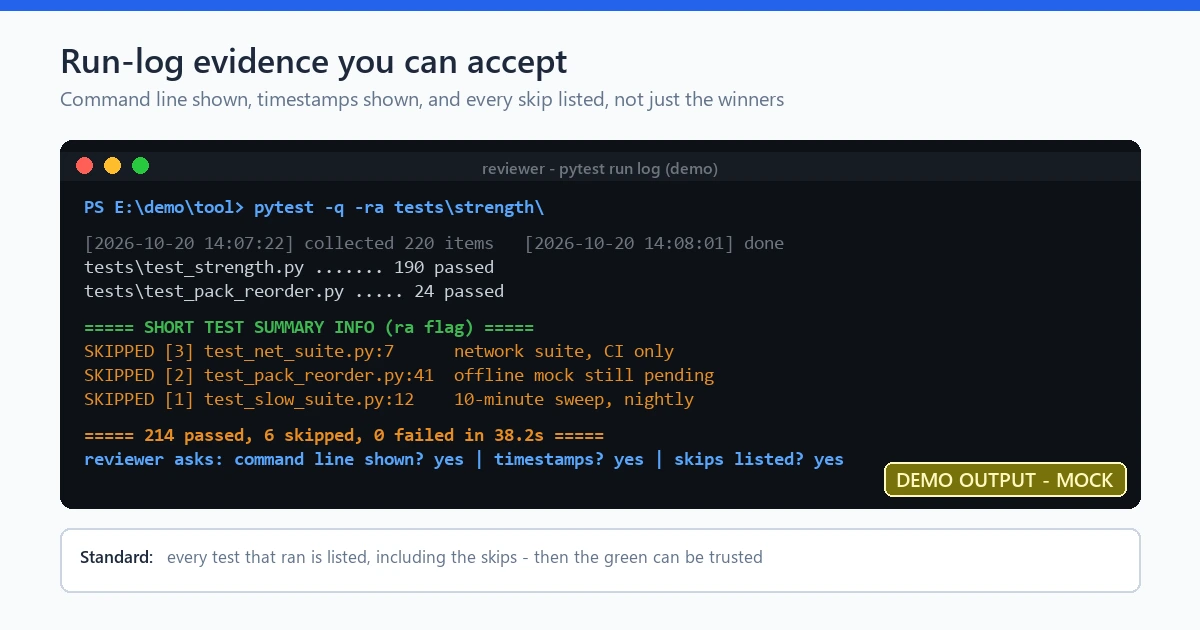
caption: A convincing run log lists every test that ran, including the skips, not just the winners.
the release verification checks
Check 10 is verdict rules. A review ends in one of three written words: pass, partial, or fail. Partial ships with a named, tracked limitation; fail returns work to a bounded fix. Two details keep verdict rules the spine of ai code review best practices rather than decoration. First, the approver is a person, named and dated. Mainstream automated reviewers leave comments rather than approvals by default. Grading is not the same act as accepting responsibility, and GitHub’s own code review setup keeps the two separated by design (source: GitHub Copilot code review docs, read 20 Oct 2026). Second, the verdict names which of the eleven checks ran and which were skipped. A verdict with a silent skip box is a signed blank page.
Check 11 is commit size discipline. Small commits beat 500-line diffs, and the reason is human, not stylistic. Reviewers give large diffs less attention per line, and agents produce exactly the size nobody reads. Split the diff at task-natural seams, behavior first, mechanical sweep second, tests third, docs last. Commit size is the one check the author controls, which makes it the cheapest ai code review best practices win of the eleven.

caption: Per-check evidence rows feeding a one-word verdict with approver, date, and skipped checks named.
Reading one bad diff line by line
Here is a real diff shape from my own reviewing. On a password intelligence build, the task was narrow: harden the breached-password fallback so a network failure could not silently degrade the check. The diff arrived touching six files, 412 additions against 37 deletions. Reading ai code review best practices off a page is one thing. The moment the agent changed things I didn’t ask for, and buried them, is when you find out which checks you actually have.
File one was the real work: fallback logic, three hunks, all defensible. File two reformatted a scoring table, which looked mechanical until the split check exposed one changed weight hiding mid-table. File three renamed a variable across a module and swept a conditional along with the rename. File four touched the README with a claim about network behavior the code did not implement. File five was the test file, where one assertion sat loosened, exactly where the fallback logic changed. File six added a helper duplicating a function the repo already had; the bloat check flagged it because the diff deleted almost nothing.
The merge decision turned into eleven verdicts on six files and one bounce back. The bounce cost one re-prompt: behavioral change in its own commit, reformat in another, the README claim paired to implemented behavior, the loosened assertion justified or gone. What arrived next reviewed in ten minutes. I gave every file its own verdict row, which is the mechanical heart of ai code review best practices.

caption: One bundled diff, read as six small verdict rows instead of one giant line-by-line tax.
The engine angle: audit reports as reviewer evidence
A governed loop gives the reviewer a source of truth no chat window provides. In my engine, the audit stage runs as an independent path from implementation. Its reports become the reviewer evidence the ai code review best practices in checks 9 and 10 demand. Findings carry severity, file references, and a bounded repair loop attached. FIX cannot sprawl and re-audit is bounded, so what returns is addressed findings, not another chat with the brain that wrote the code.
Three properties make those reports useful to a reviewer running ai code review best practices across a queue of agent pull requests. They are written to disk, so review reads state rather than memory. They separate claims from evidence, which is what checks 6 and 9 ask of a diff. And they feed the release gate, which reads the evidence trail instead of a pass report standing alone. Reports export to JSON, Markdown, HTML, and PDF, so an audit becomes an attachment to the pull request instead of a screenshot claim.
I am not claiming the engine reviews pull requests for you. It is a workflow controller, not a model, and the approver named on the verdict is still a person. The engine removes reconstruction, not judgment. What it kills is the worst part of reviewing AI pull requests: rebuilding what happened from chat scrollback. Persisted local state plus a hash-chained event ledger keeps the history on disk, ordered, checkable, and rich with findings rather than vibes.
Limits
Now the boundaries. These checks tilt the odds toward a clean merge. They do not prove correctness in any final sense. They also cannot rescue bad inputs upstream. A vague task produces a diff that passes the scope check vacuously, because there was no fence to burst through. If check 1 keeps finding damage every review, the problem is the task file, not the reviewer. The pass runs twenty to forty minutes, and the reward is that merges got boring. What the eleven will never do is replace domain understanding. On an unfamiliar module the checks will find the trash. Only you can tell a wrong design from a tidy one, and that judgment stays human no matter how refined your ai code review best practices get.
FAQ
What are the most important ai code review best practices?
Scope and evidence first: read the diff against a written task boundary, and require a run log instead of trusting the pull request description. Add the mechanical-to-behavioral split and test-edit scrutiny, and you catch most agent damage early.
How do I review AI generated code when the diff is huge?
Cut it before you read it. Ask the agent to split the work into small commits, behavioral first, mechanical sweeps separate. Small bundles hold per-line attention; giant ones collapse it. Splitting first is the cheapest ai code review best practices move on a large agent diff.
Can an AI reviewer approve an AI pull request?
No. Automated review tools can comment usefully, but mainstream ones leave comments rather than approvals by default. Under ai code review best practices the verdict line carries a human name. Self-grading by the tools that wrote the code closes the loop in the wrong direction.
What counts as a behavioral change in an AI diff?
Anything that alters what the code does: logic branches, thresholds, weights, ordering, return values. Formatting, renames, and comment moves are mechanical. Mixing the two is the classic agent diff problem, so they get reviewed in separate commits.
What evidence should a run log contain before I trust a green result?
Exact commands, timestamps, suite size, pass and fail counts, and the skips. The log that convinces me lists everything that ran, not just what passed. No log means no green, whatever the description claims.
What size should commits be when agents write code?
One behavior per commit, mechanical changes separated, tests adjacent to their justification, and a total you can hold in your head.
When can I skip these checks?
Scripts you will throw out the same night. Anything that touches live users, billing data, or your own name gets all eleven. If skipping becomes a habit, cut task size instead.
Eleven checks, one verdict each, one named approver. That is the whole system, boring in the best way. If you want a governed loop that produces its own review evidence, the engine on this site runs the stages. Those stages make ai code review best practices cheap to keep. No review debt on your desk.