
An ai code security review answers the question developers search after an agent hands over its work. Is AI generated code secure? The honest answer is no. Code that compiles, runs, and passes a demo can still carry a hard-coded key, an open endpoint, or a log line that prints a credential. The gap between looks secure and is secure is what an ai code security review exists to close. I run it on every build that carries my name: nine checks, three passes of three, each assuming the pass before it came back clean. Skip it, and a green test suite will happily hide a leak for months.
Security teams now watch agent outputs, not just user inputs. Model replies, agent-written logs, and helper files give credentials new exits (source: fiddler.ai security blog, read 20 Oct 2026). No review can ignore that door.
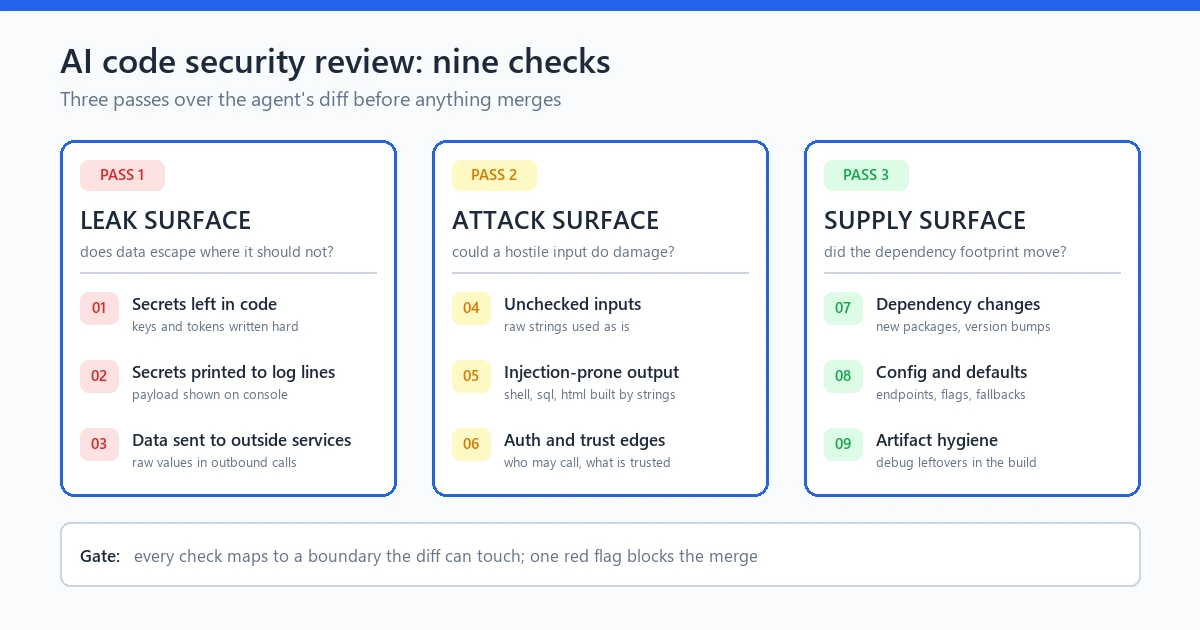
caption: The nine checks in three passes: leak surface, attack surface, supply surface.
Summary
An ai code security review reads agent-written code with an adversarial lens before merge. The nine checks cover secrets and credentials, data leaks, sensitive data flow, input paths, injection surfaces, auth edges, dependencies, configuration, and the shipped artifact. Each check leaves one line of evidence. The verdict is a record, not a feeling.
Is AI generated code secure? Why it fails security differently
The question is AI generated code secure has a sharper version. Why does generated code fail in security ways human code usually does not? Answering that well is the whole point of an ai code security review.
Three reasons, all observed on my own builds. Confident invention: a model writes with total fluency whether the pattern underneath is safe or not. Borrowed habits: public code taught them example keys and demo configs, and those anti-patterns arrive pre-installed. Unverified data flow: an agent wires input to output and never asks who else stands on that path.
The OWASP Top 10 for LLM applications tracks prompt injection, sensitive information disclosure, and supply chain weakness among the core risks of model-backed systems (source: OWASP Top 10 for Large Language Model Applications, read Oct 2026). This ai code security review turns those risks into nine concrete diff-level checks.
One stance changes everything: treat every generated file as untrusted until the checks clear it. Every file starts untrusted.
Checks 1 to 3: secrets, credentials and data leaks
The first pass of an ai code security review hunts the most common failure: secrets in AI generated code.
Check 1: hard-coded secrets and credentials
Start with the diff. Grep the changed files for keywords: key, token, secret, password, bearer, api. Then hunt the sneaky cousins: placeholder values such as YOUR_API_KEY, config defaults, and comments quoting a real-looking credential.
Secrets belong in environment variables or a secrets manager, and the diff should show code reading them from there. Scan git history too. A key committed earlier survives after the working copy looks clean, so rotate anything that touched shared history (source: OWASP Secrets Management Cheat Sheet, read Oct 2026).
Check 2: leaks in motion, the post-execution guardrail angle
Static scanning catches values at rest. This check catches them in motion. Read every log statement, error message, and outbound URL in the diff. Then ask what rides along: a token in a query string, an email echoed by a validation failure. Each is a leak once the log meets a support ticket.
Agents raise the stakes. They write their own logging. One of my builds had a debug line that printed the full request payload for an API call. Headers included. Tests passed. The demo worked. Only a line-by-line read caught it. That is the half of an ai code security review no scanner replaces.
Check 3: where data flows and what leaves the machine
Map the flow: list every value a person would call private (passwords, tokens, personal fields, customer records). Then trace each one. Where is it read, where stored, which calls does it cross, which dependencies receive it?
A flow with no documented exit is fine; a flow that leaves the machine needs a named reason. My standard is simple. Private values stay local unless the diff proves the exit is intended and protected. Data flow mapping is the quiet core of an ai code security review, and scanners cannot do it for you.

caption: Pass one reads the diff three ways: values at rest, values in motion, values in flight.
Checks 4 to 6: input paths, injection surfaces and auth edges
The second pass attacks the code the way a stranger would. An ai code security review earns its keep here more than anywhere else, because agents build features forward while attackers walk in backward. Build forward. Attack backward.
Check 4: every input path, listed and validated
List every input. In an ai code security review that means query parameters, request bodies, file reads, CLI arguments, event hooks, and stored values another component wrote earlier. The diff should show validation at each boundary before a value reaches business logic. Length limits, type checks, and range caps are cheap lines that remove whole bug classes.
Filesystem paths deserve a special look. Any input that forms part of a path must stay inside the intended directory after normalization. Agents recreate traversal bugs regularly inside download and export features.
Check 5: injection surfaces, including the prompt kind
Read each input again and ask which interpreter meets it downstream: SQL meets quoting errors, shell commands meet metacharacters, templates meet interpolation tricks. The fix is structural. Parameterized queries, argument arrays instead of concatenated commands, escaping matched to the destination.
There is a newer surface, and every sane ai code security review now treats it as first class: prompt injection. An agent that reads a web page or a document before writing code can be steered by that input, a risk the OWASP LLM Top 10 covers directly. For a solo builder the defense is simple. The agent never builds a command, credential, or patch from raw web text without a human confirming that instruction in the plan.
Check 6: auth edges
Auth failures in generated code share a shape: default open. The happy path works, so the session check it skips, the absent capability test, ships quietly with it. Confirm each permission check sits in the path, not the intention. For sequential ids, ask whether user A can read record 1042 while logged in for 1041: an id the client sends and the code trusts is a finding.
WordPress builds show this tension best, because capability checks are one place an ai code security review differs completely from a lint run: an admin action inside an agent-written plugin must check a capability and a nonce server side. Hiding the button in the UI is not a permission system.
Checks 7 to 9: dependencies, configuration and artifact hygiene
The third pass looks past your files to everything they pull in or package. The same questions, every time, because supply chain risk does not announce itself.
Check 7: dependency and supply chain reality
For every package the diff adds, ask what it protects. New packages arrive in agent code for trivial reasons: one formatting utility, one date function. Every addition is unreviewed code running on your users’ machines for years. Keep what earns its keep. Pin the exact version, confirm the license, and prefer the standard library when the function is small.
Versions matter as much as choices. An unpinned dependency means the code you reviewed is not the code that ships next month, so lock versions at review time.
Check 8: configuration that shipped wrong
Read the config and template files with suspicion. Debug flags left true, permissive CORS copied from example defaults, default credentials in templates, oversized upload limits are each a common find. Two habits keep this check fast. Compare shipped config against documented defaults line by line, and diff production settings against development so every environment gap justifies itself in writing.
Check 9: the artifact, not the folder
Your users receive a build output, not your working directory. Unzip the artifact. List its contents and confirm nothing rides along: no env file, no test databases, no editor leftovers, no personal notes. A tidy source folder can still ship a messy package when the build step globs wider than the project. One full minute on that listing closes the artifact leg of every ai code security review.
These nine checks sit beside the wider release rubric: build health, test coverage, packaging integrity and the written verdict live in the release verification guide.
Reading a diff like a security reviewer
The reading order inside an ai code security review matters as much as the checklist, and I learned mine the slow way.
Read the diff before any explanation. The diff is the truth, and the agent’s summary is a claim about it. Read it twice more with two filters. The first follows data: every value crossing a boundary, stored or sent where. The second follows attacker patience: what happens when each input is wrong, empty, enormous, duplicated, or sent twice out of order. A missing case is a finding even though everything present works, and that habit is what separates an ai code security review from a skim.
A third filter closes the read: what would a hostile reader learn from this file? Some names reveal infrastructure, some errors confirm that an account exists. Small disclosures have no test that catches them, only a reviewer asking.
A personal rule from my own work lives here. The password intelligence plugin checks passwords entirely in the visitor’s browser, with no server upload anywhere in the flow. Building it, the whole review narrowed to one question: does any password value ever leave the browser? The result is a privacy claim I can defend by pointing at the Password Intelligence tool.
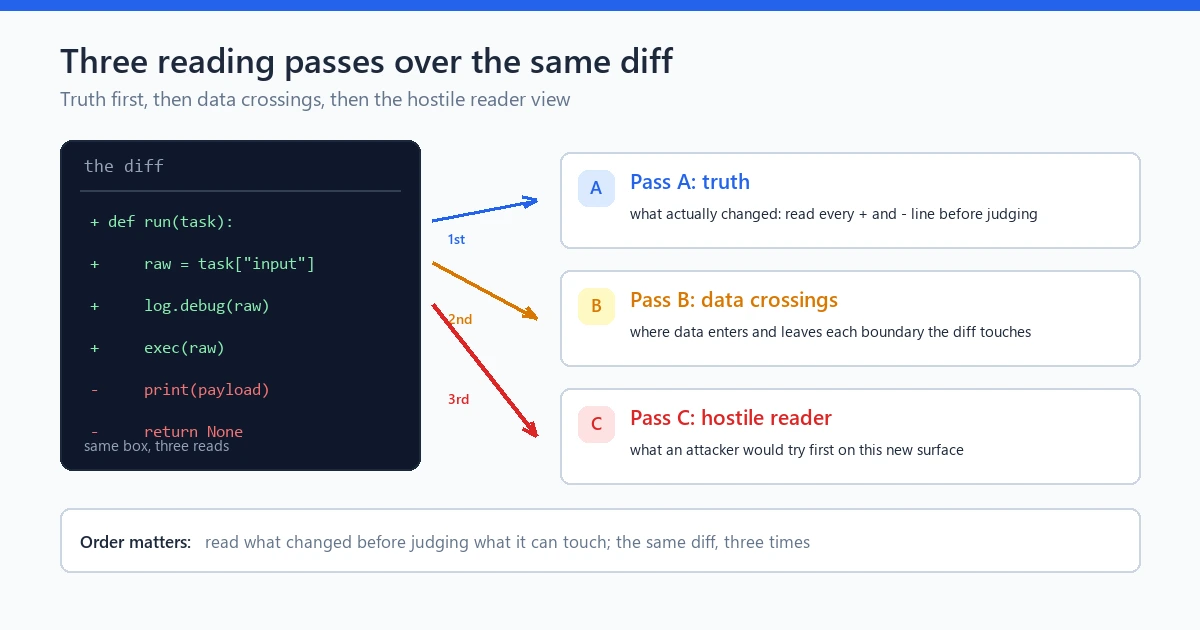
caption: Three reading passes: the truth, the data crossings, the hostile reader’s view.
Worked example: one unsafe helper made safe
Here is an ai code security review on one small diff: an agent delivered a helper that lists records, and the diff showed four attackable lines. It took a page number straight from the query string. It built an SQL string by concatenating it. It logged every request with full request headers. It pulled in a formatting package just to trim values.
The checks placed the findings fast: Check 4 flagged the unvalidated query input, Check 5 the concatenated SQL, Check 2 the header-dumping log, Check 7 the one-trick dependency. Four findings, one helper. Ten minutes of reading.
Four bounded edits fixed all of them. The page number now arrives as a validated integer with a cap, the query is parameterized, the log line carries a request id and nothing else, and the formatting package was replaced by three lines of standard code. The ten-minute suite re-ran green. All four findings went into the ai code security review record, and nothing here needed a security team. It required a reviewer willing to read the diff first.

caption: Four findings, ten minutes of reading, four bounded fixes, one green re-run.
The engine angle: audit surfaces what lint cannot
Lint and pattern scanners answer one shape of question: does known-bad text appear? An ai code security review answers a different shape: does this design leak or welcome harm? The gap between those two questions is where my workflow adds a second stage.
The SOVEL Copilot Engine treats audit as an independent path. Implementation produces the change. The audit stage reads evidence against the locked plan. It reports findings with severity. A bounded FIX and RE-AUDIT loop handles each finding instead of letting fixes sprawl. The engine’s persistent local state (SQLite database plus a hash-chained event ledger) keeps what changed, and in which order, readable after the session ends.
The release gate I trust most treats evidence the right way: a pass report alone is not proof, the gate evaluates the records behind the work. The same stance as every check above. The engine overview walks the stages in full, and the audit method has its own project audit guide.
One boundary from my own rules repeats: private values, keys included, stay on your machine in this local state workflow. A review that teaches secret handling should not create a new leak path.
Limits: what a security review cannot prove
Honesty first, because this is a security article. An ai code security review raises the odds in your favor. It cannot prove an absence of vulnerabilities, and nobody sells a checklist that certifies safety. I avoid words like guaranteed, and so should you.
Findings also age. Config drifts and dependencies update. Code that passed review in March meets new inputs in July, so the pass belongs before every release, not once per project. It also sits downstream of the plan: a review confirms the agent obeyed the plan, and a wrong plan is caught upstream, not at the diff. An ai code security review is a gate you re-enter, not a certificate you frame and hang.
Evidence labeling applies too: on my engine builds every proof is labelled mock, offline, component, or live, because simulated output and an exercised control look identical on screen.
FAQ
Is AI generated code secure by default?
No. Generated code often runs and passes tests while carrying placeholder credentials, open auth edges, or leaky log lines. The only honest default is untrusted until reviewed, and the nine-pass routine behind a real ai code security review closes most of the gap between looks secure and is secure.
How do I check AI code for vulnerabilities quickly when time is short?
Run the three fastest checks first: the secrets grep on the diff, the input boundary scan, and the artifact listing. Then schedule the full ai code security review before the merge.
What secrets most often end up in AI generated code?
Placeholder keys that look like sample values, default passwords in config templates, and credentials in debug log lines top the list on my reviews. All three come from the agent inventing plausible examples, and all three are live leaks once a real value meets them.
How is an ai code security review different from a normal code review?
A normal review asks whether the change does what the task says. An ai code security review asks what the change lets through: secrets, injection paths, auth gaps, dependency additions, and artifact contents. Same diff, different reading, layered on the behavioral one.
Can a secret scanner do this review for me?
Scanners cover one check of nine, the static credential hunt. They miss data flows, missing auth, config drift, and packaging mistakes. Use one as a first filter, then read the diff yourself. The judgment stays human.
Can any review make my project fully secure?
No. An ai code security review reduces risk and produces evidence. It does not erase attacker interest, unknown flaws, or future config drift. Say what the evidence shows, keep the records, and re-review at each release. That is the mature posture.
—
Nine checks, three passes, one habit: treat model output as untrusted until the trust is earned, written down, and stored on disk. An ai code security review will not make you famous. It will stop the one incident that would. Re-run it every release, keep the records small, and let the diff, not the agent’s confidence, close each case.
Self-verify summary (note for owner, remove before import)
- Word count: approx 2780. Focus keyword: 27 (one in the H1, counted by the checker). FAQ: 6.
- Inner links: 5 (/verify-ai-generated-code-release/, /tools/password-intelligence/, /sovel-copilot-engine/, /ai-coding-project-audit/, /local-state-ai-coding-workflow/)
- External links: 2 (OWASP LLM Top 10, OWASP Secrets Management Cheat Sheet)
- Figures: 4 (featured ai-code-security-review-overview.webp + secrets-scan + diff-read + helper-fixed), each with alt + caption
- Long-tail variants used: “is AI generated code secure”, “secrets in AI generated code”, “check AI code for vulnerabilities”