
Nine vibe coding problems explain why the app that won the demo falls apart on its first real user. I build with AI every day. The problem was never the model; it was the missing scaffolding around it.
The pattern is so common it has its own punchline: demos impress, production breaks. A prototype comes alive in an afternoon, then the first empty form submission or the first package update knocks something over nobody can trace. Write the vibe coding problems down once and they stop looking like bad luck: they are the predictable result of building without gates. None of this is bad luck.
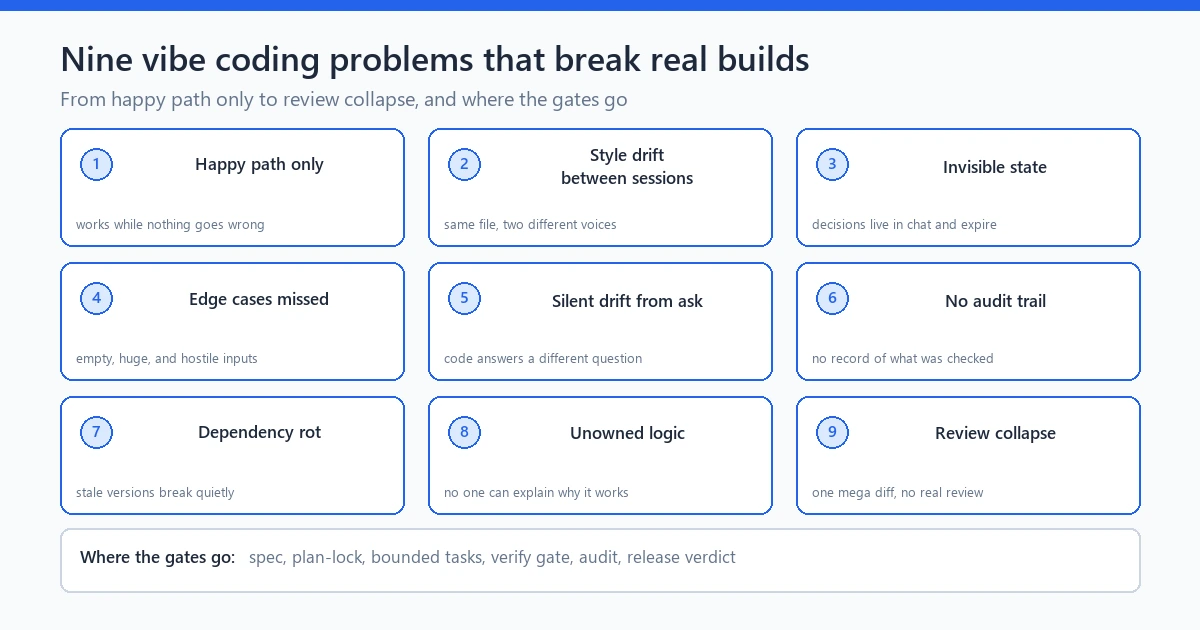
caption: The nine failure areas that separate a working demo from a maintainable production build.
What vibe coding got right
Credit where due, because a fair list of vibe coding limitations starts with the wins. Vibe coding made software feel approachable: describe the thing, watch it appear, learn by pushing. I use the loop for drafts, throwaway scripts, and API probes. It’s genuinely useful.
Why vibe coding fails in production is now a standing article genre, so credit the movement first: speed to a first draft is real, keep it. These are not arguments against the tools, only the additions between draft and release, because every one of the vibe coding problems below is missing evidence.
Problem 1: happy path only
The first three live in the code, quiet at first, each one louder as the project grows.
The happy path is the run where everything behaves. The first of the vibe coding problems walks that road beautifully and falls off the edges. Ask for a signup form and you get one that handles a clean submission and crashes on a double click, a blank email, or a short password.
This is not carelessness by the model: a prompt that demonstrates success teaches success and stays silent about failure. Happy-only code is a bridge built for one truck, fine until the second truck. The fix is written acceptance criteria naming the rejections before code exists, the same contract a testing process demands. Name the rejections first.
Problem 2: inconsistent style between sessions
Monday your agent writes async await. Wednesday it writes promise chains with a different error style and different naming. The code still runs, which makes it worse, because nothing forces the disagreement to the surface. Six sessions later the codebase reads like five authors who never met.
This is the vibe coding problems entry you smell only when a third contributor joins. That’s the tell. I hit it on the password intelligence plugin: two functions computed strength scores with different thresholds, and the tests passed because each matched the function nearest to it, so conventions went into a spec the agent reads first. Written conventions hold. Remembered ones decay.
Problem 3: invisible state
Vibe coding keeps project state where the vibe is, inside the chat window. Scrollback is not a spec. The renamed field, the dropped feature, the “we changed our mind on auth” decision, all live in scrollback that no tool indexes. When context fills or the quota ends mid-task, the next session quietly contradicts the last one.
Late-night confusion follows: the codebase becomes the only memory, and code does not say why. State needs a disk that survives sessions: a task ledger, checkpoints, a note of decisions touched. When state is invisible, every resume is a rewrite. When state is on disk, a stopped run resumes. That difference is why invisible state made the vibe coding problems list at all.
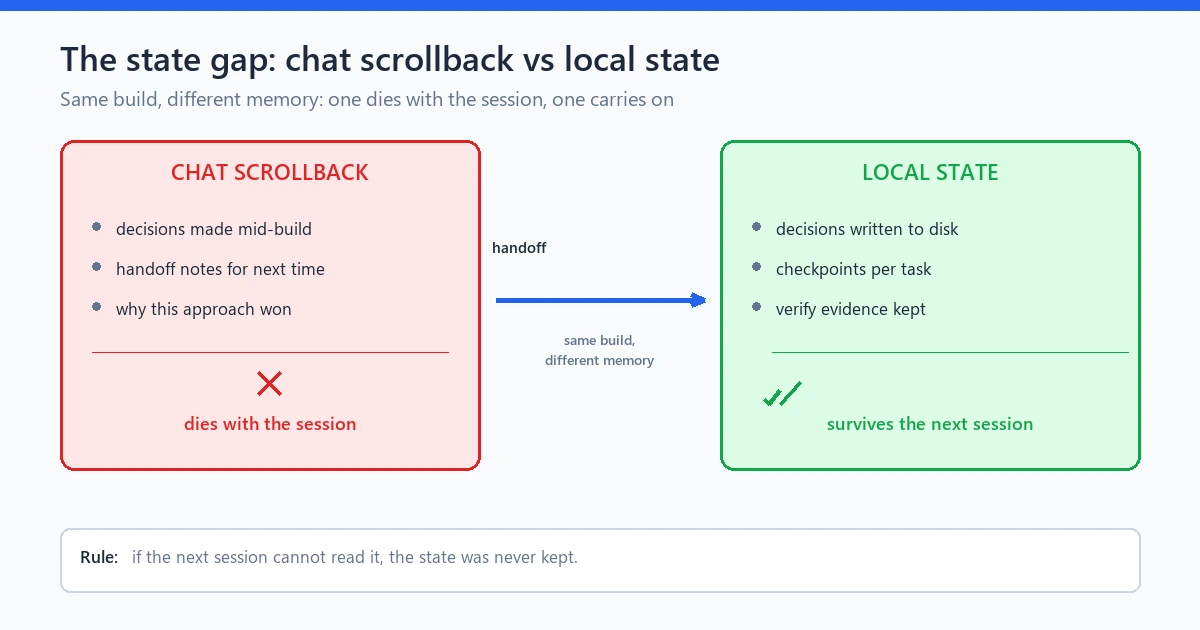
caption: Chat memory dies with the session. A local ledger keeps decisions, checkpoints, and evidence on disk.
Problem 4: edge cases undone
The next three live between the code and the plan: the vibe coding problems the demo never previewed, skipping the first commit, showing up in week four.
Edge cases are the support queue in costume. Empty inputs, max lengths, unicode, zero, negatives, the value exactly at the boundary. Happy path code meets each of these for the first time in front of a user, the most expensive venue for a first meeting.
The builder.io breakdown of vibe coding limitations calls it directly: prototypes survive on assumptions, and production runs on the inputs the prompt never mentioned. The disciplined version is cheap: list the five edges, write them as tests, run them.
Problem 5: drift
Drift is a quiet disagreement between what you believe the software does and what it does. The agent renamed a field, folded two functions, or reworded the checkout rule, the demo still passed, so nobody noticed. Two weeks later another part of the app relies on the old shape and fails in a way nobody can explain.
Drift compounds because each change is small and locally sensible. This is exactly why spec driven development with AI gained support in 2026: a written, versioned spec crystallizes the intent, and the agent works inside it instead of improvising around it. No spec, no drift detector, which is why drift holds its own line on the vibe coding problems list.
Problem 6: missing audit trail
The question that ends arguments is “what changed and who approved it”. In a vibe-built project the answer is usually a shrug. There’s no plan to diff against, no task list to tick, no gate record to point at. Something breaks, and you run debugging archaeology instead of reading a report.
An audit trail is not paperwork for its own sake. It is the memory your future self borrows, and one of the vibe coding problems that costs the most exactly when you cannot afford it. Every governed build produces one as a side effect: locked plan, per-task evidence, verify results, a final verdict. Not having one costs a weekend.
Problem 7: dependency rot
The last three are the ones that end projects. Not with a crash, but with a slow loss of confidence.
The model writes against packages as it last saw them, and your project installs today’s versions, often not the same thing. Every fresh prompt keeps generating against the old world, so the rot goes unrecorded: APIs renamed, defaults changed, deprecated calls logging warnings you snooze.
Of the vibe coding problems, this one hides the longest, so I treat dependencies as a standing audit item. The failure shape is specific: the code looks right, the docs were real, and the installed version moved on. Pin versions, read changelogs, and add a regression test per repaired call. Dependency hygiene is the line between an update being routine and an update being an incident.
Problem 8: unowned logic
Somebody has to own every line that ships. In a vibe-built project, ownership dissolves. The function was written by a model, in a session nobody remembers, against a rule nobody wrote down. It works, mostly, and the one person who could explain it does not fully remember either.
Unowned logic is a business risk wearing a code costume. Ownership gets restored with three artifacts: a spec for intent, tests for behavior, and a note pointing to the decision record. If a feature has none of the three, treat it as unwritten before you extend it. Among the vibe coding problems, this one turns fastest into the call you did not want.
Problem 9: review collapse
Vibe coding multiplies output. Review capacity does not. Months of AI sessions produce far more diff than any reviewer can honestly read, so review degrades from reading to scanning to approve-all, and the vibe coding problems above all roll through a gate that no longer gates. A pile of unreviewed code is a liability, not a deliverable.
The counter is unglamorous: small tasks, small diffs, one job per change. Honest review survives at small sizes and dies at large ones. Structured teams route generated work through the same pull request discipline as human work: review collapse is a process failure long before it is a personnel failure.
The fix: what discipline adds, stage by stage
So where does that leave you when this list reads like the last month of your life? Tired of trying to make vibe coding work is a fair place to be. The fix is additive, not a restart: keep the fast model and the fast loop, and add the few things between prompt and release that every shipped build needs. Each one retires a named member of the vibe coding problems list.
- Write the spec. One page: outcome, constraints, exclusions, acceptance criteria a test could name. This is what drift is checked against.
- Lock the plan. Tasks, files touched, one test per task, approved before code. A locked plan turns “quick extra” suggestions into a decision instead of an accident.
- Cut the work into bounded tasks. One job, four lines of contract, one sitting. Small tasks keep diffs reviewable, which is how review survives growth.
- Verify each task at a gate. Build clean, tests pass, edge inputs covered, no secrets in logs. Evidence gets recorded, not remembered.
- Audit before release with independent eyes. Score gaps by harm, fix the confirmed ones, re-audit, then export with a manifest.
- Release on a verdict, not a vibe. An owner signs off because the evidence is green, or stops the release because it is not.
Every one of the vibe coding problems above has a gate that answers it. The gates cost far less than the debugging seasons they replace, because each one pays back while a fix is still cheap.
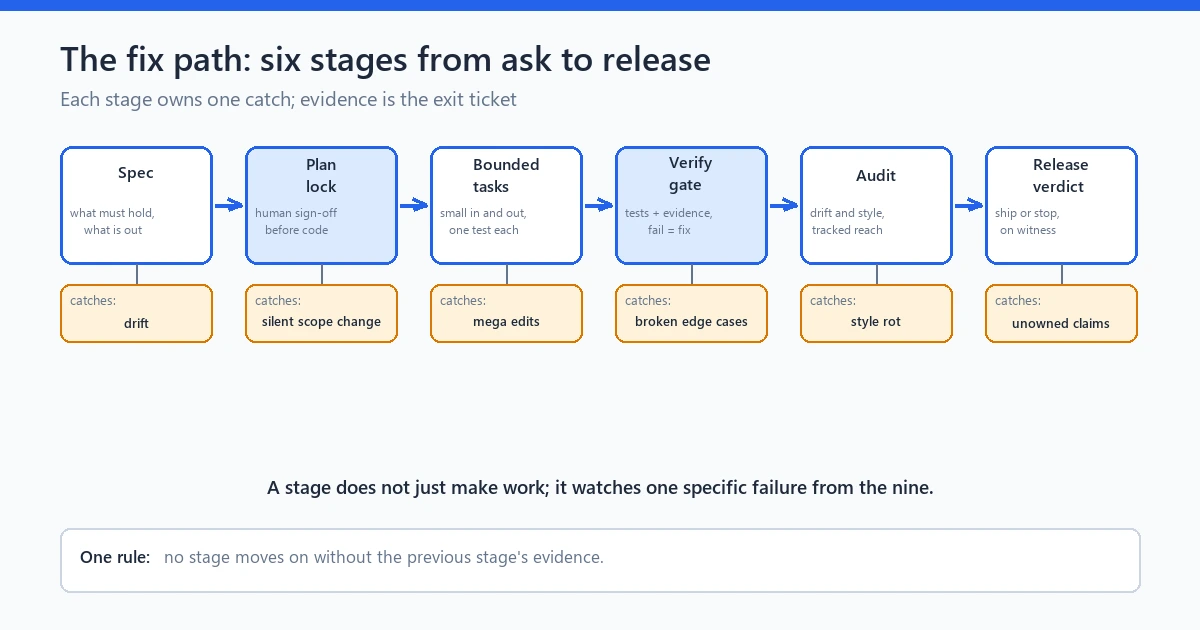
caption: The additions that turn a vibe-coded build into a shippable one. Nothing here replaces the AI; everything here catches what it misses.
Same build, both ways
A real one, from a plugin week: a CSV export of password audit results, small feature, half-day vibe. The loose run turned a prompt into a button, a download, and a demo that worked. Then I remembered the fun inputs: commas, newlines, quotes, duplicated field names. Most produced a broken file, because nobody wrote the rule.
Redoing the same feature with discipline took forty minutes longer. The spec named the escaping rules for commas, quotes, newlines, and the UTF-8 header. The plan had three tasks: writer function, edge test set, verify gate on a sample file with hostile characters. The gate failed once, on the newlines, the fix was two lines, the re-run clean, and the feature shipped with a record of every input it survived. Same model, same afternoon. The difference was where each of the vibe coding problems got paid: once at the gate, once in front of a user. The edge cases existed in both runs. One run scheduled them.
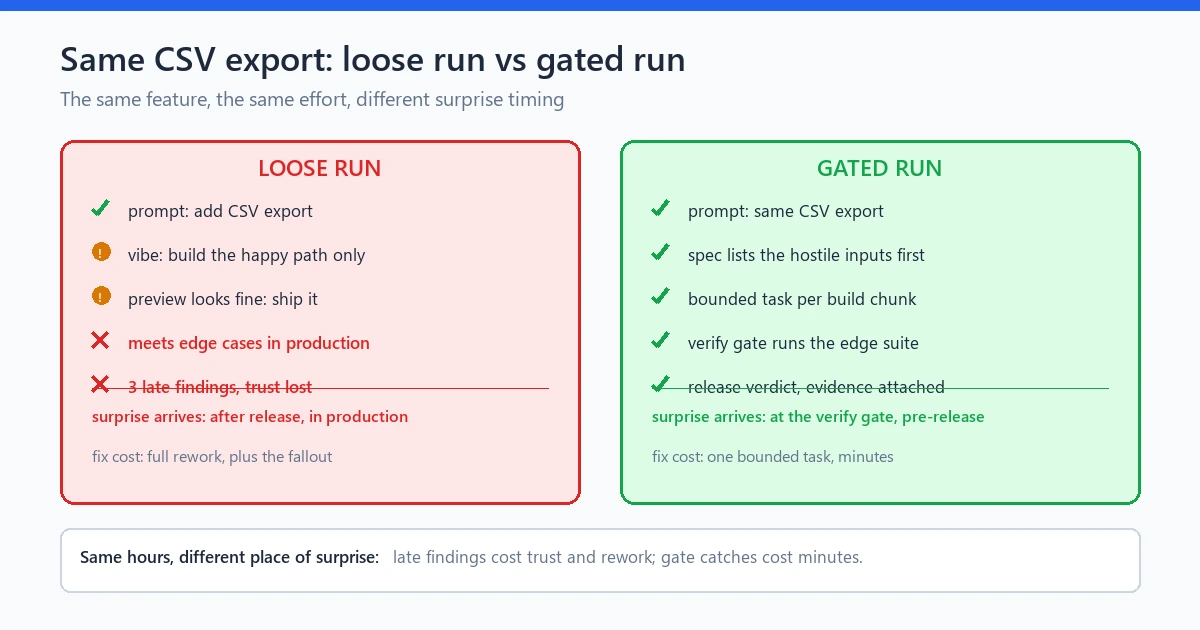
caption: One feature, two runs. The loose run meets edge cases in production; the gated run meets them at the verify gate.
The engine angle: gates turn vibe into evidence
I keep that discipline honest with a workflow engine I built, the SOVEL Copilot Engine, and honest about what it does: nothing generates code for itself. It is a local-first workflow controller that runs your chosen AI models, through adapters for OpenAI, Anthropic, and Gemini, on your own keys. The stage order is fixed: IDEA to RESEARCH to ANALYSIS to PLAN to PLAN LOCK to IMPLEMENTATION to AUDIT to FIX and RE-AUDIT to FINAL REPORT to EXPORT to RELEASE GATE.
What the stages buy you is exactly the missing evidence behind the vibe coding problems in this article. State persists on disk in an SQLite-backed store with a hash-chained event ledger, so decisions survive sessions, the direct answer to invisible state. The audit stage is separate from the build path and reads the locked plan before it reads the code, which catches happy-path work and drift, two headline vibe coding problems. A pass report alone is not proof: the release gate evaluates the evidence and can say no. Exports run to JSON, Markdown, HTML, PDF, DOCX, and EPUB, so the audit trail is a file you can hand to a client.
If that sounds heavy, start smaller without the engine: a spec page, three task lines, a test script, an evidence note. The tool is a convenience. The gates are the point. The product page describes the engine, and the case study shows the chain end to end on a shipped plugin, hashing checks and deliverability gates included.
Limits
Honest limits, because every tool deserves them. A workflow engine is not an AI model. It doesn’t make models smarter or cheaper: provider charges still apply, quotas still bind, and demo runs prove demo paths only. Gates raise the odds of a clean release; they do not certify perfection, and no stage replaces a human who reads the diff and knows the product’s intent. Gates fix the listed vibe coding problems; they are not a guarantee of flawless code. The moment code faces users, money, or data, the gates stop being optional.
FAQ
Why vibe coding fails in production
Why vibe coding fails in production comes down to missing evidence, not bad models. Vibe coding optimizes for the demo: fast output, plausible code, no gates. Production runs on edge cases, consistent conventions, dependency health, and a record of what changed, and each needs a gate the demo never had.
Is vibe coding safe for a real business?
For prototypes and throwaway scripts, yes, and it is a fast way to learn. For anything touching users, payments, or data, the vibe coding problems stack up into real risk: unreviewed logic, undocumented behavior, and no audit trail when something breaks. Keep the drafting speed and add review gates before release.
What are the most common vibe coding problems?
The most common vibe coding problems are: happy path only code, inconsistent style between sessions, invisible state, missing edge cases, drift from intent, no audit trail, dependency rot, unowned logic, and review collapse. They share one root cause: output generated without written specs, bounded tasks, or recorded evidence, and each maps to a specific gate.
Can I fix vibe coding problems in an existing project?
Yes, and you do not rewrite from scratch. Write the spec for what the app is supposed to do, audit the code against it, and list gaps by harm. Fix the highest-harm gaps with bounded tasks and tests, pin your dependencies, and route new changes through the gates from now on. Most projects recover in days once the spec exists, because the vibe coding problems that had no visible owner now have a written one.
Can a non-technical founder still ship with vibe code?
Yes, keep going, just borrow the gates. Non-technical builders ship real products with AI when someone, a paid reviewer or a workflow tool, holds the plan and checks the evidence for them. Name what the product must do, keep changes small, and put every release through a checklist before real users see it. The checklist does the engineering judgment you have not learned yet.
Vibe coding or governed AI development: which do I pick?
Pick by stakes, one task at a time: explore and draft in the loose mode, plan-lock and gate whatever ships. If a single project keeps both, label each task so modes never mix silently. My full mode comparison spells out the gates, the state, and the failure costs.
the governed vs automation comparison
Summary
The nine vibe coding problems are not a verdict on AI. They are the invoice for skipping the boring half of software: specs, gates, evidence, ownership. It always arrives. Keep the speed that made the term famous. Add the six stages that make a build survivable: written spec, locked plan, bounded tasks, verify gates, independent audit, release verdict.
Start with the release checklist before your next build. Read the case study for proof that this discipline holds on a real product. Your next demo can still impress. Production breaks only for builds that never scheduled their edge cases.
the twelve check release checklist
the spec driven development guide