
This engine is software that turns a brief into a structured lead-magnet draft, applies a production process and exports the result in several formats. The engine handles the argument, the section order and the review gate. A designer or editor still handles the final polish.
This answer matters because the market is full of tools that call themselves lead magnet engines when they are template editors. A template editor starts with a layout. A lead magnet engine starts with a reader, a promise and a format. The difference shows up in the first draft, long before anyone opens a design tool.
This guide explains the term in plain language, shows the six stages inside a working engine, and names the jobs it should not be asked to do. It also explains why a local-first engine is a different purchase from a monthly design subscription.
What is a lead magnet engine in plain English?
A lead magnet engine is a production system for lead-magnet content. You give it a topic, a reader and a desired format. It returns a draft with a title, an introduction, numbered sections, a closing and a call to action. It also returns supporting files that show how the draft was built.
The word engine matters. A generator produces one output from one prompt. An engine runs a repeatable process with stages, checks and a record. If the idea is weak, the engine stops. If the sections repeat, the engine flags them. If the draft is missing a concept, the engine names the gap.
That process is useful when you produce more than one lead magnet. A single checklist can be written by hand. Ten client checklists, a framework, a scorecard and a mini course need a system. The system keeps the structure consistent while the topic changes.

How is a lead magnet engine different from a template builder?
A template builder asks you to choose a layout. A lead magnet engine asks you to choose a reader and a job. The layout comes later.
That order changes the quality of the draft. When the layout comes first, the writer fills boxes. When the reader comes first, the writer decides what the reader needs to know. The boxes can still be attractive. They are just less likely to contain a useful argument.
It also produces more than a PDF. A working engine can output Markdown for editing, HTML for review, PDF for sharing, DOC for Word edits and JSON for audit. The same draft moves through different hands without being rewritten from scratch.
The third difference is the review gate. A template builder lets you export anything. A lead magnet engine can block a draft that repeats itself, misses the subject or fails a domain check. The block is not a guarantee of quality. It is a floor.
What are the six stages of a lead magnet engine?
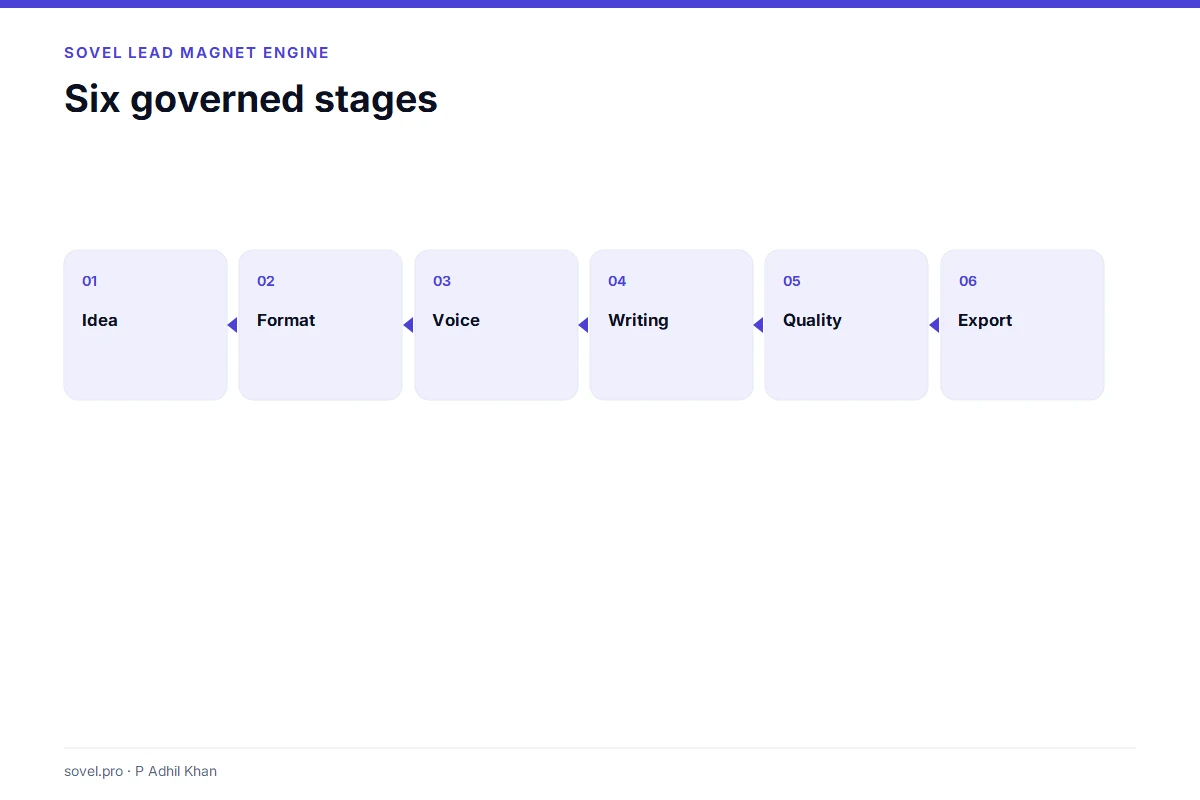
A useful engine runs six stages. The names vary by product. The jobs do not.
1. Idea
The engine extracts a topic, a subject and an audience. It builds an idea card with a promise and a format hint. A vague brief fails here. That is a feature. A weak idea should not consume an hour of design time.
2. Format
The engine chooses a format. A checklist fits a quick operational win. A framework fits a method. A case study fits proof. A scorecard fits diagnosis. The format decides the section count and the depth the reader expects.
3. Voice
The engine chooses an awareness stage and a distribution channel. A top-of-funnel piece sounds different from a bottom-of-funnel piece. A newsletter checklist sounds different from a client workshop blueprint.
4. Writing
The engine writes the title, subtitle, intro, sections, closing and call to action. Each section has a headline, an opener, a mechanism, a framework, an example and a closing rule. The repeated anatomy is what makes the draft reviewable.
5. Quality
The quality gate checks readability, structure, content and tone. It looks for repeated sentences, weak subject coverage, missing examples and unknown placeholders. The score is mechanical. It is not a fact-check.
6. Export
The engine writes the files. The output usually includes Markdown, HTML, PDF, DOC, JSON, an evidence ledger, a manifest, a summary and verification notes. The manifest hashes the files. The ledger records the basis for each section.
What goes into a lead magnet engine?
The engine needs four inputs.
- A brief. One reader, one problem, one promise. A paragraph is enough if it is specific.
- A format. Checklist, framework, case study, scorecard, mini course, tool template, hack list, system blueprint or prompt tool.
- A voice. The awareness stage and the channel. A cold reader needs more context than a warm buyer.
- An optional domain context. A sitemap, an ICP file or a playbook. The engine can use it to ground the topic and the audience.
The brief is the input most people rush. They write “make a lead magnet about marketing”. The engine cannot fix that. A better brief is “a checklist for SaaS founders who need to audit customer onboarding before a security review”. The second brief gives the engine a reader, a job and a constraint.
It can work without an ICP file. It can work without a sitemap. It cannot work without a topic. The quality of the topic sets the ceiling for the draft.
What comes out of a lead magnet engine?
A completed run produces a package, not a single file. The package usually includes:
- a readable HTML draft for review;
- a PDF for sharing;
- a DOC for Word edits;
- a Markdown source for a CMS;
- a JSON report for automation;
- an evidence ledger;
- a run manifest;
- a summary and verification notes.
The package matters because a lead magnet is rarely finished by one person. A writer edits the Markdown. A designer opens the PDF. A client marks up the DOC. A developer imports the HTML. A reviewer checks the ledger. One source, several handoffs.
The ledger is the part that separates a production engine from a text generator. It does not prove the draft is true. It shows what each section is based on and what still needs a check.

Why does a lead magnet engine need an evidence ledger?
A lead magnet usually makes claims. Some are harmless, such as “a checklist is easier to scan than an essay”. Some are commercial, such as “this process reduces onboarding time”. The second kind needs a source or a label.
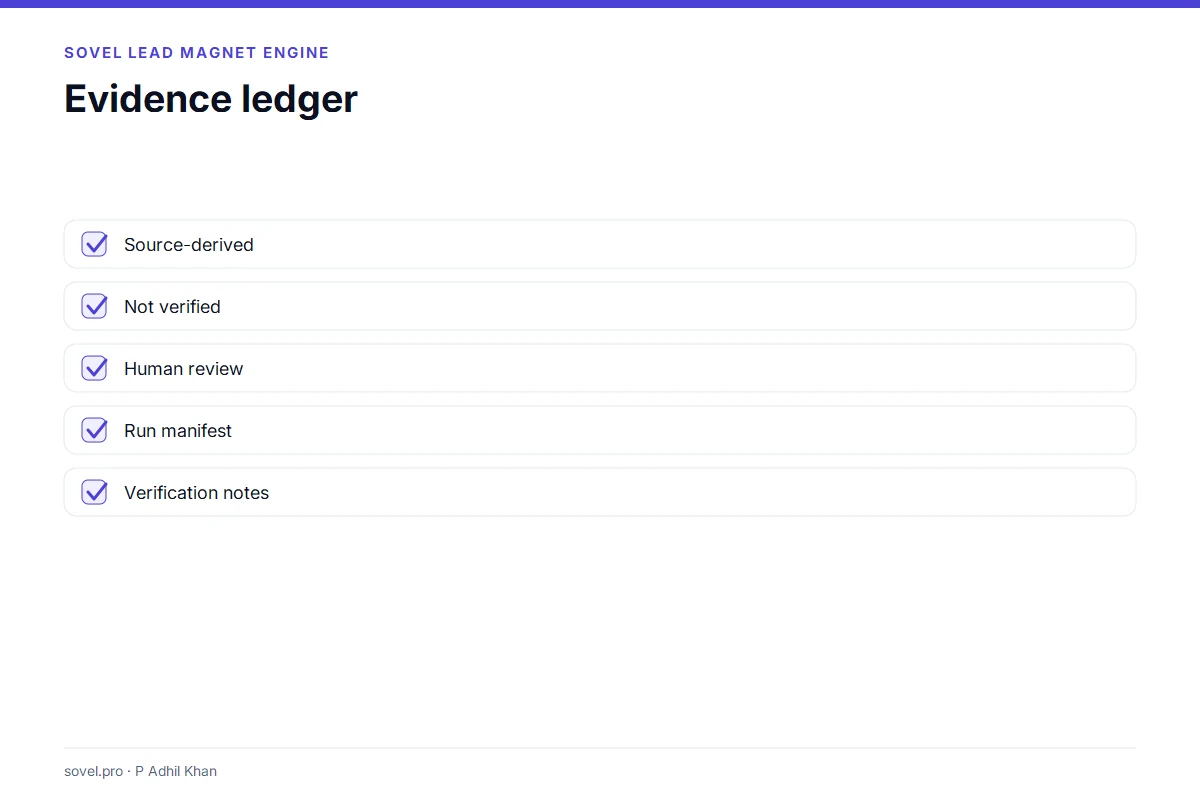
An evidence ledger records the basis for each section. A simple version uses four labels:
- Verified. A source was checked.
- Source-derived. The claim comes from supplied material.
- Inference. The claim is reasoned from the material but not checked.
- Not verified. The claim needs a human check.
The labels are not decoration. They tell a reviewer where to spend time. A draft with ten NOT VERIFIED labels is not ready to publish. A draft with ten VERIFIED labels still needs a check on the source quality.
An engine that does not label claims pushes the entire review burden onto the reader. The reader has to guess which sentences are safe. That guess is where mistakes reach clients.
Why does local-first matter for a lead magnet engine?
A lead magnet brief often contains client material. A customer name, a product plan, a pricing page, an internal process. Sending that material to a hosted tool creates a data transfer that someone has to approve.
A local-first engine runs on the writer’s machine. The brief stays in a local file. The draft stays in a local folder. The topic memory stores a keyed fingerprint rather than the raw topic. External services are optional and off by default.
That does not make the engine automatically compliant with every privacy law. It changes the data map. The buyer can see where the data goes, which is the first step in deciding whether the tool fits the project.
A cloud tool can be the right choice for a public topic. A local engine is the safer default for client work. The buyer should know which one they are buying.

Who actually needs a lead magnet engine?
The engine is useful for four groups.
- Consultants who write lead magnets for clients and need a repeatable first draft.
- Agencies that split research, writing and review across several people.
- Technical marketers who work in an editor or agent and want a tool call.
- Authors and educators who need a structured draft they can edit.
It is not useful for a buyer who wants a landing page with a form. That buyer needs a capture tool. It is not useful for a buyer who wants a designed ebook in twenty minutes. That buyer needs a template editor.
The distinction is not about sophistication. It is about the job. It is worth paying for when the hard part is the argument, not the layout.
How do you choose an engine?
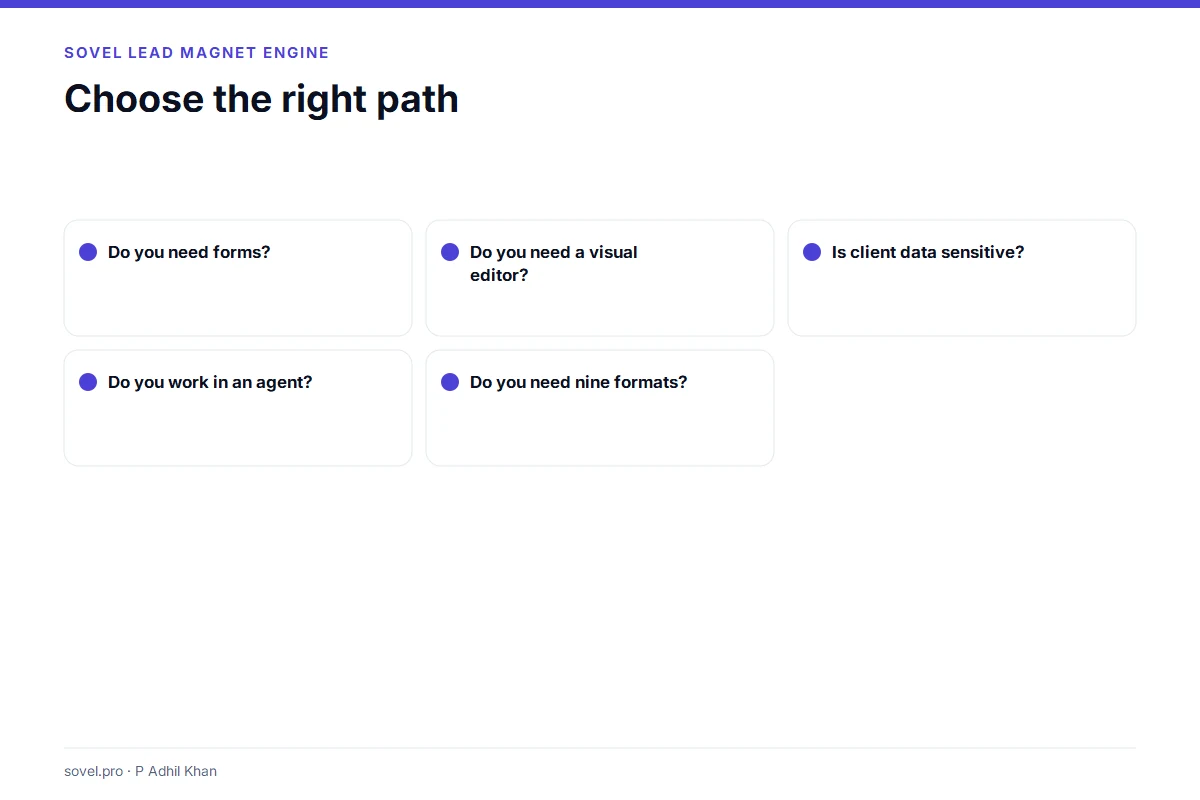
Use five questions.
- Does it start from a brief? If it starts with a template, it is a design tool.
- Does it produce more than one format? A single PDF is a document. A package is a production system.
- Does it label evidence? If every claim looks equally certain, the review is harder.
- Does it run locally? If client data is involved, the data map matters.
- Does it show its limits? A tool that claims to do everything is harder to trust.
The answers do not need to be yes for every buyer. They need to match the job.
What does a lead magnet engine not do?
It does not capture leads, host a landing page, send email or run a nurture sequence. Those jobs belong to a form tool, a page builder and an email platform. A buyer who needs those jobs should not expect an engine to replace them.
It does not verify facts. It can label a claim as source-derived or not verified, but the label is a review aid. Someone still has to open the source and check the number.
It does not replace an editor. The draft can pass a mechanical gate and still read badly. The gate checks structure, repetition and coverage. It cannot tell whether the argument is interesting.
It does not replace a designer. The PDF can be clean and still look plain. A designer adds hierarchy, brand assets and the visual finish that makes a lead magnet feel worth downloading.
It does not guarantee distribution. A lead magnet needs a page, a form, a thank-you message and a follow-up. The engine stops at the draft. The rest of the funnel is a separate project.
What should a lead magnet engine never promise?
The engine should not promise rankings, traffic, revenue or conversion rates. It does not control distribution. It should not promise fact verification. It does not check the world. It should not promise a native .docx if it writes RTF. It should not promise team roles or SSO if it is a single-user tool.
The honest promise is narrower and more useful: a structured draft, a review gate, several formats and a record of how the draft was built. That promise is enough for a consultant who needs to start faster without handing client data to a random app.
For the search and accessibility context, see Google Search Central and the W3C accessibility introduction.
Frequently asked questions
What is a lead magnet engine in one sentence?
This engine is software that turns a brief into a structured lead-magnet draft, applies quality checks and exports the result in several formats for review.
Is a lead magnet engine the same as an AI writer?
No. An AI writer generates text from a prompt. A lead magnet engine runs a production process with stages, gates, evidence labels and export files. Some engines use AI for parts of the process. The process is the product.
Does a lead magnet engine replace a designer?
No. It produces a draft that a designer can improve. A designer still handles layout, typography, brand assets and final polish. The engine reduces the time spent on structure and argument.
Can a lead magnet engine work without an API key?
A local-first engine can. The core uses deterministic rules and templates. Optional semantic judgment may require a key, but it is off by default. Check the product documentation before you buy.
Is a lead magnet engine safe for client data?
It depends on where it runs. A local-first engine keeps the brief and draft on your machine by default. A cloud engine sends the data to a server. Read the privacy policy and the data map before you use either one for client work.
How many formats should a lead magnet engine produce?
Enough to cover the handoffs. Markdown for editing, HTML for review, PDF for sharing and DOC for Word edits cover most workflows. JSON and a manifest help with audit and automation.
Does a lead magnet engine guarantee a good lead magnet?
No. It guarantees a process. The quality of the brief, the evidence and the human review still decides whether the lead magnet is useful.
What is the biggest mistake buyers make?
They buy a design tool and expect a production system. The draft looks polished and still says nothing specific. Start with the argument, then choose the design layer.
The plain answer
The engine is a production system for the draft. It starts with a brief, chooses a format, writes to a structure, checks the result and exports a package. It is useful when you produce lead magnets often and need a consistent review process.
If you only need a designed PDF, use a design tool. If you need a governed draft that a team can review, use an engine. The category is narrower than the marketing suggests, and that is why it is useful.
Start with a small test: one public brief, one checklist and one review pass. The SOVEL Lead Magnet Engine product page shows the working version. For the next step, read the lead magnet creation workflow, then compare the nine formats. If you need the wider production context, see the SOVEL engine workflow guide.