
The question what is a lead magnet sounds basic, and that is exactly why it gets answered badly. Most pages reply with a one-line definition, paste a list of twenty ideas, and leave you with no way to judge whether any of it applies to your funnel. The useful answer is longer: a lead magnet is a free, specific, downloadable asset a business offers in exchange for an email address and permission to follow up. The definition is easy; the nine qualities that make one actually work are where most sites stop short.
This guide gives both. First the honest definition and the psychology of the trade, then nine answers drawn from what working magnets share in practice, then a way to judge any idea before you spend a day building it. Every claim here is either standard practice you can verify elsewhere or comes from a real governed production run shown near the end, with artifacts you can check yourself.

What does the phrase actually mean?
A lead magnet is an asset you can point at: a checklist, a scorecard, a template, a short course, a framework. Ads, popups and newsletters are different species entirely. The visitor pays with an email address and consent to receive follow-up; the business pays with something genuinely useful. Email marketing only works when that first trade is fair, which is why the magnet is the foundation every list-building tactic sits on.
The phrase hides a market transaction inside a marketing term. Ask what is a lead magnet and the honest answer starts with “an exchange”, because every quality that matters downstream traces back to that: specificity, speed to value, relevance to the thing you will sell later. A magnet that solves a problem adjacent to your paid offer pre-qualifies the subscriber. A magnet that solves something unrelated fills your list with people who will never buy.
That is also why the phrase survives in every marketing vocabulary: it compresses the whole deal into two words. When a new teammate asks what is a lead magnet, the practical reply is “the deal we offer a stranger before they trust us”, and everything on a landing page either serves that deal or distracts from it.
The psychology behind the exchange
The trade works because of reciprocity, the well-documented tendency to return a favor: a genuinely useful gift creates a small obligation the visitor resolves by trusting you with their inbox. Behavioral research on reciprocity describes the effect and its limits honestly: the gift must feel voluntary and genuinely useful, or it reads as a bribe. A recycled PDF that promises a lot and delivers a list of platitudes does the opposite. It teaches the subscriber that your emails will also disappoint.
What is a lead magnet, psychologically? It is the first proof of competence you hand a stranger. Nobody subscribes because the form looks nice. They subscribe because the magnet answered a question they had this week, in less time than it took to find your page, and left them with a next step. That proof-of-competence framing also explains the failure mode: a magnet built for volume instead of relevance grows a list that never opens, and deliverability decays with every ignored send. Consent rules such as GDPR Article 6 require a lawful basis for storing and using that email address, and relevance is what keeps consent meaningful rather than merely collected.
There is a second psychological layer worth naming: specificity lowers risk for the visitor. “A guide to marketing” asks the visitor to gamble ten minutes on a vague promise. “A 9-point onboarding security checklist” asks for ninety seconds on a narrow promise. Narrow wins because the perceived cost of being wrong is small. Every strong magnet on the internet is narrow at the headline and broad in the payoff, and that is what is a lead magnet reduced to one sentence: a small, honest bet the visitor wins immediately.
Nine real answers to what is a lead magnet
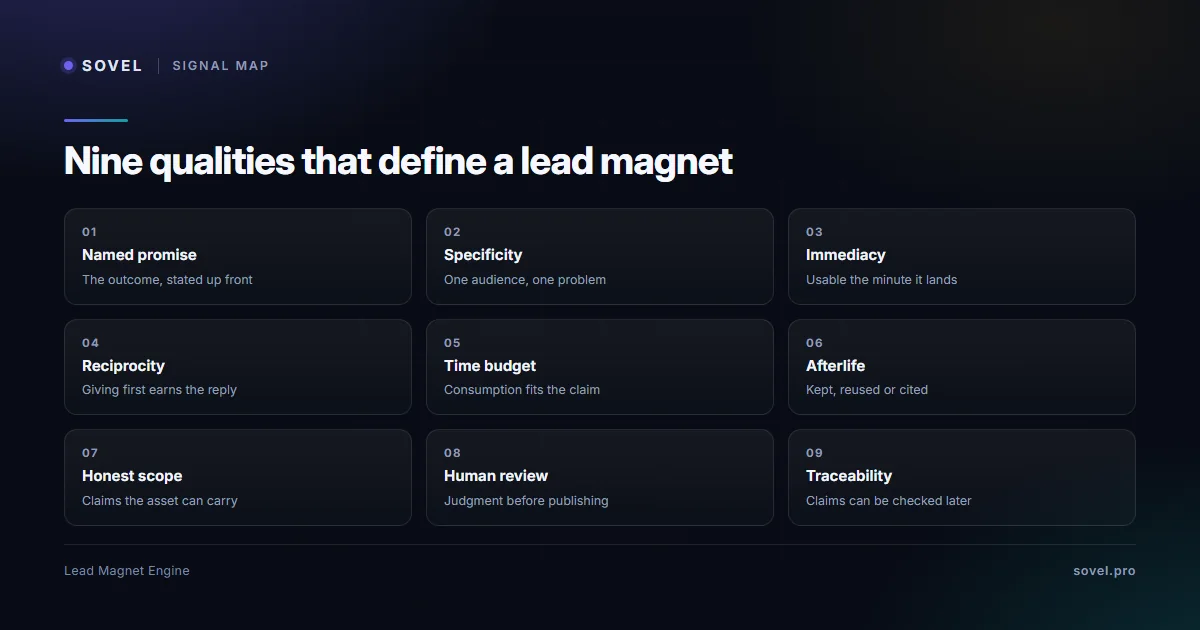
Definitions only go so far. Here are nine answers, each one a quality you can check on any magnet in ten seconds, drawn from what working assets share in practice.
- It is a promise kept in one sitting. Ask what is a lead magnet in the strictest sense and you get this: a asset whose promise is fulfilled inside one download, one read or one working session. If the visitor needs to attend a webinar, wait a week or buy something before the value lands, the magnet is a voucher, not a magnet. The best ones deliver complete value before the first follow-up email arrives.
- It is the smallest useful unit of your expertise. A consultant who bills for a 40-page audit does not give away the audit. They give away the 10-point pre-check a client runs before they ever call. Ask what is a lead magnet in commercial terms and the answer is: the smallest unit of your paid expertise that still produces a result. Small enough to consume fast, weighty enough to demonstrate the thinking behind the paid work.
- It is a self-qualifying filter. Every magnet answers “who is this for” by what it asks about. A scorecard for e-commerce onboarding attracts e-commerce operators and repels everyone else, which is the point. What is a lead magnet for, beyond list growth? Sorting. A specific magnet grows a smaller list of the right people; a vague magnet grows a big list of strangers who damage your open rates.
- It is a format decision, not a writing decision. The same advice packaged as a checklist, a scorecard and a five-day course produces three different subscriber behaviors: immediate action, self-assessment, and sustained nurture over days. What is a lead magnet structurally? A format chosen to match the promise. When the format matches, consumption is easy; when it does not, even great advice rots in a download folder.
- It is a bridge, mapped deliberately. The magnet should end one step before the paid offer begins. A checklist on writing cold emails bridges to a cold-email service. A scorecard on site speed bridges to a performance engagement. What is a lead magnet in funnel terms: the bridge from a public problem to a private conversation. If the bridge is missing, you collected an email for nothing.
- It is honest about its own limits. Working magnets state what they do not cover. A checklist for WordPress security that says “not for multisite installs” earns trust precisely because it excludes. Overpromising attracts the wrong subscribers and produces refund-grade disappointment in the first email. Honesty inside the asset is a conversion feature, not a disclaimer chore.
- It is verifiable. The claims inside the magnet should survive a fact-check. Numbers need sources, recommendations need reasons, and anything unverified should be labelled as such rather than stated with false confidence. What is a lead magnet to a skeptical professional reader: a document whose evidence trail they can follow. Engineers, consultants and agency buyers check; magnets built on invented statistics fail that check publicly.
- It is edited for one reader. Not “small business owners” but “the person who just moved their store to a new host and is scared about migration”. Writing for one reader produces the specific language that triggers the “this is for me” reaction in thousands of similar readers. What is a lead magnet tonally: a letter to one person that many people recognize themselves in. What is a lead magnet tonally: a letter to one person that many people recognize themselves in.
- It is a draft until a human signs it. This answer comes from production practice rather than theory: any magnet generated with software assistance needs a named human review before it ships, because mechanical checks measure structure but not judgment. What is a lead magnet in process terms: a draft, an evidence trail, and a person who takes responsibility for the final advice.
What a lead magnet is not
Clearing the misconceptions saves more budget than any tactic list. A lead magnet is not a newsletter signup. A newsletter is a recurring promise; a magnet is a one-time payoff. Lumping them together produces landing pages that ask for a subscription when the visitor expected an immediate download, and the conversion rate collapses.
It is also not a discount coupon, a contact form wearing a costume, or a 60-page ebook nobody finishes. Discount codes attract deal-seekers, forms are a ask with nothing offered, and oversized ebooks are where good advice goes to die unread. What is a lead magnet, negatively defined: a specific, finite, immediately consumable asset. Length and grandeur are the two most common ways to ruin one. The trap sits in what the asset promises, not in the asset itself; a magnet can be substantial and still convert if the promise is narrow. What is a lead magnet not responsible for? Open rates, sales emails or the product itself; it starts the relationship and hands off cleanly.

Which format carries which answer
The nine qualities above are format-independent, but consumption is not. The table below maps the common formats to the promises they carry best, so you can pick the shape before writing a word.
| Format | Best when the promise is | Typical consumption |
|---|---|---|
| Checklist | “Do this in order, fast” | One sitting, minutes |
| Framework | “Understand the method” | One sitting, focused read |
| Audit scorecard | “Judge where you stand” | Interactive, self-scored |
| Mini course | “Walk me through it over days” | Sequenced, inboxes |
| Tool template | “Save me the setup work” | Working file, reused |
| Case study | “Show me the proof” | One sitting, skeptical readers |
| Hack list | “Give me the shortcuts” | Skimmed, tactical |
| System blueprint | “Show me the whole machine” | Reference, revisited |
| Prompt tool | “Make AI useful for this” | Working file, AI-heavy teams |
The format decision deserves its own deep guide, so the full breakdown lives in the separate article on lead magnet formats, including when each shape fails. What is a lead magnet, format-wise: whichever shape makes your specific promise easiest to consume. A promise about speed wants a checklist; a promise about judgment wants a scorecard; a promise about transformation over time wants the mini course. Across every row of the table the shape changes but the spine stays identical: one promise, one payoff, one bridge to what comes next.

How to judge a lead magnet idea before building it
Most bad magnets are predictable before a word is written. Run any idea through five checks and the weak ones identify themselves.
The specificity check. Can a stranger repeat the promise back after one reading? “Improve your onboarding” fails; “find the 6 gaps in your customer onboarding in 15 minutes” passes. If you cannot state the promise narrowly, the idea is not ready yet, and this is why serious list builders ask what is a lead magnet before they ask how to get one: the second question is pointless until the first has a specific answer.
The bridge check. Does a paid offer exist one step downstream? If the magnet’s topic has no commercial continuation, it builds a list you cannot serve. The fix is usually a different topic, not more persuasion; and if the downstream offer exists but its economics are unclear, the lead magnet software pricing guide shows what the tooling layer of that continuation actually costs.
The consumption check. Can the target reader finish it in the time the promise allows? A “15-minute checklist” that takes an hour breaks its own promise, and the subscriber remembers.
The evidence check. List the factual claims the magnet will make and mark where each one comes from. If a claim has no source and no label, cut it or fix it. This check catches the invented-statistic problem before it ships, not after a client spots it.
The review check. Decide who signs off on the final content and what they are signing. A named human with a pass/fail decision converts “content process” from a hope into a control. Teams that skip this check ship mistakes and discover them in replies from subscribers.
Run all five checks on paper first; none of them require the asset to exist. A worked example: “free email marketing tips” fails all five in under a minute, because the promise is vague, the bridge to a paid offer is undefined, the consumption time is unbounded, the claims have no sources, and no one owns the review. Sharpen the same idea to “the 12-point deliverability pre-check we run before any client campaign” and every check starts passing: the promise is narrow, the bridge is the campaign service, the consumption is one sitting, the claims map to documented tests, and the campaign lead signs it. That is what is a lead magnet judged as a process, not as a writing task. For the full build after an idea passes, the step-by-step walkthrough in how to create a lead magnet covers production from brief to export.

A real production run, start to finish
Theory is cheap, so here is what a governed production run looks like on a real project. The run shown below produced a hack-list magnet on AI engineering evidence practice, on the machine, in one pass, with every quality from the nine answers enforced mechanically where possible and flagged for human review where not.
The engine behind it, SOVEL LEAD MAGNET ENGINE, is a local production tool: it reads a topic brief, selects the format, drafts against a format spec, runs quality gates, and exports the magnet in nine output files including an evidence ledger. The run completed with status PASS across six pipeline stages, ten evidence records, and zero blacklist hits, and the verification notes stated plainly what was verified and what was not. That evidence ledger is the practical version of the evidence check above: every section’s content is labelled by origin, so the human reviewer spends time on judgment instead of fact-hunting.
The local-first detail matters more than it sounds. Because the engine runs on your machine, client-confidential briefs never leave your disk, which is the whole argument behind local AI content generation for agencies and consultants. A hosted generator can produce the same-shaped PDF, but the review trail and the privacy posture are different products; what is a lead magnet without a traceable evidence trail? A PDF that just claims to be right.
What is a lead magnet, in production terms, then? A governed draft: structure enforced, claims labelled, limits documented, and a human signature at the end. If you want the same discipline for your own magnets, the SOVEL LEAD MAGNET ENGINE product page documents the six-stage pipeline, the nine formats and the honest limitations, with one-time pricing instead of a subscription.

FAQ
What is a lead magnet in one sentence?
A free, specific, immediately useful asset a business trades for an email address and permission to follow up. The definition sounds small; the nine qualities above are what separate magnets that convert from files that quietly rot in download folders.
Do lead magnets still work when everyone uses one?
Yes, because the reader’s problem has not changed: they still want a fast, trustworthy answer to a specific question. What stopped working is vagueness. A specific magnet with a clear promise and honest limits still converts; a generic ebook does not, and never really did. Asking what is a lead magnet once a year is worth the time, because the definition drifts toward vagueness every time a team gets comfortable.
Can AI write a lead magnet for me?
It can write the draft; it cannot take responsibility for it. AI tools produce structure and coverage fast, which makes them good production assistants, but the claims still need sources, the advice still needs judgment, and a human still needs to sign the result. The pattern that works: generate the governed draft locally, review the evidence ledger, edit where your knowledge beats the machine, and publish only after that review.
How long should a lead magnet be?
Long enough to fulfill the promise and no longer. Checklists run one to three pages, scorecards two to five, mini courses one short lesson per day, and templates are as long as the work requires. Length is a downstream consequence of the promise, never a goal in itself; anyone asking what is a lead magnet should measure the promise first and the page count second.
What makes a lead magnet convert well?
Specificity at the headline, immediate value in the asset, and a visible next step toward the paid offer. Design polish matters less than those three, and that trio is the practical test of what is a lead magnet in the wild. The five pre-build checks above catch most conversion killers before production starts, which is cheaper than fixing them after launch.
Is a lead magnet the same as a free trial or discount?
No. A trial or discount is a taste of a paid product; a lead magnet is a standalone piece of expertise that works without buying anything. Mixing the two attracts deal-seekers rather than readers, and the difference shows up in your open rates within weeks.
How many lead magnets should a business have?
One excellent magnet per audience segment or offer, not one per blog post. Start with a single magnet mapped to your core service, measure how subscribers behave over 30 days, and only then build a second one for a different segment. A library of mediocre magnets damages deliverability faster than a single strong one builds the list.