
A content gap analysis for entrepreneurs is a revenue-first audit of the questions your buyers ask and the answers your market does not provide. The output is one prioritized asset with a clear business job, not a 40-page research document.
Most content gap advice is written for marketing teams with a dedicated writer, a research tool, and six months of runway. A founder has a smaller site, less time, and a direct revenue target. The method has to change.
This guide gives you a nine-step content gap analysis for entrepreneurs. It uses sales calls, support tickets, search data, competitor pages, and buyer interviews. It ends with a score, a brief, and a 90-day test. You can run it with free tools and a spreadsheet. If you want the mechanics first, the content gap analysis tutorial walks through a shorter six-step version. For the category definition, start with the content gap analysis guide.
Why founders need a different content gap process
A founder’s content gap analysis starts with a constraint. You have room for one asset this month, maybe two. That changes the question from “what could we write about?” to “which gap is worth our only writer’s next 20 hours?”
Large content teams can afford to cover a topic cluster and wait. A founder cannot. Every asset needs a job: answer a sales objection, capture a high-intent query, or replace a repeated onboarding call. If the asset has no job, it becomes another page that needs maintenance.
There is a second difference. Founders have access to evidence that marketing teams usually do not. You can join a sales call, read the support inbox, and ask five customers what they searched before they bought. That first-hand evidence is stronger than a keyword volume estimate. A content gap analysis for entrepreneurs should start there, not in a keyword tool.
The process below treats content as a sales asset with a distribution plan. It does not promise that a gap will rank, get cited by an AI answer, or produce leads on a schedule. It gives you a defensible reason to build one page and a way to decide whether to keep it.
The 9-step content gap analysis for entrepreneurs
The sequence moves from revenue to evidence to one asset. Do not skip the scoring step. A long list of gaps feels productive and produces nothing.
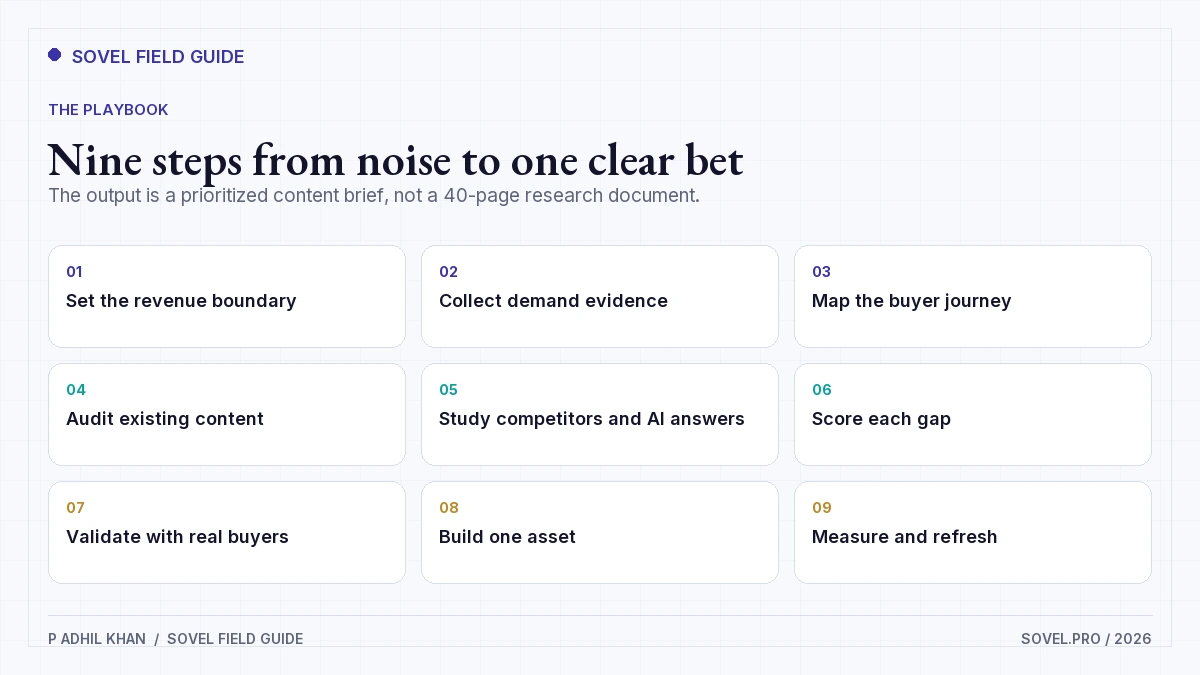
Step 1: Set the revenue boundary
Write down the offer you want to sell in the next 90 days and the buyer who signs. Then list the three questions a buyer asks before they trust you with money. Those questions define the search area. A content gap analysis for entrepreneurs that ignores the offer produces traffic that never converts.
For example, a payroll consultant who wants restaurant clients should not start with “payroll.” The revenue boundary is “restaurant owners with 10 to 50 hourly staff who are opening a second location.” The questions are tip credits, multi-state withholding, and hiring paperwork. That is a workable boundary.
Step 2: Collect demand evidence from five places
A content gap analysis for entrepreneurs needs five kinds of evidence, and no single tool has all five. Gather evidence before you open a keyword tool. Use five sources:
| Source | What to capture |
|---|---|
| Sales calls | Objections, stalled deals, the words buyers use before they ask for a discount |
| Support inbox | Repeated tickets, onboarding questions, answers your team writes from memory |
| Search Console | Queries with impressions but weak clicks, plus pages that almost rank |
| Communities | Reddit threads, private groups, conference Q&A, the workaround people describe |
| Competitors | Topics they own, questions they miss, claims they make without proof |
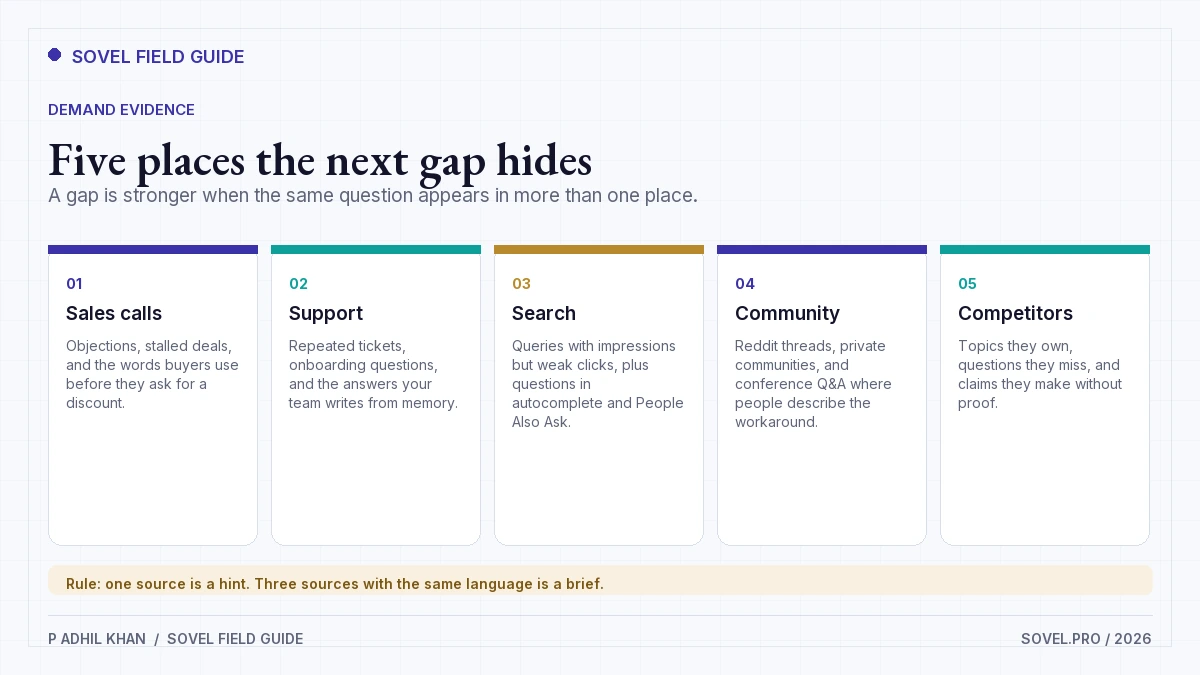
Put every phrase in one sheet with a source column. Do not clean up the language. “How do I stop my payroll provider from charging me for every amendment” is better evidence than “payroll cost concerns.” The content gap finding engine automates the collection step when the sheet gets too large.
Step 3: Map the buyer journey
Group the phrases by stage: problem aware, solution aware, provider aware, and ready to buy. A founder often has too much top-of-funnel content and nothing for the last two stages. The gap is usually closest to the money.
For each stage, write the question the buyer asks and the decision they need to make. Then mark whether you have a page that answers it. This map becomes the spine of your content gap analysis for entrepreneurs. It shows whether a missing page is a traffic problem or a conversion problem.
Stage mapping also stops you from writing the same article twice. A problem-aware query like “why is my payroll bill higher this month” needs a diagnostic answer. A provider-aware query like “Gusto vs ADP for restaurants” needs a comparison. The first builds trust. The second captures a decision. If both queries appear in your evidence, you have two gaps, not one. Decide which stage pays for the next 90 days.
Step 4: Audit what you already have
List every page that touches the topic. For each one, record the target query, the last update, the internal links, and the action it asks the reader to take. You will find three types of waste: pages that repeat each other, pages that answer a question halfway, and pages with no next step.
Do not delete anything yet. The audit tells you whether the gap is a new page or a better version of an existing one. A content gap analysis for entrepreneurs should prefer the cheaper fix. The audit is the least glamorous part of a content gap analysis for entrepreneurs, and it saves the most money. If a page already ranks on page 2 for the query, improving it is usually faster than publishing a new URL. The guide to finding gaps in existing content goes deeper on this pass.
Step 5: Study competitor content gaps
A content gap analysis for entrepreneurs should study competitors after the buyer evidence, not before. Pick five competitors: two direct, two adjacent, and one that owns the question you want. For each, list the pages that rank for your seed terms and the questions they answer. Then look for the questions they skip. A competitor page that covers “payroll for restaurants” but never mentions tip credit audits has a gap you can test.
Do not copy their outline. The goal is to find the missing buyer question, not to rewrite their page with different adjectives. The free competitor gap workflow shows how to build this list without a paid tool.
Step 6: Score each gap on four factors
The score turns a content gap analysis for entrepreneurs into a ranked decision. Score every candidate from 1 to 5 on demand strength, business fit, evidence quality, and ability to win. Add the four scores. A gap that scores below 14 is usually a distraction. A gap that scores 16 or higher deserves a brief.
The score is a conversation tool, not a math proof. Two people should score independently and discuss any difference of 3 or more. You can see the detailed formula in the content opportunity score guide.
Two scoring mistakes are common. The first is scoring demand from a single keyword tool and ignoring sales evidence. The second is scoring fit from ambition rather than the actual offer. A gap that requires a product you do not have is not a 5 on fit. Score what you can deliver in the next quarter.
Keep a short note for every score. “Demand 5 because 14 tickets and 3 calls in 60 days” is auditable. “Demand 5 because it feels big” is not. A content gap analysis for entrepreneurs should survive a skeptical co-founder reading the sheet.
Step 7: Validate with real buyers
Take the top two gaps to five buyers. Ask what they searched, what they read, and what they still could not find. Do not pitch the article. Listen for the phrase they use when the problem is urgent. If three buyers describe the same missing answer, you have a real gap.
This step is where most content gap analyses for entrepreneurs stop being theoretical. This is the step that separates a content gap analysis for entrepreneurs from a keyword list. A keyword can show demand. A buyer can show consequence. You need both before you spend a week writing.
Step 8: Build one asset, not ten
Write a brief for the winning gap. Include the reader, the promise, the proof, the outline, the internal links, the call to action, and the one question the asset must answer. Then build the asset. One strong page with a downloadable checklist beats four thin posts that each cover a fragment.
The brief is also your quality gate. If the draft does not answer the one question, the draft is not ready. A content gap analysis for entrepreneurs that produces a content calendar instead of a brief has already failed.
The brief should fit on one page. If it needs six pages, the gap is still too broad. Include the reader’s situation, the promise, the proof you have, the proof you need, the outline, the internal links, and the action. Then write the draft against the brief, not against the competitor page.
One asset can also be a tool, a checklist, or a short email course. A calculator that estimates payroll cost by state may earn more links and calls than a 3,000-word guide. The format should follow the buyer’s job. A content gap analysis for entrepreneurs that assumes every gap needs a blog post leaves the best option on the table.
Step 9: Measure, refresh, or retire
Give the asset 90 days. Track impressions, clicks, average position, scroll depth, replies, calls booked, and sales mentions. Then make one decision: refresh it, expand it, or retire it. Do not let a page sit for two years because it once had a good month.
A content gap analysis for entrepreneurs is a loop. The evidence from the first asset makes the next gap easier to find.
What strong demand evidence looks like
A content gap analysis for entrepreneurs is only as good as the evidence behind it. Strong evidence has three traits: it is specific, repeated, and costly to ignore.
Specific means the buyer names the situation. “Payroll is annoying” is weak. “My provider charges $25 per amendment and I file 10 a month” is specific. Specific phrases become the page’s headings and the sales team’s follow-up.
Repeated means you see the same question in more than one channel. One support ticket is an incident. A support ticket, a sales objection, and 40 search impressions for the same phrase is a pattern. A content gap analysis for entrepreneurs should weight patterns over anecdotes.
Costly means the buyer is already spending money or time on the problem. They pay an accountant, run a spreadsheet, or lose a deal. Cost is the best predictor of whether someone will act on the content.
Record the evidence in a simple table: phrase, source, date, stage, and what the buyer does today. Then score. A content gap analysis for entrepreneurs that cannot show this table is a guess with better formatting.
How to score a content gap without fooling yourself
The four-factor score works because it forces you to separate demand from fit. Here is what each factor means and how to score it.
| Factor | Question | Score 1 | Score 5 |
|---|---|---|---|
| Demand strength | Do buyers ask this in more than one place? | One mention, no search data | Sales calls, support tickets, and search queries agree |
| Business fit | Does the answer lead to your offer? | Interesting but unrelated | Direct path to a paid conversation |
| Evidence quality | Can you prove the answer? | Opinion only | Primary sources, customer data, or first-hand experience |
| Ability to win | Can you produce something better than page 1? | No access, no proof | Unique data, examples, or a tool the leaders lack |
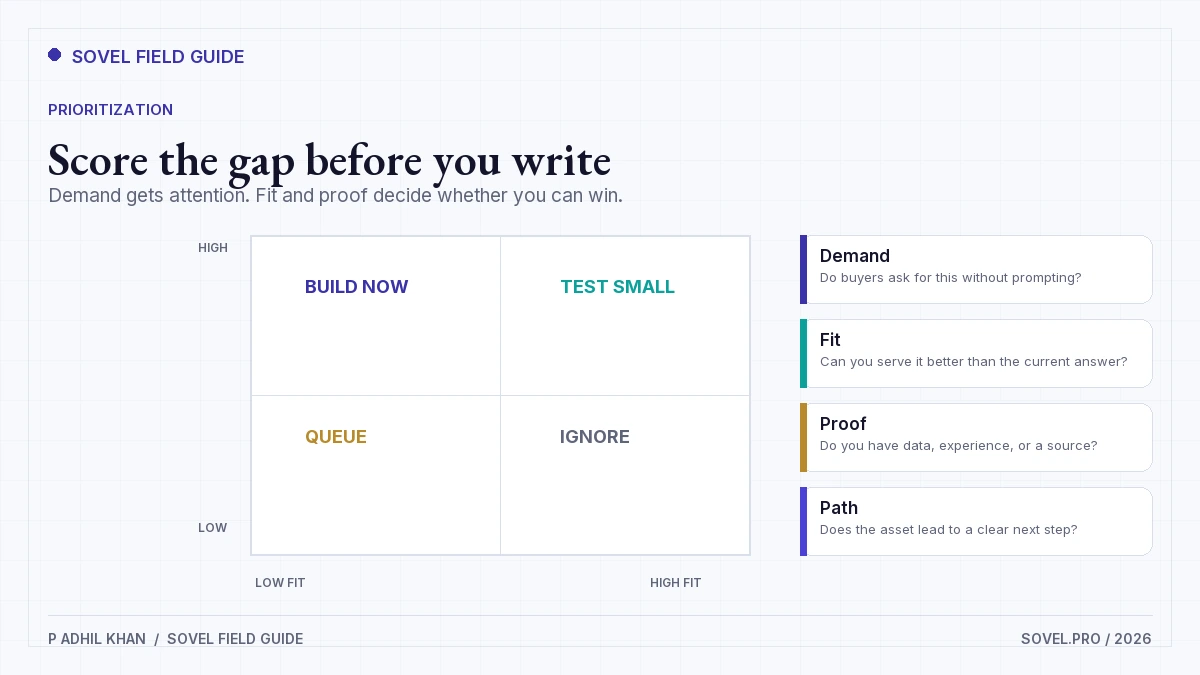
Add the four scores. Use the total to rank, then apply one override: if the gap sits in the last two stages of the buyer journey, move it up one place. Conversion pages usually deserve priority over another top-of-funnel explainer.
Keep the scoring sheet. In 90 days, you will want to know why you picked this gap. A content gap analysis for entrepreneurs is easier to defend when the reasoning is written down.
What to ignore in 2026
Google’s July 2026 AI optimization guide says the best practices for SEO continue to be relevant. That point removes most of the noise around content gaps. You do not need a separate strategy for AI search.
Here is what I would ignore:
- Special AI schema. Google says there is no special schema for generative AI search. Use Article schema for articles and leave Product schema on product pages.
- `llms.txt` as a ranking lever. Google says it ignores the file. Publish it if you want, but do not build a content plan around it.
- Forced chunking. There is no requirement to cut every section into 200-word blocks for AI. Write clear sections with direct answers because readers benefit.
- AI-only rewrites. Rewriting a page only for a model usually makes it worse for people. Improve the answer, the evidence, and the structure.
- Keyword volume as the only filter. A high-volume term with no business fit is a hobby, not a gap.
- Competitor word count. Longer is not better. A 1,200-word page that answers the question beats a 4,000-word page that circles it.
- Publishing 20 posts to look active. That is how small sites create thin content and cannibalization.
Search Console is the source for your own query data. The Performance report shows queries, pages, clicks, impressions, CTR, and average position. Use it to find pages that already have demand but weak answers. That is often the cheapest content gap in the account.
The 90-day plan
A founder can run this plan in about 6 hours a week. The point is one asset and one feedback loop, not a content factory.
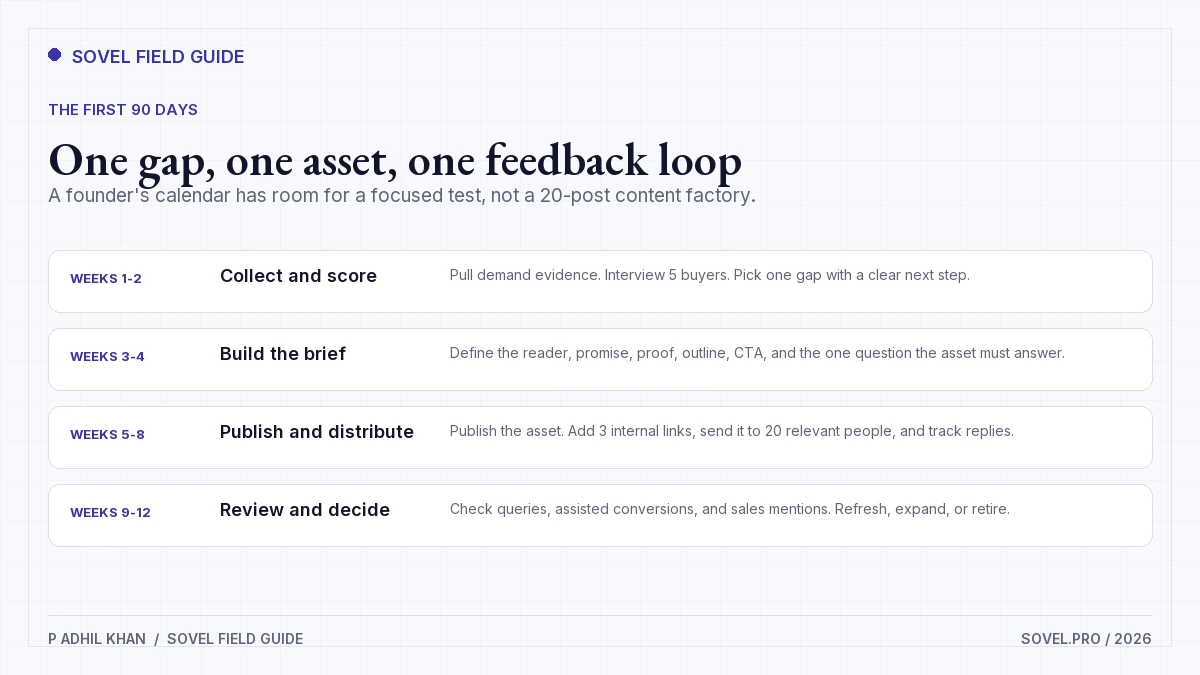
| Weeks | Work | Output |
|---|---|---|
| 1 to 2 | Collect evidence, interview 5 buyers, score the gaps | One chosen gap with a written reason |
| 3 to 4 | Build the brief, outline, and proof list | A draft plan with sources |
| 5 to 8 | Publish the asset and add 3 internal links | One live page and a distribution list |
| 9 to 12 | Track queries, replies, calls, and sales mentions | A refresh, expansion, or retire decision |
Distribute the asset by hand. Send it to 20 people who have the problem, answer a related question in a community, and add it to the sales follow-up. A content gap analysis for entrepreneurs that stops at publishing leaves the hardest work undone.
The first two weeks are the hardest because there is no visible output. Protect them. Cancel one recurring meeting and use the time for five buyer calls. The brief in weeks 3 and 4 should be reviewed by someone who talks to buyers every day, not only by the person who will write the page.
In weeks 5 to 8, publish and distribute. In weeks 9 to 12, review. Do not start a second asset before the first review. The point of the 90-day plan is to learn whether the gap is real, not to stay busy. A content gap analysis for entrepreneurs that produces a new topic every week teaches you nothing.
A worked example
This is a sample scenario, not a client case. A payroll consultant wants more restaurant clients. Her revenue boundary is restaurant owners with 10 to 50 hourly staff. Her evidence sheet has 38 phrases from sales calls, 14 support tickets, and 22 Search Console queries.
The strongest cluster is tip credit. Competitors have generic payroll pages. None has a state-specific tip credit checklist for restaurant owners. Buyers ask about it on calls, the support inbox has repeated questions, and the query has impressions but no dedicated page.
She scores the gap: demand 5, fit 5, evidence 4, ability to win 4. Total 18. The asset is a tip credit payroll checklist with a short explanation of the records a restaurant needs to keep. The call to action is a 20-minute payroll review.
She publishes in week 6, sends it to 20 restaurant owners, and adds it to the sales follow-up. At day 90, she reviews the data. If the page earns replies and call bookings, she expands it with a second state. If it earns traffic but no calls, she changes the offer or the call to action. If it earns nothing, she retires it and moves to the next gap.
That is a complete content gap analysis for entrepreneurs in one example: a boundary, evidence, a score, one asset, and a decision.
FAQ
What is a content gap analysis for entrepreneurs?
It is a process for finding buyer questions your market does not answer well, then choosing one gap that can produce leads or sales. It combines search data, sales evidence, competitor research, and buyer interviews. The output is a brief, not a list.
How is it different from keyword research?
Keyword research shows what people search. A content gap analysis for entrepreneurs also asks whether you can answer the question, whether the answer fits your offer, and whether you can produce something better than the current results. Search data is one input, not the whole method.
How many content gaps should I pick?
One at a time. A founder with limited writing time should build one asset, distribute it, and measure it for 90 days. A short list of scored gaps is fine for planning, but the work should stay focused on the top item.
Do I need paid tools?
No. Search Console, Amazon or Google autocomplete, Reddit, sales notes, and a spreadsheet cover the core work. Paid tools help with volume and competitor tracking, but they cannot tell you whether a gap fits your business. Start free and pay only for a bottleneck you can name.
How do I know a gap is real?
Look for the same question in at least three places: a sales call, a support ticket, and a search query, or two buyer interviews and a competitor gap. One mention is a hint. Three independent mentions with the same language is evidence.
Can AI run a content gap analysis for entrepreneurs?
AI can summarize interviews, group phrases, and draft a brief. It cannot verify demand or judge business fit. Use it after you collect the evidence, and check every claim it makes. A model that invents a keyword gap is worse than an empty sheet.
How long until I see results?
Give the asset 90 days before you judge it. Treat a content gap analysis for entrepreneurs as a 90-day experiment with one review point. Impressions can appear in weeks, but calls and sales mentions take longer. Review the page monthly, change one variable at a time, and avoid rewriting the whole asset after 14 days.
What if competitors already cover the topic?
Then the gap is probably a narrower question, a missing example, a different buyer, or a better format. A content gap analysis for entrepreneurs does not require an empty topic. It requires a question your buyer still cannot answer after reading the current page.