
An AI content fact checker is a program that reads a draft, extracts every claim carrying a number, a date, a price, a quote or a ranking word, and checks each one against a source you supply before the page goes live.
The short answer, in one line you can quote: an AI content fact checker verifies each number, date and quote in a draft against a source the operator supplies, and blocks publication when a claim has none.
SOVEL SAAKSHI is that engine. It runs three commands, returns four exit codes, and leaves a folder of proof for every run. It works offline, with no account, no API key and no network call. It does not judge your writing. It decides whether each claim has a witness, and it refuses to publish the ones that do not.
Most writers meet this problem the way I did, and most of them go looking for an AI content fact checker only after a mistake is already live.
What a wrong number actually costs you
[A wrong price that stayed live for eleven days, reproduced from a different product page in the same catalogue.]
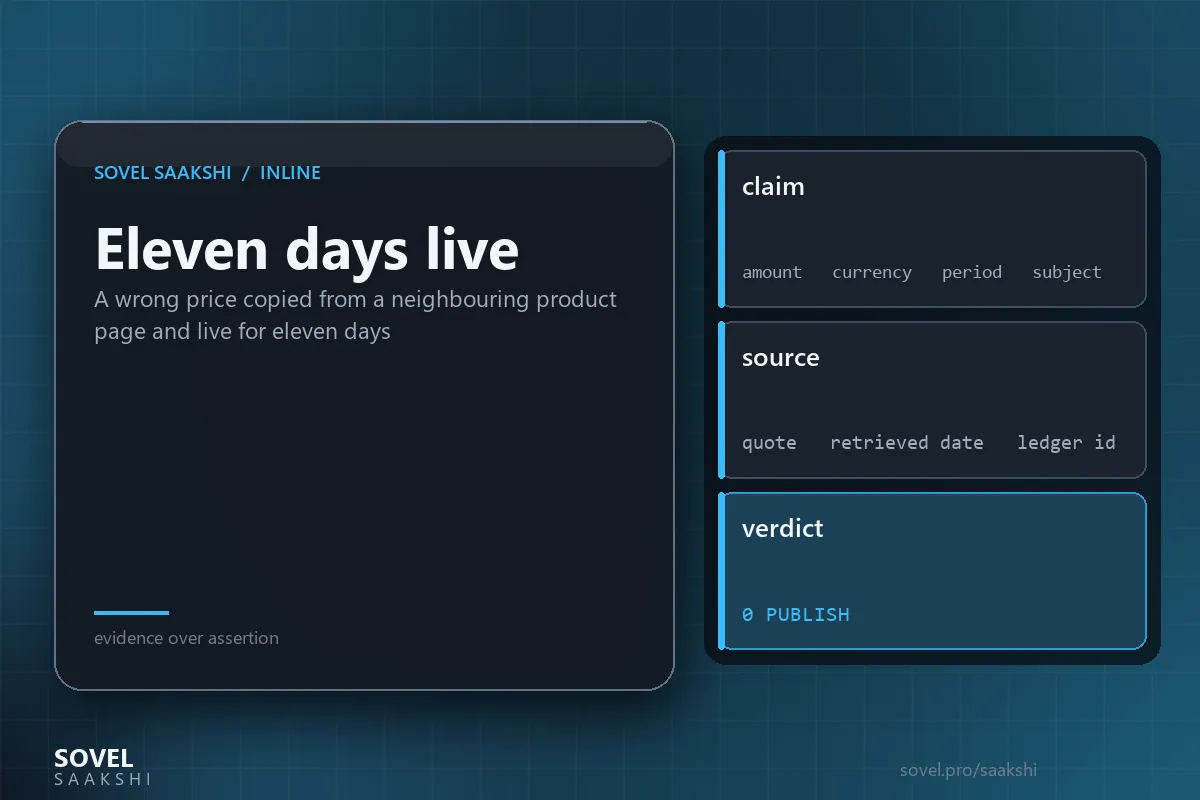
We published a price that was wrong for eleven days. Nobody invented it. It came from a real page in our own catalogue, a different product with the same amount, the same currency and the same one-time wording. Every part of the sentence was true except the part that mattered, which was which product it described.
The writer did not catch it. The editor did not catch it. The person who approved the page did not catch it. A customer caught it, by asking a question we could not answer.
That is the shape of the problem an AI content fact checker exists to solve. Not invented statistics with a smell of nonsense about them. Correct numbers attached to the wrong subject, which is much harder to see and much easier to publish.
The cost an AI content fact checker is meant to remove is not only the correction. It is the eleven days of decisions other people made on a false figure, the refund conversation, and the small permanent discount on everything else you publish afterwards.
Why a number alone is never evidence
An AI content fact checker is only as good as these four things, and most drafts supply one of them. A claim with a figure in it needs all four to count as evidence.
- The amount, which is the part everyone checks.
- The currency, because 9,999 is a different claim in rupees and in dollars.
- The period, because an annual price is not a monthly price and a 2024 statistic is not a 2026 one.
- The named subject, which is the part almost nobody checks: does the source name the same product, the same edition and the same tier that your sentence names?
An AI content fact checker is useful in proportion to how honestly it handles the fourth point. A tool that compares digits will approve a sentence about the Pro edition using a source that priced the Personal edition, because nine thousand is nine thousand. That approval is worse than no check at all, since it hands you a green tick you did not earn.
[An evidence ledger entry, showing the four fields an AI content fact checker needs before it can call a claim supported.]
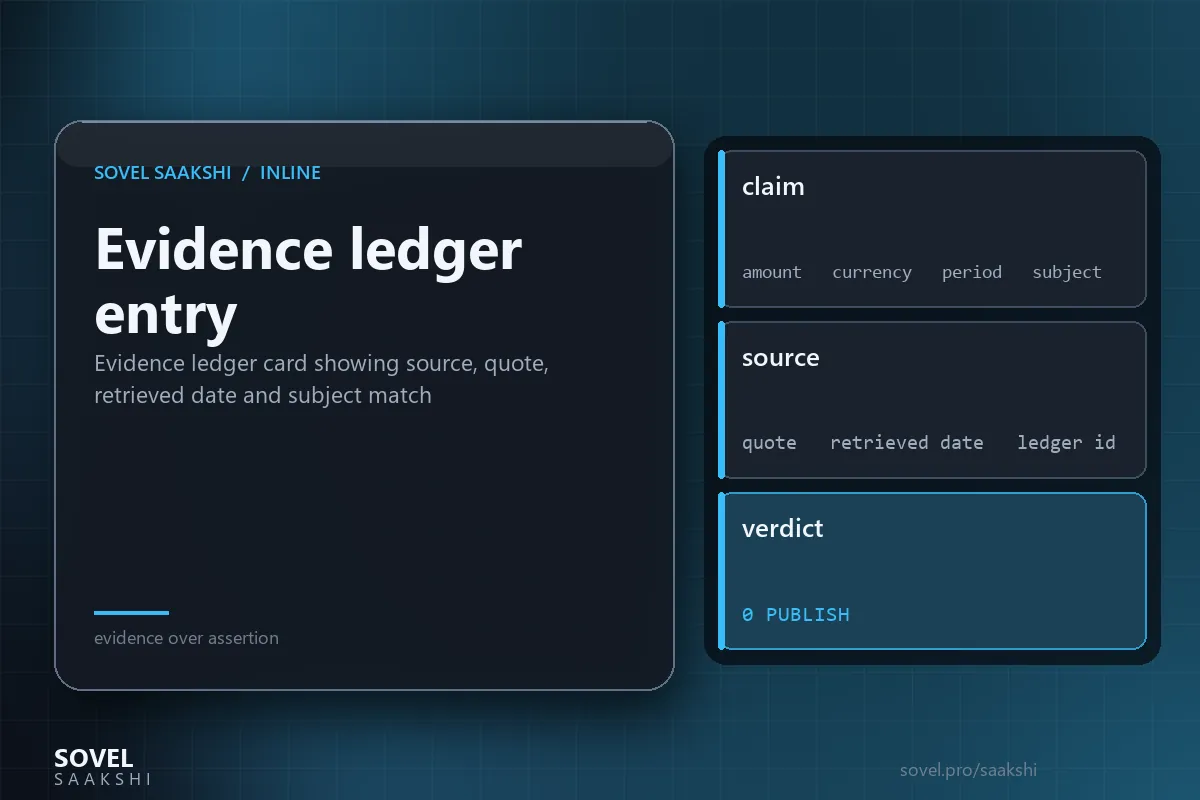
SAAKSHI treats the subject as material. If the claim names the Pro edition and the quote does not, the source is skipped entirely rather than credited partially. The claim comes back unverified, and unverified claims block. The same happens when a real word sits between your subject and the shared word in the source, because “the weatherwidget plan” and “the weatherwidget backup plan” are two different offers, no matter how close they look.
An AI content fact checker that applies this rule is blunter than most. It also produces one you can leave running in a publishing routine without reading every line of output, which is the only version that survives a busy week.
Three commands, four exit codes
The whole interface of this AI content fact checker is three commands. There is nothing to configure before the first run, and nothing that phones home during it.
[The three commands as they appear in a terminal, with the exit code each one returns.]
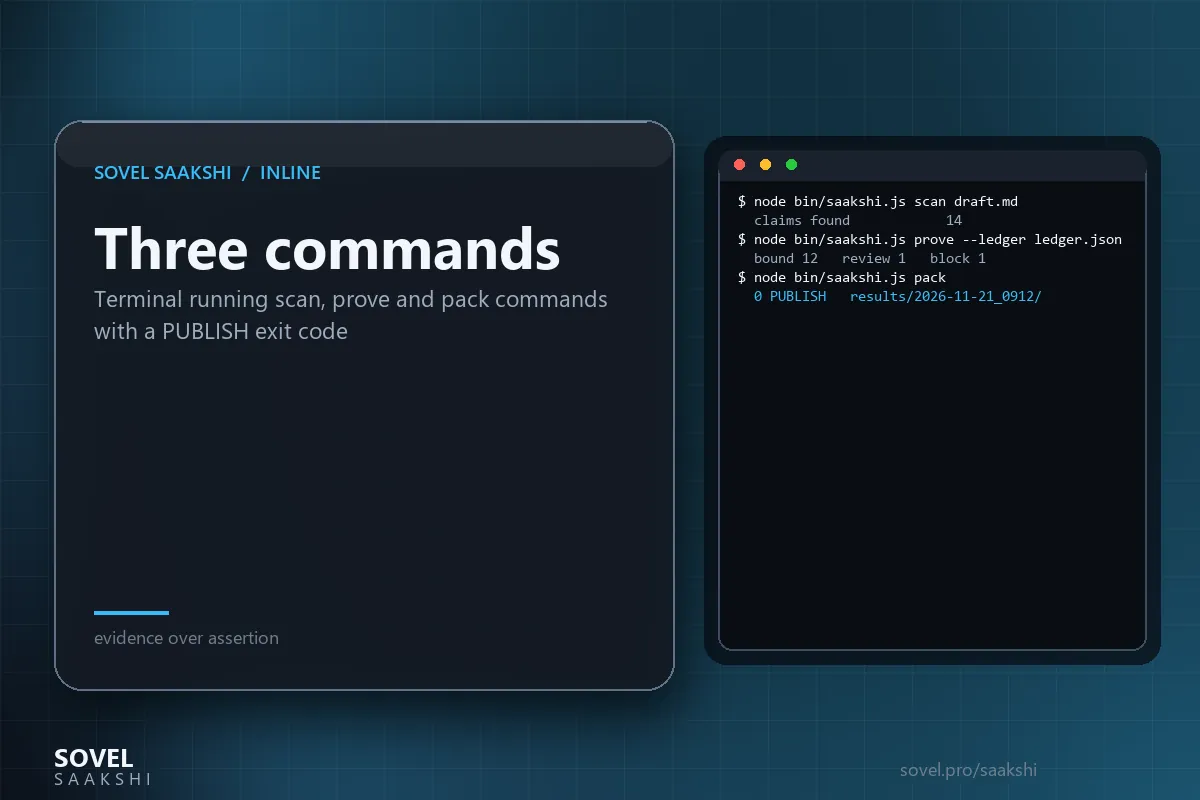
node bin/saakshi.js scan draft.md
node bin/saakshi.js prove draft.md --ledger ledger.json
node bin/saakshi.js pack draft.md
scan reads the draft and extracts every claim that carries something checkable: a price, a date, a percentage, a quoted line, a named person, a ranking word such as best or fastest. It does not judge, it lists.
prove takes a ledger you write yourself, which is a small JSON file holding your sources, the exact quote from each one and the date you retrieved it. It binds each claim to a source and returns a verdict for each binding.
pack writes the artefacts, so a run is not a mood but a record. An AI content fact checker that reports and writes nothing cannot be checked by anyone else.
The exit codes are the part to build a habit around:
0  PUBLISH   the claim has a witness
3  REVIEW    the claim is an inference or an estimate, a human decides
2  BLOCK     no evidence, or evidence about something else
1  ERROR     the engine could not run
For an AI content fact checker, an exit code is a decision, and a decision can be wired into a script, a hook or a publishing checklist. An opinion cannot. This is the difference between a tool that suggests and an AI content fact checker that gates.
Consider what code 2 means in practice. It is not “we could not find a source”. It is “the source you bound does not support this sentence”, which covers the wrong product, the wrong tier, the wrong period, the wrong currency and the claim that has no source at all. Each of those five has produced a real embarrassment for someone, and four of them survive a human reading pass, because the sentence itself is well written.
What one run leaves behind
Every run of this AI content fact checker writes a folder named for the date, the time and the draft. Inside it are a report in four formats, a proof file, and a source card for every bound claim.
[A results folder after one run: HTML report, PDF report, DOC report, Markdown report, proof file and source cards.]

The report formats exist because the person who asks the question is rarely the person who ran the check. HTML is for reading in a browser, PDF is for attaching to a client email, DOC is for the editor who works in Word, and Markdown is for the repository. The proof file carries a hash, so a later reader can tell whether the file changed after it was written.
The source card is the part of an AI content fact checker that survives the week. One claim, one link, one quote and one retrieved date, on a single page. When a client asks where a figure came from, the answer is a page you can send, not a memory you have to trust. That is what makes an AI content fact checker a business tool rather than a writing aid: the output belongs to the person who has to defend the claim.
One limitation of any offline AI content fact checker sits in this section, because this is where people misunderstand the output. The hash proves integrity, meaning the file has not been altered since the run. It does not prove identity, meaning it cannot tell you who ran it or whether they were honest. If you need identity, that is a process question, and no local engine answers it.
Three editions, one engine
Every edition ships the same engine. An AI content fact checker does not get more accurate when you pay more, which is why the editions differ on rights and not on features. What changes is the licence: how many machines, how many named people, and whether the work you check is your own or a client’s.
Personal
₹2,499 one-time, perpetual v0.x
One machine, one named user, your own publishing only.
Pro
₹6,999 one-time, perpetual v0.x
Two machines, one named user, your own products and client-facing deliverables you sell as your own.
Agency
₹14,999 one-time, perpetual v0.x
Five machines, five named users, client work allowed.
| Edition | Machines | Named users | Commercial use | Client work | One-time price |
|---|---|---|---|---|---|
| Personal | 1 | 1 | No | No | ₹2,499 |
| Pro | 2 | 1 | Yes, your own products | No | ₹6,999 |
| Agency | 5 | 5 | Yes | Yes | ₹14,999 |
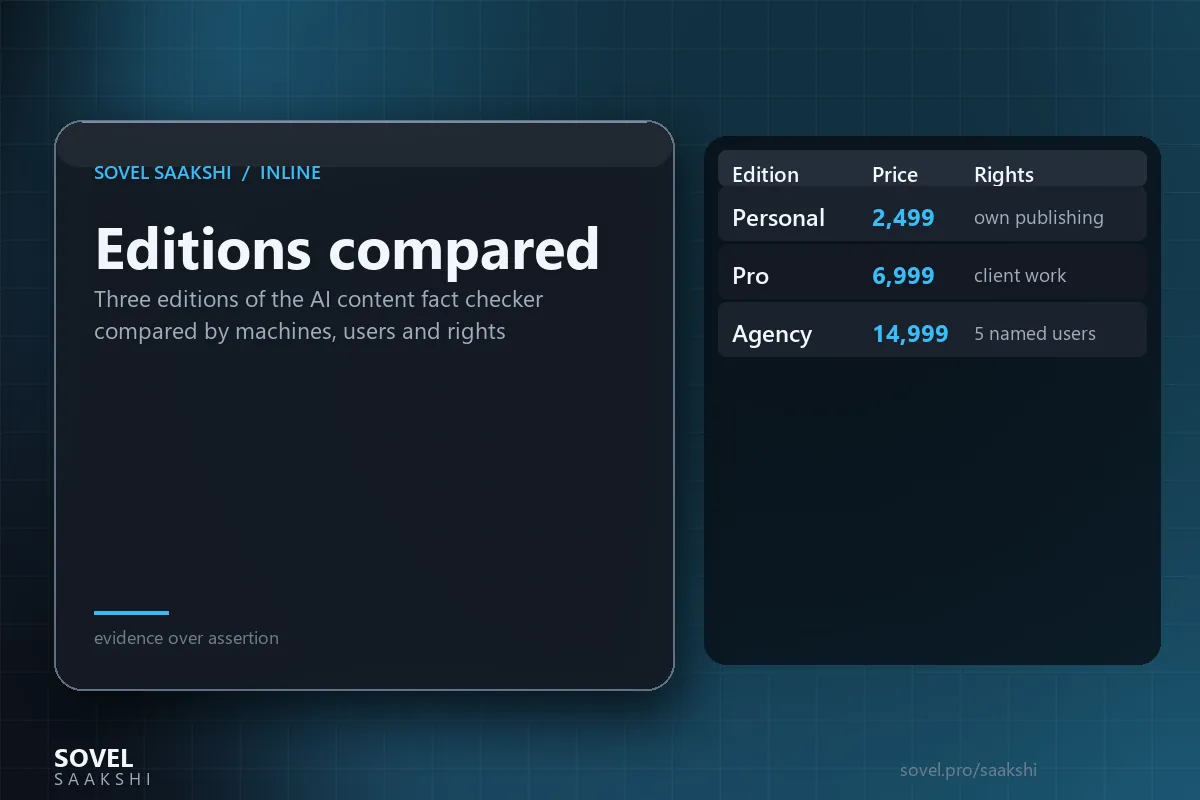
Prices are in Indian rupees and exclude GST, which is added at checkout. Payment is one time, and the licence is perpetual for the v0.x line. There is no subscription, no renewal, no seat meter and no activation, because an AI content fact checker that needs to call a licence server cannot claim to work offline.
Choosing an edition of an AI content fact checker is a question about rights rather than features. The short version: if you check your own blog, Personal covers it. If you sell what you write, Pro covers it. If a client pays for the deliverable, Agency covers it.
What it will not do
Nine things, listed because a buyer who discovers a limit after paying is a refund, and a buyer who reads it before paying is a customer who stays.
- It does not prove identity. No offline AI content fact checker can. The manifest proves integrity. It shows a file was not altered, not who produced it.
- It does not render Devanagari or CJK inside the PDF. The PDF font is WinAnsi, so Hindi, Chinese and Japanese characters appear as question marks there. HTML and Markdown keep full Unicode. This is a real limitation of the PDF writer, not a setting you can flip.
- It has no activation and no phone home. The licence is contractual. The engine is byte identical in all three archives. Traceability comes from a manual purchase register, not from a licence check.
- It is not an AI-text detector.
saakshi stylemeasures writing evenness and reports signals. It does not claim to know whether a machine wrote your draft, and no honest tool can. - It does not fetch sources from the web. Sources come from the ledger you write, which is why a run is offline and reproducible. The trade is that you must supply the quote and the date yourself.
- It redacts URLs by parameter name, not by entropy. A token inside a query string is caught. An opaque token inside a path, such as
/download/9f3c1b/file.zip, is not, so paste a clean link. - It reads Markdown deterministically. Tables and inline HTML are handled. Prose patterns outside the extractor are not, and the extractor will not invent a claim it cannot see.
- It is tested on Windows, Ubuntu and macOS in CI. Debian, Fedora and WSL2 are supported but are not in the CI matrix. Alpine is not supported, because the build assumes glibc.
- It compares names and tiers, not meanings. An AI content fact checker compares what a source says with what your sentence says, and nothing more. If two sentences both say
weatherwidget, the engine treats them as the same subject and the operator decides whether they are. It is a witness, not a judge of what words mean in the world.
Nothing on this list is a future promise. It is the behaviour of version 0.1.9, which is the version you buy.
What is actually tested, and what you can re-run
A test suite proves the code does what we said it does. It does not prove that the claims in your draft are true, and no ai content fact checker can promise that. What the suite does prove is narrower and more useful: the same draft produces the same verdict, on every supported system, without a network, and the exit code you see is the exit code the test asserted.
On 19 November 2026 the suite ran six jobs in one push, on Windows, Ubuntu and macOS, on two Node lines. All six passed. The build also carries a release gate that fails the archive if it grows a dependency, a network call, a licence file that disagrees with the edition, or a version string that does not match the manifest.
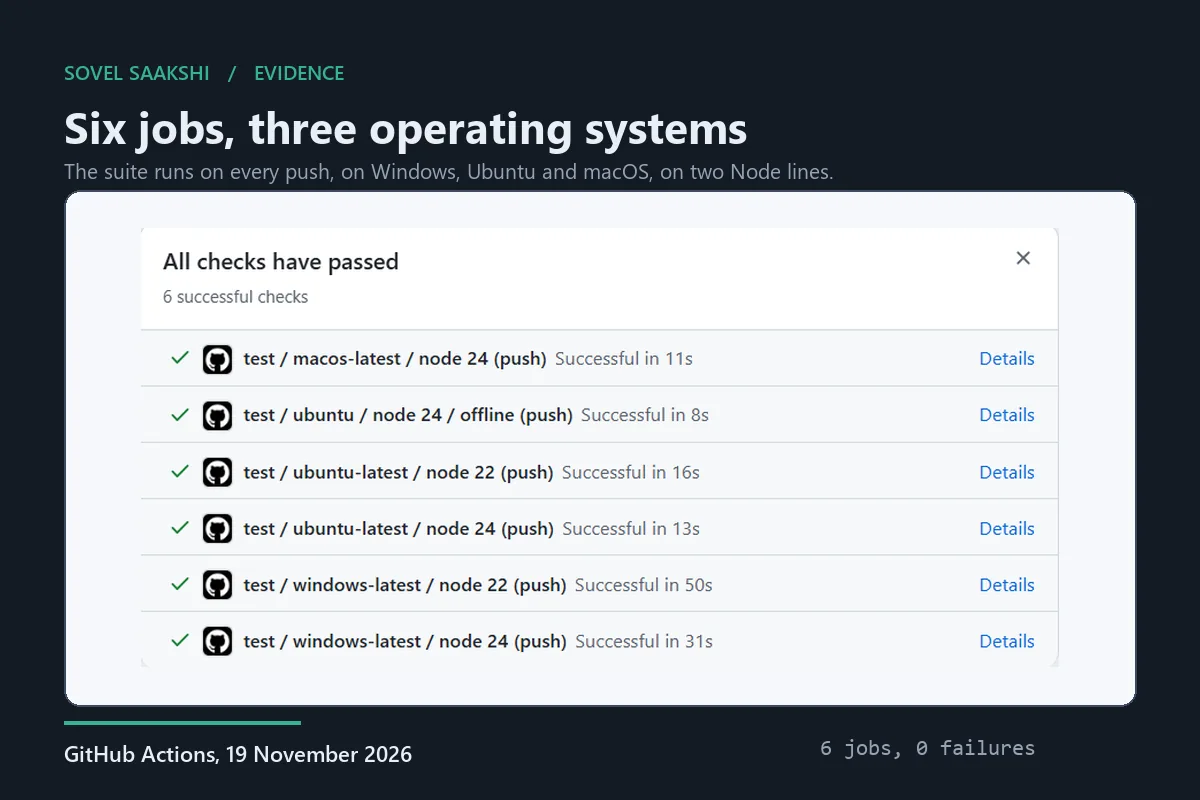
You do not have to take the picture on trust. After you unzip, node --test runs the same hundred and fifty tests on your own machine in under a minute, and saakshi doctor runs thirty eight environment checks before you ever point the tool at a draft. The forty seven gate rules and the twenty six adversarial scenarios are named in docs/VERIFICATION.md. If a run disagrees with the picture above, that is a bug worth reporting and the address is in the archive.
Run the same draft twice and an ai content fact checker returns the same verdict, because the extraction and the ledger are deterministic. None of that makes an ai content fact checker right about your draft; it makes the engine predictable, which is the property a reviewer can defend in a meeting.
Who should buy an AI content fact checker
Four kinds of buyer get value from an AI content fact checker on the first day.
- The writer who publishes numbers. Pricing pages, comparisons, buying guides. One wrong figure in a buying guide is a refund and a comment you cannot delete.
- The freelancer whose client asks for proof. Instead of a screenshot of a search result, you send a source card with a quote and a retrieved date.
- The agency that hands deliverables to a client. Five seats, one standard, and a proof file per deliverable, which is the cheapest way to end the “where did this number come from” email chain.
- The team that writes with a model and reviews with a human. The human review does not disappear. It moves to the claims that failed, which is a much shorter list than the whole draft.
Three kinds of buyer should keep their money.
- Anyone who wants an AI detector. This is the opposite of that product.
- Anyone who wants the engine to find sources for them. It verifies the sources you give it, and the honest version of the other promise does not exist yet.
- Anyone who needs a cloud dashboard with team analytics. This is a local command line tool with a folder of output, and pretending otherwise would make both of us unhappy.
Google now asks for exactly this
On 1 October 2026, Google updated its guidance on generative AI content. The sentence that matters reads:
It is critical to manually factcheck and review all AI-generated content for accuracy and trustworthiness before publishing. It applies to metadata as well, meaning titles, meta descriptions, structured data and image alt text, which can appear in Search results.
Read that list again. Titles, meta descriptions, structured data and alt text. Those are the surfaces almost every site generates automatically and almost nobody reads line by line. Google is not asking for a tool, and no honest vendor should claim it is. Google is asking for a review, and for a record of it.
That is exactly the shape of the problem an AI content fact checker solves. The review becomes a command, the record becomes a folder, and the four surfaces Google names are the ones you can check in the same pass. You can read the guidance yourself at Google Search Central. If you want the longer version of what changed and what it implies for a small publisher, I wrote it up in what Google changed about AI content.
What people ask about an AI content fact checker
What is an AI content fact checker?
It is software that extracts checkable claims from a draft and compares each one with a source you provide. It returns a verdict per claim, and it blocks publication when a claim has no supporting source. It is not a detector of machine writing and it does not search the web on its own.
How does it check a claim against a source?
With an AI content fact checker, you bind the claim to a source in a small ledger file: the URL, the exact quote and the date you retrieved it. The engine compares the amount, the currency, the period and the named subject. If any of the four is missing or belongs to something else, the claim is not supported and the run does not publish.
Do I need an API key, an account or an internet connection?
No. There is no key, no login and no network call, which is enforced by a release gate rather than promised in a paragraph. The engine runs from a folder with Node installed and nothing else. That is also why the first run takes a minute and the hundredth takes a second.
What happens when a claim has no source?
The claim comes back unverified and the run exits with code 2. The draft does not publish. You then either find a source, soften the claim into an estimate, or remove it. All three are legitimate endings, and the engine accepts a human decision as long as the decision is written down.
Can it tell that a quote is about a different product or edition?
Yes, and this is the part that separates an AI content fact checker from a digit comparer. If the claim names the Pro edition and the quote prices the Personal edition, the source is skipped and the claim is unverified. The engine is deliberately one directional: a price list that names all three editions can support a claim about one of them, but a quote about one edition can never support a claim about another.
Does it work for prices, dates, statistics and quotes?
All four, plus named people, percentages, page counts and ranking words such as best or fastest. The extractor is deterministic over Markdown, so the same draft produces the same claim list every time, which is what makes a second run comparable to the first.
What files does one run produce?
One run of this AI content fact checker produces a report in HTML, PDF, DOC and Markdown, a proof file with a hash, and a source card per bound claim. The folder is named for the date, the time and the draft, so two runs never overwrite each other and a disagreement about a number can be settled by opening the right folder.
How is this different from an AI detector?
An AI content fact checker does not read style at all. A detector reads style and guesses authorship. This reads claims and checks sources. One answers “did a machine write this”, the other answers “is this true”, and only the second question can put a number in front of a customer without risk. The longer comparison is in detector versus verifier.
What do the three editions cost, and is it a subscription?
Personal is ₹2,499, Pro is ₹6,999 and Agency is ₹14,999, in Indian rupees, excluding GST, paid once. The licence is perpetual for the v0.x line and includes maintenance and security updates for that line. It is not a subscription, there is no renewal and there is no activation step.
[TRUSTPILOT]
Try one draft before you decide
Run this AI content fact checker on a draft you have already published and see what it catches. If it catches nothing, you either write more carefully than most or your ledger is too generous, and both are worth knowing. If it catches something, you will understand the product in about four minutes, which is faster than reading this page twice.
If it does not fit how you work, keep your money. The honest limits above exist so that decision can be made before payment rather than after.
Support is support@sovel.pro, security reports go to security@sovel.pro, and the licence terms are at sovel.pro/license-terms. The archive you download documents the engine: a quickstart, the evidence policy and the full threat model.
For the editorial version of this workflow, read how to fact check AI generated content first. For the command level version with exit codes, read verify AI content before publishing. For the long document case, start with verify claims in a document. If your question is which tool to buy, the comparison sits in fact checking tool. Every SOVEL SAAKSHI run answers one question for an ai content fact checker buyer: which claim in this draft has no record behind it?
Citations are checked by a citation verification tool rule set rather than by eye.
Send a draft that cannot be uploaded, and the run uses the offline fact checker path with no network at all.
Anyone who started with a guide on ai content verification will recognise the four steps in the report.
The ledger is the part of an ai content fact checker that a buyer should judge, because the interface is replaceable and the record is not.
The report is where an ai content fact checker earns its place, because a claim list with no record beside it is an opinion with better formatting.